

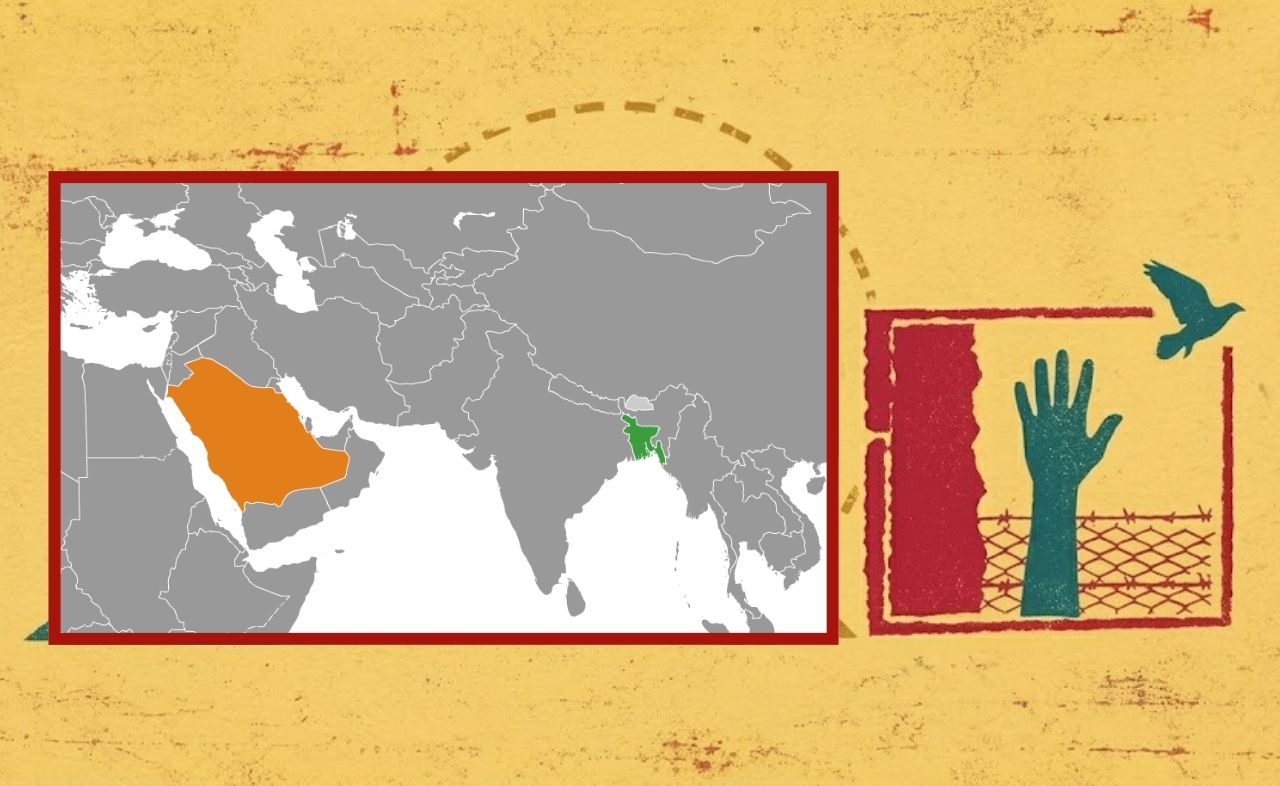
Bangladesh learnt of the executions the way everyone else did. On 14 October the Saudi interior ministry issued a statement: Nazerul Islam Abdul Basir and Siti Akhtar, Bangladeshi nationals, had been put to death in the Makkah region for an ‘immoral act’ inside a mosque. The sentence was passed under ta’zir, confirmed by a higher authority, carried out on a royal order. The statement gave no description of the act, no name for the mosque and no date of arrest.
The consulate general in Jeddah, which has Makkah within its jurisdiction, told The Daily Star that the ministry had not notified it beforehand. State Minister for Foreign Affairs Shama Obaed Islam said on 17 October that Dhaka heard of the sentence and its execution on the same day, that a formal letter had gone to Riyadh, and that nothing detailed had come back. Her ministry has also asked when the two travelled to Saudi Arabia for work, and who they were.
Read that last request again. Two citizens executed by a foreign state, and their own government still needs to be told who they were.
By the ministry’s own account, the case went through an investigation, a trial, an appellate confirmation and a royal order. Even at Saudi speed that is months rather than days, though without an arrest date nobody can be exact. For all of that time the pair sat in custody some 80 kilometres from a Bangladeshi mission, and the mission had no idea. Article 36 of the Vienna Convention on Consular Relations required Saudi Arabia to tell detained foreigners they could ask for their consulate to be informed, and to pass the request on without delay. Perhaps it did neither. Perhaps the two were never given the chance. That is Riyadh’s breach to answer for.
The minister’s response made it worse. On 17 October Shama Obaed called the executions ‘a major lesson for us’, said Saudi Arabia has ‘its own legal framework’, and urged expatriates to obey host-country law. She was lecturing two dead people on compliance, with her ministry unable to say who they were, whether they had a lawyer, or whether they ever asked for the consulate. She also cited the mission’s labour wing for the allegation against them, which means somebody in the mission had the story, only too late to matter. A minister’s first duty is to ask what happened.
The blindness is Dhaka’s own. Missions of labour-sending countries usually learn about arrests from the ground: a family phones home, a recruiting agent panics, someone in the community passes on a name. A consulate that none of those channels reaches isn’t really present where it is supposed to be. The Philippines keeps a dedicated legal assistance fund for nationals abroad. Bangladesh has its Wage Earners’ Welfare Fund, built from contributions every departing worker makes and, by all accounts, sizeable. Nothing in the public record shows it paying for a lawyer in a Saudi courtroom or an interpreter in a Saudi cell. If it has, nobody has said so.
Now the case itself, where the facts are thin and the rumours thick. The two were barely adults, they only kissed, a bystander filmed them, they were beheaded: none of this is verified, and repeating it as fact muddies the questions that deserve answers. But a thin statement is not a neutral one. Ta’zir is discretionary. Hadd, the fixed punishment for adultery, demands four eyewitnesses or a confession, and ta’zir carries no such threshold; the judge decides. So what evidence was heard matters more here, not less. Did either defendant have a lawyer? An interpreter? Why ta’zir rather than hadd? The ministry cites the sanctity of ‘time and place’, which suggests an aggravating factor it never explains. As a devil’s advocate one can go further and ask what a statement this sparse might be covering. I am not claiming it covers anything. A state sure of its verdict usually publishes more.
Other governments have stood where Dhaka stands. Indonesia stopped sending domestic workers to Saudi Arabia after Ruyati binti Satubi was beheaded in 2011, and in 2015 widened the ban across much of the Middle East. Sri Lanka condemned the 2013 execution of Rizana Nafeek and tightened its recruitment rules. Governments with real weight get commutations and quiet flights home. Bangladesh cannot copy Jakarta’s ban; Saudi remittances and some two million workers make a withdrawal of labour a threat nobody would believe. Leverage exists, but it must be procedural and collective. This includes sharing cases with Colombo Process and Abu Dhabi Dialogue partners, pooling complaints, making each unexplained death sentence a diplomatic cost. What those other governments had, above all, was a file. Cases collected, precedents ready, a position on paper. Dhaka’s file, as far as anyone can tell, is empty.
The treatment of Bangladeshis in Saudi Arabia generally explains why. The kafala system ties residence to an employer; confiscated passports, unpaid wages and swapped contracts are old complaints among South Asians. Bangladeshis have paid some of the highest recruitment costs in the world to get there, often borrowing against land. A de facto freeze on new Bangladeshi visas lasted until 2016, and when the domestic-work corridor for women opened, returnees came back with accounts of abuse. In the Gulf nationality works as a rank, and pay, housing and the benefit of the doubt slide down it, with South Asians near the bottom. Rights groups have noted for years that foreign nationals from poorer countries are executed in Saudi Arabia out of proportion to their numbers. A system that discounts a worker’s wage and his complaint will not start valuing his defence.
So what should Dhaka do? Stop begging for clemency case by case and negotiate. A written bilateral protocol on consular notification, fixing a deadline after arrest, guaranteeing access, and requiring notice at each stage of any capital case. A standing legal-aid panel in Jeddah and Riyadh with interpreters, paid from the welfare fund. Labour attachés who visit detention facilities on a schedule and report to Dhaka, with recruiting agencies obliged to flag any worker who goes silent. A precedents file of commuted and reduced sentences from other countries, ready to attach to every clemency request. And a joint position with other sending states at the multilateral forums where Saudi Arabia does care how it looks. None of it needs a rupture with Riyadh. It needs a foreign ministry that treats a migrant’s arrest as its own business.
On Sunday, Bangladesh’s foreign ministry sought an explanation from Saudi Ambassador Abdullah Zafer H bin Abiyah over the executions, with a physical copy of the note verbale handed over to him. Officials, however, said the meeting was not a formal summons. The ministry sought details, but Dhaka also expressed confidence that the incident would not affect bilateral relations. Riyadh may reply that everything was done under law, and Dhaka will have no means of saying otherwise. Somewhere in Bangladesh there is presumably a family waiting for a call from the ministry. The reports don’t say whether anyone has rung.
