

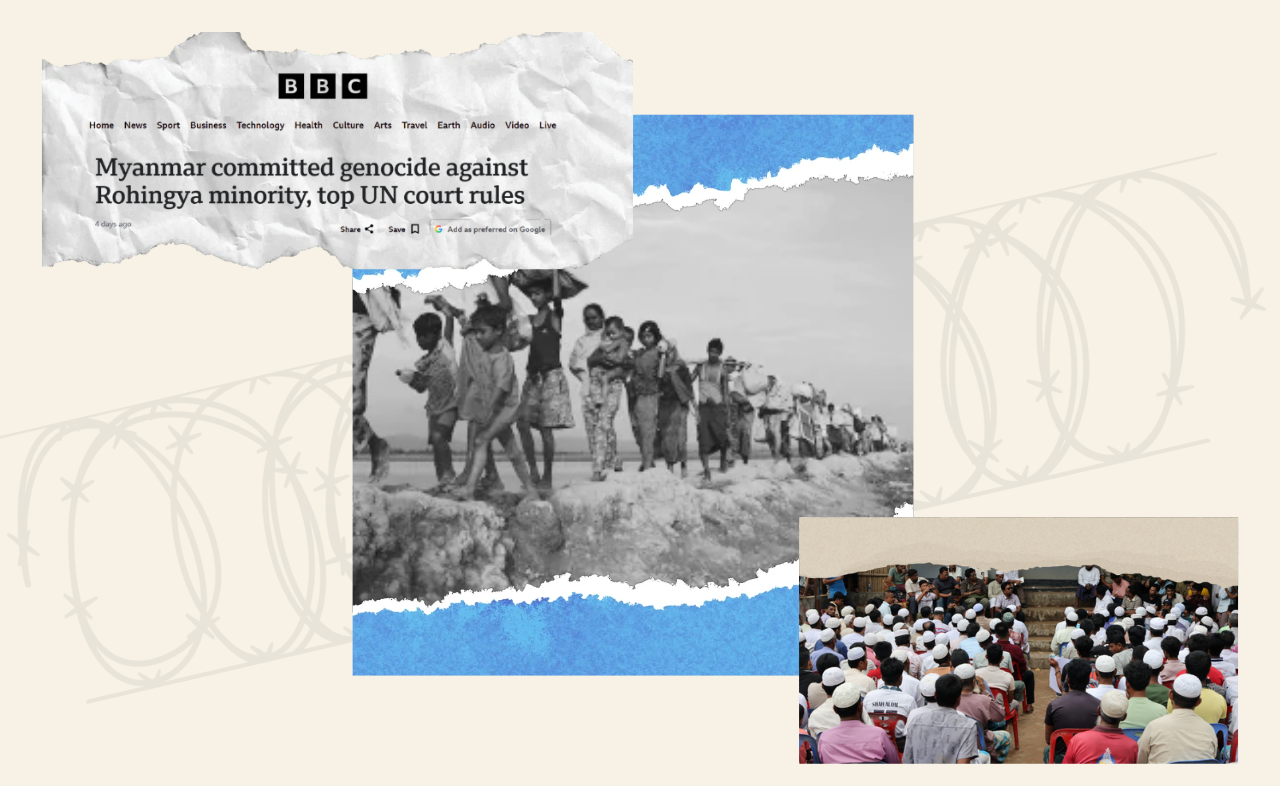
On November 19, thousands of Rohingya in the Cox’s Bazar camps stood in front of a big screen and cheered as the International Court of Justice said Myanmar had committed genocide against them. By November 20, a Bangladeshi minister was already talking about calendars. Humaiun Kobir, the state minister for foreign affairs, told Reuters that return would not happen soon, but Dhaka would press for safe passage within one to one and a half years.
These two scenes sit uneasily together. An international court has held a state responsible for genocide and ordered it to take people back to land it no longer controls. Bangladesh was never a party to the case, yet it carries the weight of the answer: more than a million refugees, a shrinking aid budget, and now a promise of return with a number on it. The verdict gives Bangladesh a stronger voice, not a lever.
Nine to six
The case, formally titled The Gambia v. Myanmar, began in November 2019, when The Gambia filed a case against Myanmar at the ICJ over alleged genocide against the Rohingya. The move followed the military crackdown in 2017, which forced more than 700,000 Rohingya to flee to Bangladesh amid reports of mass killings, rape and village destruction. Backed by the 57-member Organisation of Islamic Cooperation (OIC), The Gambia invoked Article IX of the 1948 Genocide Convention, arguing that Myanmar should be held accountable for its actions. Led by then Justice Minister Abubacarr Tambadou, the country took the case despite having no direct connection to the crisis.
The majority held that Myanmar’s security forces acted with intent to destroy a substantial part of the Rohingya in northern Rakhine in 2017. President Yuji Iwasawa said the evidence showed at least 10,000 killed. Myanmar was also found to have failed to prevent the genocide and to punish it. The ICJ had never held a state responsible for committing genocide itself; in 2007 Serbia was faulted only for failing to prevent and punish what happened at Srebrenica. This is the first time the ICJ has held any state responsible for genocide, and there is no appeal against it.
The remedies read well and settle little. Myanmar must facilitate safe and voluntary return, restore or replace collective property, help search for the disappeared and protect the Rohingya from persecution. Compensation was left open, with a plan due in November 2028. Myanmar must report to the ICJ within two years on what measures it has taken to bring Rohingyas back to their land. The 1982 citizenship law, which left most Rohingya stateless, is absent from the published summaries of the order, an omission that returns below. Only The Gambia can take non-compliance to the Security Council.
Six judges dissented, and their quarrel was with method. The Council on Foreign Relations summarised their joint opinion as finding the majority’s holistic inference of intent so loose it shaded into arbitrariness, with at least two other explanations left standing that cannot be squared with genocidal intent. Myanmar’s government called the decision non-unanimous and unfair on the judgment, a line that will travel further in Naypyitaw than the majority’s reasoning. Even Judge ad hoc Kress, who sided with the minority on intent, wrote that his view did not rule out a breach of the duty to prevent.
A Council in no hurry
Article 94 of the UN Charter lets The Gambia take the matter to the Security Council, which may recommend or decide measures to give the judgment effect. It has never done so for any ICJ judgment. Richard Horsey of the International Crisis Group said an attempt would almost certainly meet a Chinese and Russian veto, and the Council on Foreign Relations adds that Washington is unlikely to welcome enforcement. Britain, which expelled Myanmar’s defence attaché after the verdict, won closed consultations on Wednesday and a private meeting on 7 December.
Bangladesh holds one card of its own. Reuters reports that it has the presidency of the UN General Assembly for a year from September. A resolution there carries no veto and no force, which makes it a poor weapon and a decent notice board for keeping compliance in public view until 2028.
Where the order cannot reach
The ICJ order is addressed to Myanmar’s government. Reuters reports that the Arakan Army holds nearly all of Rakhine State, including the land most refugees would return to, and has said nothing publicly about the verdict. Horsey said how the Arakan Army treats the Rohingya who remain will count for more than anything Naypyitaw says. Thomas Kean, also of Crisis Group, noted days earlier that its relations with Rohingya communities are badly strained: in 2024 Rohingya armed groups fought beside the military against it, and the military conscripted Rohingya into militias. An independent Myanmar analyst, Sai Kyi Zin Soe, told Reuters the odds of a safe return remain low, pointing to the civil war that followed the 2021 coup.
Dhaka’s ministers have asked Myanmar and the Arakan Army alike to respect the ruling, though only one of them is bound by it. Myanmar said in August that it had verified 3,08,797 camp residents as former Rakhine residents, with returns to start once security improves. The Arakan Army controls the ground where that security would have to be built. Dhaka goes on negotiating with a state now found responsible for genocide and, as Horsey observed, increasingly with the Arakan Army too.
The pull of pressure
Reuters reports that only about 69 per cent of this year’s UN humanitarian funding requirement has been met, and AP reported in April that ration cuts were starting, with Bangladesh’s refugee commissioner warning of disorder and of people leaving in search of food and work. The Rohingya are barred from legal work in Bangladesh, and the foreign ministry still calls repatriation the only viable solution. A government stretched this thin could start to believe that discomfort in the camps will do part of the persuading.
A BRAC study presented on Thursday argues otherwise. It interviewed 576 Rohingya aged 15 to 35 in twelve camps in 2025. Some 76.7 per cent said they would go home if conditions were met, and 82.6 per cent would do so on a guarantee of citizenship and equal rights. But 52.6 per cent would stay even if aid and work were taken away, and fewer than one in ten would return to an unstable Myanmar because camp security had worsened. Squeezing the camps does not seem to empty them. What would bring people home, by their own account, is citizenship, the one thing the published order does not name. Chris Lewa of the Arakan Project put the same point from the other side: without citizenship, rights and real security, she said, return is not possible.
What Dhaka can still use
Vocabulary, for a start. State Minister Shama Obaed Islam said the judgment strengthens the footing Bangladesh has spent years building, and she is right: a plea has become a finding by the highest court there is. It also supports a demand Rohingya advocates already make that reparations be kept apart from humanitarian aid, as Matthew Smith of Fortify Rights told Al Jazeera. Dhaka could ask donors to shield aid from the compliance fight.
The court set one date, November 2028. The one to one and a half years is Dhaka’s own and runs faster. If the minister’s clock expires first, the cost lands on the refugees and on Bangladesh’s credibility, and Naypyitaw pays nothing.
None of it turns into a return without a line to the Arakan Army that does not wait for the Security Council: quiet talks about a protected area, about guarantees the group can offer and the Rohingya can believe, and about the citizenship question no court has touched. It is an uncomfortable conversation with a force accused of atrocities against the same people.
The Security Council will discuss all this behind closed doors on Wednesday. By then Dhaka’s own clock will have been running for five days, and the Arakan Army will, for all anyone knows, still be silent.
