

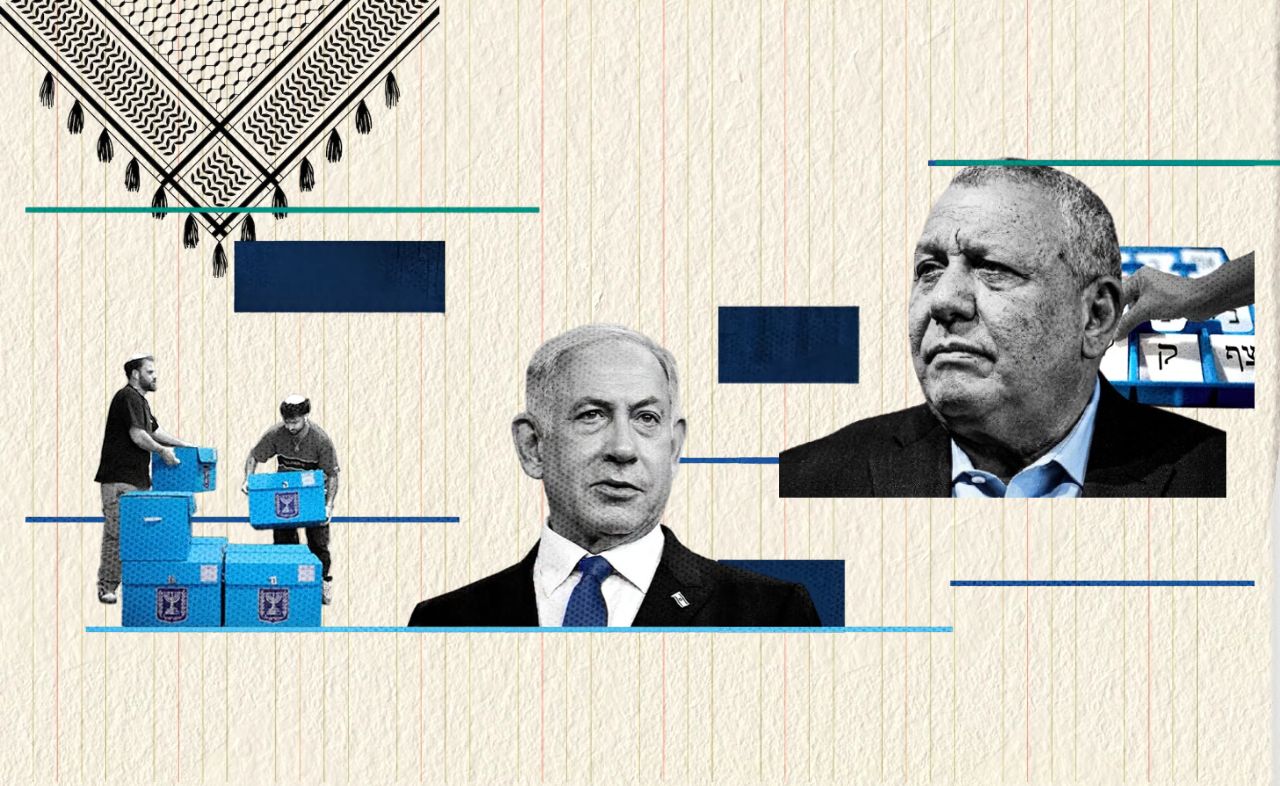
Israel’s 27 October election has produced no clear winner, which means Benjamin Netanyahu and opposition leader Gadi Eisenkot will compete to form the next government. Netanyahu’s Likud party is leading the election but hasn’t won enough seats to form a government on its own. Gadi Eisenkot is also looking for help to build a coalition government. As uncertainty continues, one question matters beyond Israel’s borders: what would change for Palestine if Netanyahu lost power?
This is crucial for Palestine. The occupation, expansion of settlements, the war in Gaza and the denial of their basic rights remain major concerns. Eisenkot brings a different style of leadership where he prioritises accountability and has his own perspective on handling the war in Gaza. Yet his ideologies are not totally different from Netanyahu’s.
As Eisenkot’s Yashar Party is considered centrist, offering an alternative to Netanyahu’s right-wing politics, his leadership could bring changes in Israel’s policies.
The Continuity of Israeli Policy on Palestine
A change in Israel’s leadership doesn’t necessarily mean a change in its stance on Palestine. Although Netanyahu and Eisenkot represent different political ideologies, their positions on fundamental issues concerning Palestine share important similarities. This became obvious in Gadi Eisenkot’s interview with The Times of Israel on 6 October 2026. In the interview, he said that any future political solution would offer Palestinians limited self-government rather than full statehood. Israel would retain full security control over the territory between the Jordan River and the Mediterranean Sea. He also rejected the idea of an independent Palestinian army. Eisenkot’s position raises concerns about whether his approach would lead to genuine Palestinian self-determination. His views portray the absence of full Palestinian sovereignty and the continuation of Israeli security operations. Therefore, his vision differs from the two-state solution, which envisages Israel and an independent Palestine existing as sovereign states.
Eisenkot’s idea about controlling Hamas reveals another continuity. In the same interview, he criticised Netanyahu’s handling of the war in Gaza and claimed that Netanyahu couldn’t ensure Israel’s long-term security. Eisenkot also said Hamas must lose its military capabilities and governing power. He promised that if he became the Prime Minister of Israel, he would dismantle Hamas within 18 months. He indicated that Israel could achieve this goal through the US-backed framework. That makes one thing clear: even if he talks about different strategies, his broad objectives are very similar to Netanyahu’s.
The possibilities of change under Eisenkot
Although Gadi Eisenkot shares similarities with Netanyahu on several issues, his leadership could change a few things in Israel’s governance, security policies, and policies toward Palestine. One of his clearest promises is to tackle violence by Israeli settlers against Palestinians. In the same interview, Eisenkot said that he would implement stronger law enforcement in the West Bank. He also added that he would take administrative measures against Jewish extremists. His position on settler violence could be a real change from Netanyahu’s approach. Violence by Israeli settlers against Palestinians has created real fear for people’s safety. Stronger law enforcement and proper accountability for the culprits could help protect Palestinians in their daily lives. But stopping settler violence and ending the occupation are two separate issues. Even if stronger law enforcement is implemented, it would not stop settlement expansion, remove restrictions on Palestinian movement or give Palestinians control over their own land. His government could only enhance some aspects of their lives without changing the power imbalance between Israel and Palestine.
Another possible change could be about the Palestinian Authority (PA), which governs parts of the occupied West Bank. Eisenkot has advocated that the PA should take responsibility for managing Palestinian communities while Israel retains the overall security control. This could let Palestinians run public services like schools and hospitals with far less interference from the Israeli government. But self-governance is not the same as independence, and that difference matters. If Eisenkot maintains Israeli influence over security, settlements and major decisions, Palestinians would still lack full independence. His proposal could give the PA more freedom for governing Palestinians without enabling them to decide their own political future.
Can Arab parties make a difference?
The strong performance of Arab-led parties in the election could also impact the formation of Israel’s next government. Arab-led parties got 19 seats in Israel’s 120-seat parliament, where a party needs the support of at least 61 members to secure a majority and form the government. Neither Netanyahu nor Eisenkot got a clear majority, so these Arab parties could become significant in coalition negotiations. Their electoral results reflect the political impact of Arab citizens of Israel, who may advocate for greater equality and stronger protection against discrimination. There is a high probability that these parties won’t support Netanyahu. Therefore, if these parties choose to support Eisenkot in forming the government, they could use their parliamentary strength to push for renewed peace negotiations, recognition of Palestinian statehood and greater pressure to end settlement expansion.
Although Arab parties may have enough seats to determine who forms the government, the opposition has resisted relying on them. Even if they agree to join a coalition, their support may not guarantee a change in Israel’s policies toward Palestinians
