

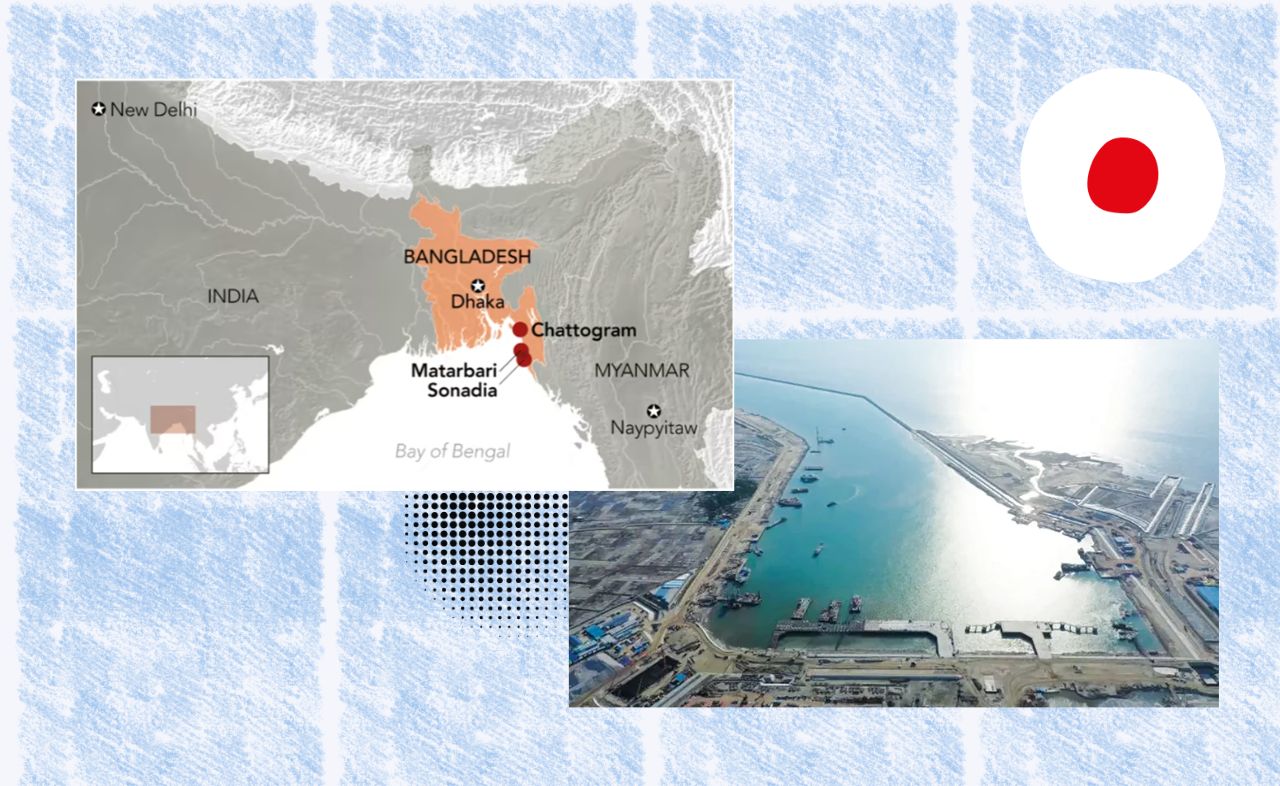
Matarbari deep-sea port was supposed to be finished by 31 December this year. In the first week of April, the Chattogram Port Authority put physical progress at just over 5 per cent, a figure that covered site clearing, a boundary wall, connecting roads and dredging. On 27 October, in Tokyo, two prime ministers described the same port as the centre of a regional hub for logistics, energy and industry. The strategy has travelled faster than the quay.
That gap explains what ‘BIG-B (Bay of Bengal Industrial Growth Belt) for Shared Prosperity’ is for. It reads less like an expansion than like insurance. A late and costlier flagship, begun under one government, is being re-anchored to the vocabulary of another, while Japan’s pitch shifts from cheap loans towards rules and private capital. If so, ‘freedom of decision’, the phrase both prime ministers put into the joint statement, has a plain test. Whoever writes the rules around Matarbari holds the freedom.
When Dhaka’s planning adviser explained the choice of Japan in October 2024, he gave two reasons, lower interest and a longer repayment period, and added that China and India had wanted the port too. Before the Tokyo trip, the foreign secretary said Dhaka would raise concerns over rising project costs and loan interest rates. The port’s own bill has risen 37 per cent, to Tk 24,381 crore, and the deadline has moved to December 2029. Japan did lend in Tokyo: about $295.5 million for two projects. The number that travelled was another one. The joint declaration says Japanese private companies may invest 1 trillion yen over five years, which the Prime Minister’s Office put at $6.3 billion. One is a pledge. The other is an estimate of what companies may do.
Not all of the delay belongs to Japan. The Business Standard attributed years of it to land acquisition and other issues. Dhaka cannot treat the schedule as Tokyo’s problem alone.
The politics ran ahead of the construction too. Sheikh Hasina laid the foundation stone of the first terminal on 11 November 2023. The interim government called the port its sole mega project. Tarique Rahman was briefed on the layout at the site on 9 August. Japan’s ambassador wrote in May that Tokyo had kept cooperation going through the interim period and would keep advancing its flagship projects with the BNP government, and in Tokyo Rahman noted the importance of Japanese Prime Minister Sanae Takaichi’s FOIP (Free and Open Indo-Pacific) initiative for peace, stability and prosperity. One port, three governments, and Japan has stayed with all of them.
The vocabulary is not new either. On 2 May in Hanoi, Takaichi presented an updated FOIP built around helping countries gain the autonomy and resilience to decide their own future. Its three priorities are infrastructure for the age of AI and data, public-private cooperation and rule-making, and security cooperation. The BIG-B pillars in the joint statement include resilience against geopolitical uncertainty, public-private partnership in rule-making, and cooperation for peace and stability. So ‘freedom of decision’ comes from Japan’s regional catalogue, and Dhaka has now co-signed it. In Hanoi, Takaichi also warned against excessive dependence on a single country, and Jiji read that against China’s rare-earth export restrictions. The autonomy on offer is autonomy from one dependence, delivered through a different partnership.
Sonadia looks different from here. China was keen on the port and submitted a detailed proposal. In August 2020 the cabinet annulled the Sonadia authority act, citing biodiversity, though the replacement sits 25 kilometres away. A Daily Star analysis says opposition from Japan, the United States and India contributed to the shelving. Matarbari was shaped to be acceptable in Delhi as well. An official from JETRO, a Japanese trade promotion body, has said Japan wants better links between India’s northeast and Bangladesh, and a brief from IDE-JETRO, the research arm of JETRO, calls the port a hub for a value chain reaching Northeast India, Bhutan and Nepal. Lailufar Yasmin of Dhaka University describes Japan as a guarantor between Dhaka and Delhi. Japan has added hardware to that role: a defence equipment and technology transfer agreement signed in February, and five patrol boats handed over by August.
Three things can be checked, and none depends on reading adjectives. The first is tariffs and operators. The port authority has begun hiring international consultants to set tariffs for Matarbari and the Bay Terminal. The civil works went to a Japanese joint venture of Penta-Ocean and TOA, and JICA agreed to lend Tk 5,427 crore of the Tk 6,197 crore for phase one. The public record I could find does not say who will run the jetties. The second is transit costs. Yasmin has urged negotiators to make sure Bangladesh does not end up paying for the roads that carry regional transit: ‘We do not want an agreement that Bangladesh ultimately has to pay for.’ The third is loan terms. If the interest-rate complaint produces no change, the shift from loans to rules will have happened without Dhaka getting anything for it.
Supporters will say I am reading too much into it. Takaichi says FOIP is ‘not about imposing anything on anyone’. Dhaka did raise the cost question, Rahman’s first state visit was to Beijing, in June, and former ambassador Kamrul Ahsan says Japan generally keeps the promises it makes. The foreign secretary has framed Dhaka’s immediate priority as making sure the country’s ports can handle future trade, a narrower ambition than the corridor Tokyo describes. All fair. But these points mostly describe how the port was chosen, years ago. The new paper deals in rules and security, where terms are much harder to compare than an interest rate.
The Prime Minister’s Office said a Japanese team would be sent to Bangladesh promptly to carry the plan forward. Whether Dhaka meets that team with its own draft of the rules or with Japan’s will be visible soon enough.
