

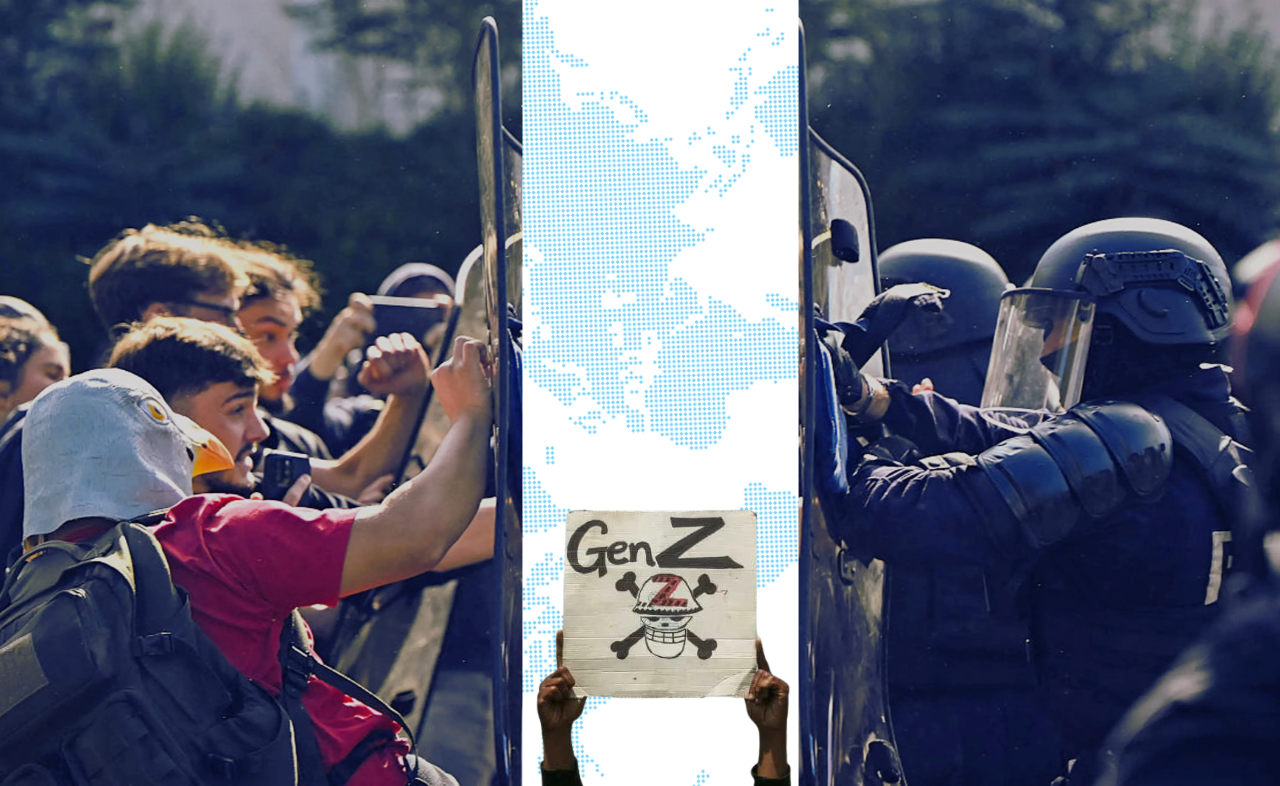
Serbia’s student-led movement has achieved something that protest movements rarely manage: it has carried the energy of the streets into electoral politics and defeated a ruling establishment. On 25 October 2026, candidates backed by the movement won Serbia’s parliamentary election, ending Aleksandar Vučić’s long political dominance after nearly two years of demonstrations. The protests began after a railway station canopy collapsed in Novi Sad in November 2024, killing 16 people and fuelling anger over corruption and government accountability. What began as a demand for answers grew into a challenge to the political system itself. The movement’s victory has now raised a harder question: can those who mobilise against a failing system build one that works better?
The phrase “Gen Z revolution” gained international prominence after Bangladesh’s July 2024 uprising, widely cited as the first successful Gen Z revolution. What began with opposition to the government job quota system escalated amid state violence and years of anger over repression, political exclusion and unaccountable rule. On 5 August 2024, Sheikh Hasina fled the country as her government collapsed. The uprising helped popularise the term and became a defining reference point for discussions of youth-led resistance.
Since then, protests across different countries have invited comparisons with Bangladesh. In India, young protesters are challenging the integrity of electoral institutions. In Albania, student-led demonstrations have confronted a government accused of corruption and failing to provide opportunities. In France, protests over school conditions have widened into anger over the cost of living and public services. By mid-October 2026, major protests were taking place across at least eight countries, driven by demands ranging from jobs and affordable housing to democratic rights and political accountability. The grievances vary, but a common frustration runs through them: people are losing faith in institutions that claim to represent them.
The idea of a global Gen Z revolution gives these events the shape of a single historical moment, with a generation rising against an established order. The comparison captures something real about the spread of youth-led resistance. Yet the protesters do not share one ideology, and their demands can lead in very different political directions. What connects them is a growing distrust of systems that promise representation while leaving many people feeling excluded from decisions that shape their lives.
For decades, the promise of progress rested on a practical expectation: education would open doors, work would provide security, and each generation would have a reasonable chance of living better than the one before it. That promise was never fulfilled equally. Even so, it helped sustain the belief that existing institutions, however imperfect, offered a route towards a better future.
For many young people, that belief is becoming difficult to maintain. Education no longer guarantees secure employment. A regular income does not necessarily provide independence. In expensive cities, people can work full-time and still struggle to afford a home.
Meanwhile, public services deteriorate, political scandals recur, and those with wealth or influence often appear insulated from the failures everyone else must endure.
The frustration runs deeper than declining living standards. The rules governing success seem increasingly detached from the effort people are told to make. Study, work hard, obey the rules, wait your turn. Yet the promised reward remains out of reach for many, while others seem to move through the same system with extraordinary ease. Eventually, people begin questioning the system’s account of how success is earned and opportunity is distributed.
The housing crisis in Spain and the electoral dispute in India reveal different dimensions of this disillusionment. One concerns access to a basic necessity; the other concerns political participation. Both raise the question of whose interests institutions ultimately serve. When housing becomes an investment opportunity while residents struggle to find a place to live, market priorities collide with basic needs. When citizens lose confidence in the institutions responsible for protecting their votes, the legitimacy of democracy comes under pressure.
In Albania, protests have centred on corruption allegations, unemployment and poor education. In France, student anger over school conditions has widened amid rising living costs and deteriorating public services. These movements have different immediate causes, but each exposes a growing gap between decisions made in the public’s name and the interests people believe those decisions serve.
The crisis deepens when the usual channels for correcting failures lose credibility. Elections may change the people in office without changing the experience of exclusion. Courts may exist without inspiring confidence in equal treatment. Public consultations may take place without convincing citizens that their objections matter.
Institutions can retain their offices, procedures and official ceremonies while losing the trust that makes their authority meaningful. A state may continue to function on paper even as fewer people believe its claims to legitimacy. Political authority cannot rest on procedure alone when citizens increasingly doubt whose interests the system serves.
Street protest becomes a way to force a response from institutions that people believe have stopped listening. When ordinary channels appear ineffective, disruption can seem like the only way to become impossible to ignore. Governments may interpret that disruption as a threat to order rather than evidence of political failure. The confrontation then widens: an initial grievance becomes part of a struggle over who gets to define legitimate political action.
Not every protest represents the public as a whole, and not every tactic used by protesters is justified. But treating demonstrations solely as a law-and-order problem leaves their political causes untouched. A government can restore order to a street without restoring the trust that emptied it of patience.
Young people are prominent in these confrontations because they are entering adulthood in economies where secure employment and affordable housing are increasingly difficult to obtain. They are expected to make long-term plans while having limited influence over the decisions that shape their prospects. Their frustration concerns what they lack today and the future they have been told to expect.
Age, however, does not create a unified political outlook. Young people differ by class, education, geography and access to resources. A university student with family support faces a different future from a young worker supporting a household. A young person in a country with functioning opposition parties confronts different political barriers from someone living under an increasingly authoritarian government.
What many share is a limited ability to influence systems that exercise considerable power over their futures. Decisions about employment, education, housing and public spending will shape their lives for decades, yet many feel excluded from making those decisions.
When people must live with consequences over which they have little control, frustration can become resistance.
Digital communication accelerates that process across borders. Protesters watch demonstrations abroad, circulate footage, borrow slogans and learn from other movements. They see how governments respond to dissent, how crowds organise and how a local grievance can become a national confrontation. Political lessons that once travelled slowly through established organisations now circulate almost instantly.
Symbols travel faster still. During the youth-led protests of 2025, the pirate flag associated with One Piece, the Japanese manga and anime series, appeared in demonstrations in several countries. Its recognisability and association with resistance offered protesters a common visual language.
A shared symbol can bring people together around an expression of dissent. It cannot, by itself, settle what political change should look like or what a movement should do once it has gained momentum.
The idea of a global Gen Z movement is useful because it identifies a pattern of youth-led mobilisation. It can also make separate movements appear more coherent than they are. People can recognise familiar frustrations across borders while disagreeing about their causes, their solutions and the political order they want to build. A common language of resistance is developing faster than a common political programme.
The difficulty begins when protest must become politics.
Decentralised networks can mobilise people quickly without relying on conventional leadership structures. They can make participation more accessible and make movements harder to contain by targeting a single leader. Once the immediate confrontation ends, however, difficult questions emerge. Who negotiates on behalf of the movement? How are competing demands prioritised? How can a coalition united against corruption or political exclusion build institutions that remain accountable after power changes hands?
A movement may force a leader to resign without developing the political capacity to hold the successor accountable. It may win a policy concession without changing the forces that produced the grievance. It may unite people who agree that the existing system is failing but disagree sharply about what should replace it.
The unity of the street can fracture when rejection gives way to the task of building an alternative.
The language of a global youth revolution therefore runs ahead of what the movements have achieved. A revolution transforms political authority and the relationships through which power is exercised. A mass protest or the departure of a leader may open the way to such a transformation, but neither guarantees it. The movements unfolding across countries have created openings for change; what emerges from those openings remains uncertain.
Their importance lies partly in what they make impossible to ignore. Protest can expose the limits of official narratives, force neglected grievances into public debate and reveal a loss of confidence that election results, speeches and economic indicators cannot fully capture. It can bring into view a political crisis that governments would rather present as a collection of unrelated complaints.
Across different political systems, people are challenging the distance between the institutions that claim to represent them and the lives they actually experience. They are questioning economic growth that leaves opportunity inaccessible, elections whose rules no longer command public confidence, and public institutions that appear indifferent to public needs.
These struggles point towards a shared political problem: institutions cannot rely indefinitely on formal authority when the people they govern no longer believe that authority serves them.
The connection between these protests lies in a growing confrontation over representation, accountability and the distribution of power. That confrontation does not require every young person to share one ideology or every movement to pursue the same future.
The streets can make the conflict visible. They can force a political system to yield. The decisive test comes afterward, when protesters must work out what should replace the arrangements they rejected and governments must demonstrate that they understand why people took to the streets in the first place.
A global political generation is not yet a settled reality. A crisis of political representation is already visible. Whether the two become the same story will depend on what happens after the protests, not simply on how many countries witness them.
