

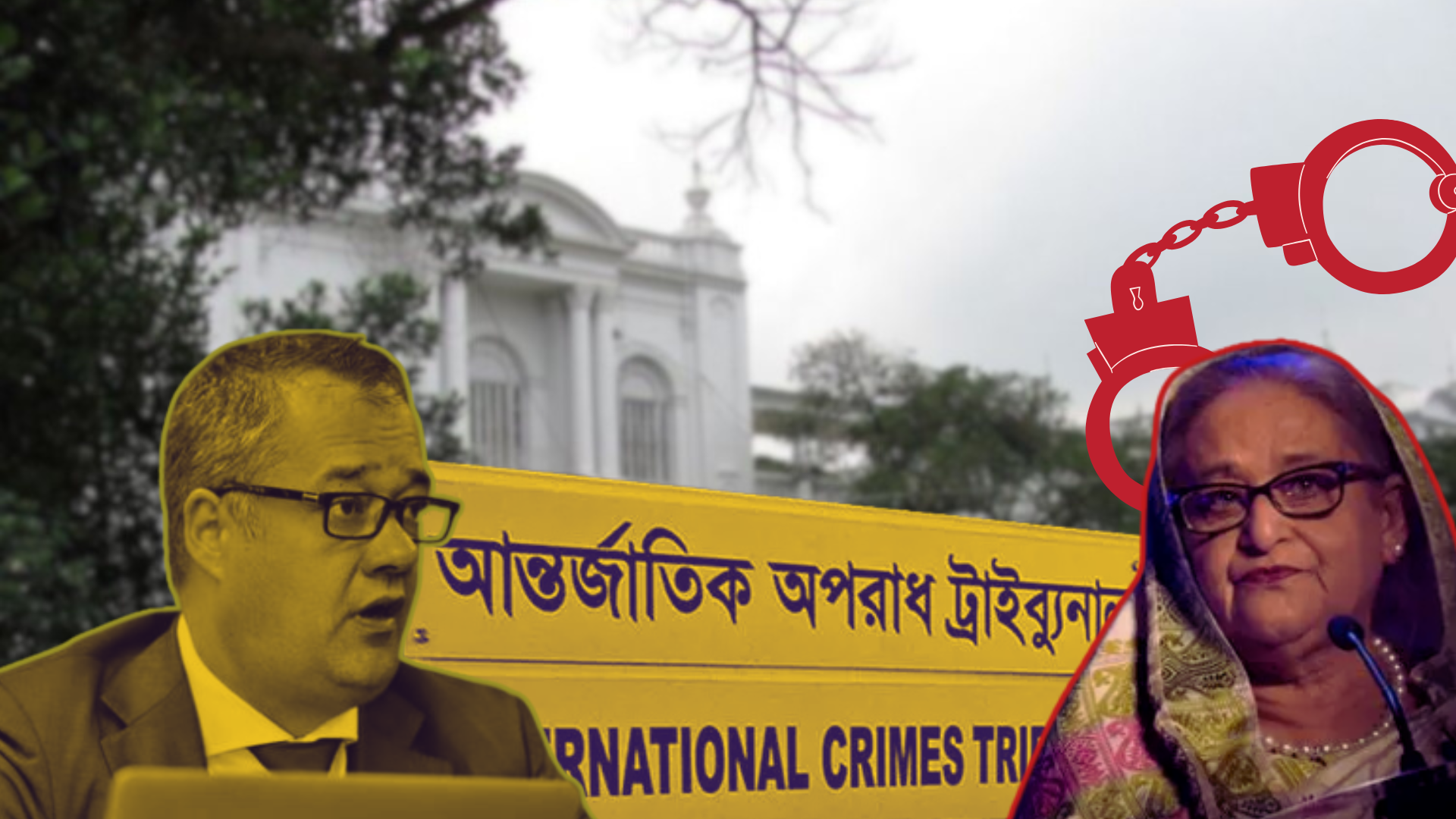
Tomorrow at 11 a.m., the International Crimes Tribunal‑1 (ICT-1) will deliver its verdict in the high-stakes crimes-against-humanity case against former Prime Minister Sheikh Hasina and two other senior accused. In a detailed emailed interview, British lawyer and tribunal adviser Toby Cadman responds to questions posed by journalist Abdul Majid Chowdhury about the integrity of the trial and its wider implications. Cadman, who has served on the prosecution advisory panel, gives insight into reforms undertaken by the tribunal, representation rights of the accused and the precedent-setting nature of the case.
Abdul Majid Chowdhury: The International Crimes Tribunal is once again in discussions over the verdict in the case of ousted Prime Minister Sheikh Hasina and three others accused of crimes against humanity committed during the July uprising. Hasina tried opposition politicians in this tribunal while in power. At the time, organizations ranging from prominent human rights organizations to the United Nations expressed concerns about the transparency of the trial process.
To what extent has the tribunal been able to maintain international standards surrounding Hasina’s case and trial this time? As the tribunal’s chief advisor, I would like to hear your position on this case.
Toby Cadman: It is important to recognize that the establishment of the International Crimes Tribunal and the adoption of its legal framework were initiated under Sheikh Hasina’s government. It is essentially the institution that her government created that is putting her on trial. An institution that her government had lauded as maintaining the highest international standards. While the previous trials conducted by the tribunal were marred by serious procedural flaws, including allegations of judicial and prosecutorial misconduct, significant amendments have since been introduced to address these shortcomings. These reforms were specifically aimed at improving the fairness and transparency of the proceedings, aligning the tribunal’s processes more closely with international standards and ensuring that all accused receive a fair trial. Ultimately it will be for the tribunal judges to determine whether the evidence presented by the prosecution is sufficient for a conviction and to determine whether the proceedings have been conducted fairly.
Abdul Majid Chowdhury: There is no lawyer appointed by Sheikh Hasina in the tribunal. Although they had that opportunity, they didn’t take it. The prosecution team had to present arguments against the lawyer appointed by the state. Do you think the quality of the trial would have been better if the accused had hired lawyers?
Toby Cadman: It is inaccurate to claim that Sheikh Hasina was left without legal representation in the tribunal proceedings. In reality, her voluntary decision to remain in self-imposed exile in India and her refusal to respond to multiple summonses from the tribunal directly resulted in the tribunal’s appointment of a state counsel to safeguard her legal interests. The appointed state counsel is an experienced advocate. This ensured that Sheikh Hasina’s legal rights were properly defended, even in her absence. The state counsel was provided access to all necessary case materials, permitted to make submissions, examine witnesses, and challenge prosecution evidence, thereby fulfilling the core functions of effective legal advocacy. Ultimately, it remains the tribunal judges’ duty to scrutinize the entire process and determine whether the proceedings adhered strictly to principles of fairness, impartiality, and due process, and whether Sheikh Hasina received competent legal representation throughout the trial.
Abdul Majid Chowdhury: Former Home Minister Asaduzzaman Khan Kamal, like Sheikh Hasina, is still at large in this case. The other accused, former Inspector General of Police Chowdhury Abdullah Al-Mamun, is a ‘state approver’. How did the prosecution team come up with the idea of making Chowdhury Abdullah Al-Mamun a royal witness or how was this possible?
Toby Cadman: On the basis that the trial process remains ongoing and the judgment has not been delivered by the tribunal judges; it would not be appropriate for me to comment on this.
Abdul Majid Chowdhury: Is it a turning point in this case for an important figure like the former IGP who was the prime witness during the final atrocities of the July uprising?
Toby Cadman: It will be for the tribunal judges to assess the former IGP’s evidence and determine whether it goes to establish the guilt of the defendants. The position of the prosecution is that the evidence is highly compelling and goes to establish the guilt of the other two accused.
Abdul Majid Chowdhury: This tribunal has sentenced many defendants to death in the past. Which has also been implemented with controversy. The Western world, including the United Nations, is strongly opposed to the death penalty. The prosecution team has already sought the death penalty as the maximum punishment. If the tribunal issues a death sentence, do you think Sheikh Hasina’s extradition will become more complicated in this case?
Toby Cadman: It is important to distinguish the prior trials, under Sheikh Hasina’s government, with the current trials that are being heard before an independent and impartial court of law with an amended legal framework. The previous death sentences carried out were quite rightly termed as arbitrary and unlawful executions by the international community. The maximum penalty is the death sentence, and it will be for the tribunal judges to determine whether a sentence of death is appropriate based on an assessment of the evidence and consideration as to the level of responsibility of the defendants if they are convicted. In terms of whether this will make extradition more difficult, it is quite clear that India has no intention of ordering extradition regardless of whether a sentence of death, or lesser sentence, is imposed. In terms of whether she could be arrested in another third state, if she were to travel outside of India, that would depend upon the state in question and whether there was a bar on extraditing a person subject to a sentence of death.
Abdul Majid Chowdhury: For the first time in Bangladesh’s 57-year history, a former prime minister has faced charges of crimes against humanity. Is this trial a controversy or a precedent for the future of Bangladeshi politics?
Toby Cadman: While this trial is indeed unprecedented in the context of Bangladesh’s history—marking the first time a former prime minister has faced charges of crimes against humanity—it is important to recognize that there are numerous international examples of former heads of state and political leaders being prosecuted for similar offenses. From the trials of Charles Taylor in Liberia to Slobodan Milošević in the former Yugoslavia, and more recently, proceedings against leaders in Israel, Sudan and Myanmar, the international community has demonstrated that accountability for such grave crimes transcends political position or national boundaries.
This case sets a significant precedent for Bangladesh, reinforcing the principle that no-one is above the law and underscoring the global commitment that impunity for crimes against humanity will not be tolerated.
Abdul Majid Chowdhury: Trials of former prime ministers for crimes against humanity are rare in world history. Critics have characterized Sheikh Hasina’s authoritarian rule as one marked by extrajudicial killings, enforced disappearances, corruption and oppression. Will the tribunal be able to present this case as a ‘textbook’ example through its verdict?
Toby Cadman: This is partly answered above. It is important that Sheikh Hasina stands accused and it is for the judges to determine guilt or innocence. There are of course credible and evidencebased allegations of a multiplicity of crimes allegedly perpetrated over a prolonged period under Sheikh Hasina’s rule. The tribunal judges’ role is to decide on the basis of the charges she faces and the evidence presented. She is not charged in this case for enforced disappearances, corruption and oppression and so one should not speculate on the wider allegations she, and members of her government, may face in subsequent proceedings.
Abdul Majid Chowdhury: Whatever the verdict, how confident are you that the verdict in this case will be internationally accepted?
Toby Cadman: In my view, it is a more a question of whether the people of Bangladesh will accept the verdict of the tribunal judges. The views of the international community are important of course and they will assess the fairness of the proceedings based on the verdict. It would not be appropriate to comment until the verdict is delivered by the tribunal judges.
Abdul Majid Chowdhury: The interim government has brought several amendments to the International Criminal Tribunal Act of 1973 to try crimes against humanity committed during the July uprising. The law was amended four times in the year since the tribunal resumed its trial on October 17 last year. The government says these amendments were made to make it timelier. Are these amendments sufficient by international legal standards?
Toby Cadman: As the Special Adviser to the Chief Prosecutor, I made several recommendations to the Interim Government. Some of the recommendations were implemented. Of course, it is a matter for the Interim Government to amend the legal framework as it deems necessary to ensure it complies with national and international law.
Abdul Majid Chowdhury: Because of the controversy surrounding the past tribunal, you recommended a name change. For example, in a conversation with Daily Jugantor last February, you mentioned the ‘International Crimes Chamber’. But we saw that the name was not changed. What were the reasons for not changing the name?
Toby Cadman: That was one of the recommendations I made, and I maintain the position that it would be desirable to do so. Of course, the name of the institution does not affect the fairness of the proceedings and so the failure to amend does not impact on whether the trial has been fair. My recommendation was made on the basis that there should be a break from the past and to ensure that the current trials are not tainted by the legacy of its past.
Abdul Majid Chowdhury: You have been a vocal critic of the tribunal’s ‘trial standards’ and ‘process’ for the past decade. Now, as an advisor to the tribunal for over a year, what have you made of the differences that you have called for correction in the past?
Toby Cadman: I have been a vocal critic on the earlier trials conducted during Sheikh Hasina’s rule when I served as defence counsel to the accused both during the trial process and following their convictions. I described those convictions as a flagrant denial of justice, and I stand by that description. They were an affront to justice. The criticisms made referred to not just the legal framework, but more the practice and the conduct of the judges and prosecutors. Let us not forget that there was evidence of the judges meeting with members of the government, taking instructions from third parties (Skypegate), interfering with and threatening defence witnesses, preventing foreign counsel from appearing, barring defence witnesses from entering the country, and coaching of prosecution witnesses. Those matters amount to conspiracy to pervert the course of justice. Whatever criticisms are made of the process now, mainly by ardent supporters of the former Prime Minister, do not come close to the level of fundamental breaches under the previous regime.
Abdul Majid Chowdhury, known at work as AMC Shahriar, is currently working for Daily Jugantor as a Sub Editor in its International Desk.
