

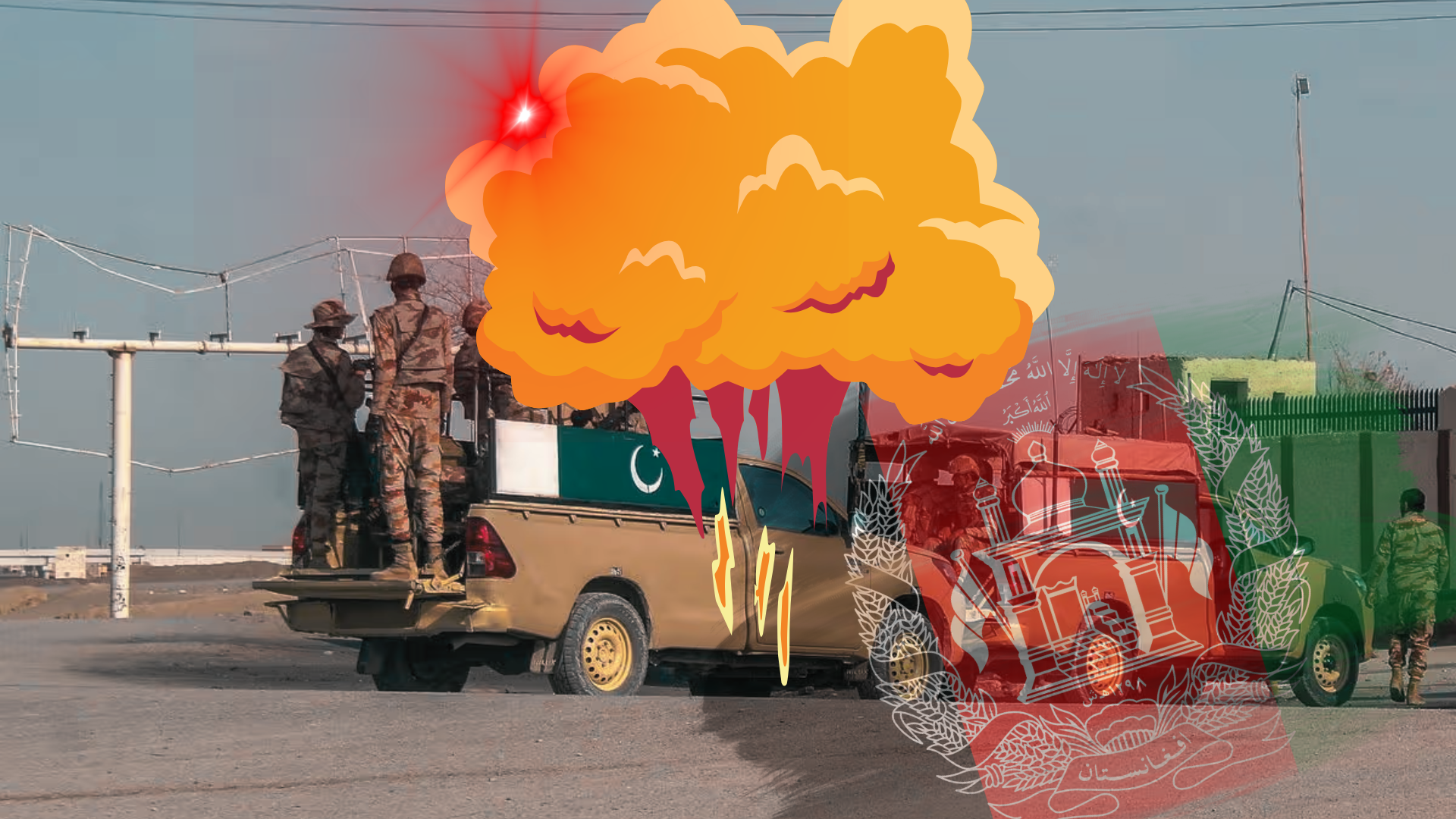
The relationship between Afghanistan and Pakistan has rarely been stable, but recent cycles of cross-border strikes and retaliatory operations mark a dangerous new phase. What was once a pattern of sporadic skirmishes and diplomatic protests has evolved into repeated military exchanges, hardened rhetoric, and growing public hostility. If this trajectory continues, the consequences will extend far beyond bilateral hostility. Repeated strikes risk destabilizing not only Afghanistan–Pakistan relations but also China’s economic corridor ambitions and the broader security architecture of South Asia.
At the heart of the crisis lies a familiar accusation: Pakistan insists that militant groups, particularly the Tehrik-i-Taliban Pakistan (TTP), operate from Afghan territory and launch attacks inside Pakistan. Kabul denies direct responsibility, arguing that Pakistan’s internal security failures cannot be outsourced to Afghanistan. The Durand Line — long contested and never fully accepted by successive Afghan governments — remains both a physical and psychological fault line. Each airstrike or artillery response reinforces the perception of violation, sovereignty, and betrayal.
Repeated military actions erode the already fragile diplomatic mechanisms between the two states. In the short term, strikes may be presented as tactical necessity; in the long term, they undermine any possibility of trust-based coordination. Border closures, reduced trade, and tightened security regimes hurt local populations on both sides. Tribal communities straddling the border face displacement and economic paralysis. As mistrust deepens, informal intelligence sharing declines, making it even harder to control non-state actors. Ironically, military escalation may strengthen the very militant networks both states claim to oppose, as instability creates recruitment narratives and operational space.
The consequences, however, do not stop at bilateral relations. One of the most significant strategic victims of sustained instability would be the China–Pakistan Economic Corridor (CPEC), the flagship of the Belt and Road Initiative (BRI). CPEC represents billions of dollars in infrastructure investments linking Pakistan’s Gwadar Port to China’s Xinjiang region. It is not merely an economic project; it is a geopolitical statement about connectivity, development, and regional integration.
China has long viewed stability in Afghanistan as a prerequisite for extending economic connectivity westward. There were discussions about linking Afghanistan to CPEC, transforming the corridor into a broader regional trade network connecting Central Asia to the Arabian Sea. However, persistent cross-border hostilities create a security risk premium that investors cannot ignore. Infrastructure corridors depend on predictability. Roads, pipelines, energy grids, and fiber-optic cables cannot function effectively in an environment of recurring airstrikes and militant infiltration.
Security costs would rise dramatically. Pakistan would be forced to divert additional military resources to border areas, stretching already strained capacities. Insurance costs for transport routes would increase. Foreign companies, including Chinese firms, might delay or downscale projects. Moreover, insurgent groups — whether motivated by ideology, nationalism, or opportunism — could exploit instability to target high-visibility infrastructure. Even limited sabotage can damage investor confidence far more than the physical destruction itself.
For Beijing, prolonged Afghanistan–Pakistan hostility presents a delicate dilemma. China seeks to maintain strong ties with Pakistan while also engaging Afghanistan pragmatically to secure its western frontier. Escalation complicates this balancing act. If conflict escalates further, China may be pressured to mediate more directly. Yet overt alignment with one side risks alienating the other. A corridor designed to symbolize connectivity could instead become vulnerable to fragmentation.
Beyond economic corridors, repeated strikes threaten broader South Asian security in multiple ways.
First, there is the risk of militant spillover. Armed groups rarely confine themselves neatly within borders. If Pakistan intensifies operations against TTP elements allegedly based in Afghanistan, militants may scatter into remote borderlands or even toward other regional theaters. The diffusion of armed actors complicates regional counterterrorism efforts and increases unpredictability. Neighboring states — including Iran and Central Asian republics — would watch developments with concern.
Second, sustained confrontation could trigger militarization dynamics. Pakistan’s military doctrine is historically shaped by its eastern border with India. A heightened western front introduces strategic strain. If Pakistan perceives encirclement or instability on multiple fronts, it may prioritize hard security responses over diplomatic flexibility. Afghanistan, internally fragmented and economically fragile, may also rely increasingly on external patrons, turning the conflict into a node within larger geopolitical rivalries.
Third, humanitarian fallout could destabilize the region indirectly. Border clashes generate displacement. Civilian casualties fuel grievance. Refugee flows place pressure on already fragile economies. Prolonged insecurity undermines trade corridors that support livelihoods in border provinces. Economic deprivation, in turn, strengthens recruitment pools for extremist networks. Thus, military escalation feeds a vicious cycle linking insecurity and underdevelopment.
Another overlooked dimension is narrative warfare. In both countries, domestic political actors may instrumentalize cross-border strikes for nationalist mobilization. Public opinion hardens quickly when sovereignty is perceived to be violated. Once nationalist sentiment peaks, diplomatic compromise becomes politically costly. Leaders may find themselves locked into escalation not because it is strategically optimal, but because retreat appears as weakness.
South Asia’s security environment is already complex. India-Pakistan tensions remain unresolved. Afghanistan is still navigating post-war reconstruction under a contested political order. Adding sustained Afghanistan–Pakistan hostilities to this mix risks creating overlapping security crises. Even if escalation does not result in full-scale war, persistent low-intensity conflict is enough to deter investment, disrupt connectivity, and weaken regional integration initiatives.
Importantly, military strikes rarely eliminate militant threats permanently. Cross-border insurgencies are political as much as military phenomena. Without coordinated intelligence mechanisms, border management agreements, and economic stabilization strategies, strikes become cyclical gestures rather than durable solutions. The absence of structured dialogue forums compounds this vulnerability.
The path forward requires recalibration. Confidence-building measures along the border, joint monitoring frameworks, and third-party facilitation mechanisms could help restore limited cooperation. Economic interdependence, if safeguarded, might serve as a stabilizing factor. For CPEC and related initiatives to survive and expand, security guarantees must be institutional rather than episodic.
Ultimately, repeated Afghanistan–Pakistan strikes risk reshaping the region’s strategic landscape. Bilateral mistrust may solidify into entrenched hostility. China’s flagship economic corridor could face chronic insecurity. South Asia’s already fragile security balance might tilt toward prolonged instability.
In a region where connectivity promises development and development promises stability, sustained militarization threatens to reverse that logic. The choice confronting Kabul and Islamabad is not merely about tactical retaliation. It is about whether South Asia moves toward integration or fragmentation. If repeated strikes continue without a parallel diplomatic architecture, the answer may increasingly lean toward the latter.
Mahmud Newaz Joy is a graduate of the Department of Mass Communication and Journalism at the University of Dhaka.
