

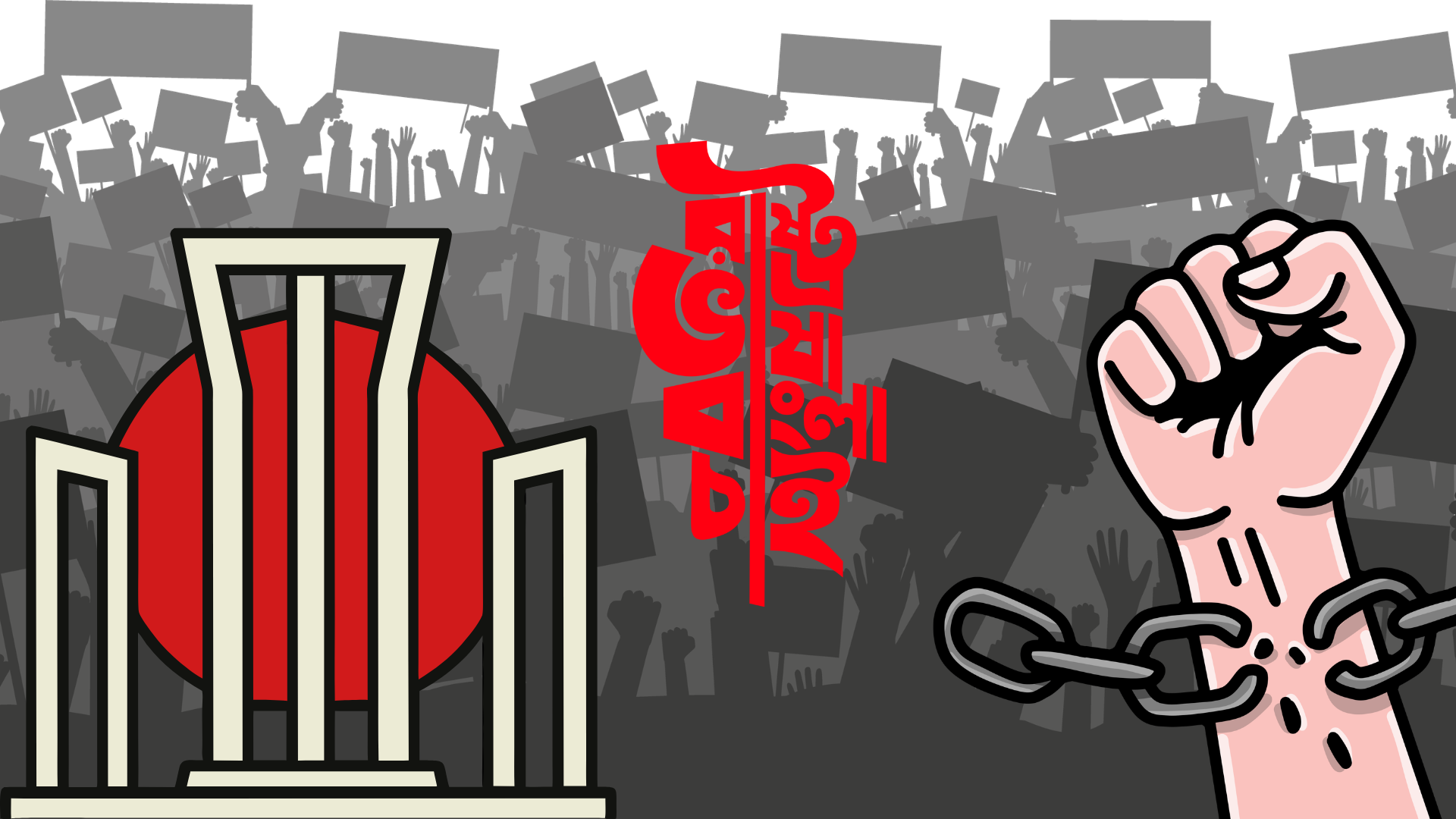
In the canon of twentieth-century decolonization, the story of Bangladesh is often told as a tale of war. The year 1971, the brutality of military repression, and the decisive intervention of India dominate the narrative. Yet the philosophical and political origins of Bangladesh’s sovereignty lie not in 1971 but in 1952—on the streets of Dhaka, where students demanded the right to speak their mother tongue. The Bengali Language Movement was not merely a cultural protest; it was a profound exercise in self-determination. It demonstrated how linguistic rights can evolve into a claim for political sovereignty.
To understand this transformation, we must situate the Language Movement within the broader crisis of postcolonial state formation in Pakistan. Created in 1947 as a homeland for Muslims of the subcontinent, Pakistan was geographically bifurcated into West and East wings, separated by over a thousand miles of Indian territory. While East Pakistan had a demographic majority—its population largely Bengali-speaking—political and military power remained concentrated in West Pakistan. The state’s early decision to declare Urdu as the sole state language in 1948, despite Bengali being spoken by the majority, was not simply a linguistic preference. It was a symbolic assertion of dominance.
Language is never neutral. It shapes access to education, bureaucracy, employment, and political participation. By insisting on Urdu alone, the Pakistani state effectively marginalized Bengali speakers from full citizenship. The protests that erupted in East Pakistan were therefore not narrow cultural grievances; they were struggles over recognition and equality. When students of the University of Dhaka defied Section 144 and marched on 21 February 1952, they were asserting a principle central to modern political theory: a people must have the right to preserve and express their identity.
Self-determination, as codified later in the United Nations Charter and the International Covenant on Civil and Political Rights, is often associated with anti-colonial liberation. However, the Bengali case complicates this framework. East Pakistan was not a colony in the traditional sense; it was part of a sovereign state. Yet the internal imbalance of power, combined with systematic cultural suppression, created what scholars term “internal colonialism.” The denial of linguistic rights became evidence that the state did not represent the will or identity of its majority population.
The Language Movement thus marked the first articulation of a distinct Bengali political consciousness within Pakistan. It was a shift from religious nationalism to linguistic nationalism. The founding ideology of Pakistan rested on the Two-Nation Theory, which posited Muslims of the subcontinent as a single nation. The events of 1952 challenged this assumption. They suggested that shared religion was insufficient to override linguistic and cultural difference. In doing so, the movement reframed the meaning of nationhood.
The political consequences were far-reaching. The recognition of Bengali as a state language in 1956 was a partial victory, but it did not resolve the deeper structural inequalities between East and West Pakistan. Economic disparities persisted; political representation remained skewed; and the central government continued to treat East Pakistan as peripheral. The Language Movement had planted the seed of dissent, but the soil of injustice allowed it to grow.
By the 1960s, under the leadership of figures such as Sheikh Mujibur Rahman, the demand for autonomy evolved into the Six-Point Movement, calling for federal restructuring and economic control. The intellectual lineage from 1952 to 1966 is unmistakable. The insistence on linguistic recognition had matured into a broader demand for political self-rule. Language became the foundation upon which constitutional claims were built.
The watershed moment came after the 1970 general elections, when the Awami League secured a majority but was denied the transfer of power. The subsequent military crackdown in March 1971 transformed a constitutional crisis into a liberation struggle. Yet even during the war, the symbolic memory of 21 February remained potent. The martyrs of the Language Movement were invoked as the first defenders of Bengali identity. The liberation of Bangladesh was thus framed not only as resistance to military repression but as the culmination of a two-decade quest for self-determination.
From a theoretical perspective, the Bengali Language Movement illustrates the layered nature of self-determination. Political scientists distinguish between “internal” and “external” self-determination. Internal self-determination refers to meaningful participation within an existing state—autonomy, federalism, cultural rights. External self-determination refers to secession and independent statehood. The trajectory of East Pakistan demonstrates how the denial of internal self-determination can catalyze demands for external self-determination.
The international community’s response to Bangladesh’s independence further underscores this dynamic. Although initial recognition was cautious, the legitimacy of the Bengali cause gained traction because it could be framed as a struggle against oppression and for democratic mandate. The earlier moral capital of the Language Movement strengthened this claim. It showed a history of peaceful protest and constitutional engagement before the turn to armed struggle.
Today, 21 February is commemorated globally as International Mother Language Day, recognized by UNESCO. This internationalization of the memory reinforces the universal dimension of the Bengali experience. Linguistic rights are increasingly understood as human rights, integral to dignity and inclusion. In multilingual societies across the globe—from Catalonia to Quebec to indigenous movements in Latin America—the question of language remains central to political belonging.
For Bangladesh, the legacy of the Language Movement is both inspiration and caution. It affirms that cultural recognition is foundational to political stability. A state that suppresses identity risks alienation and fragmentation. At the same time, the Bengali experience warns against reducing nationalism to a single marker of identity. Post-1971 Bangladesh has grappled with its own internal diversities—ethnic minorities, regional disparities, and debates over secularism and religion. The principle of self-determination must therefore be applied inclusively, ensuring that linguistic pride does not eclipse pluralism.
Ultimately, the Bengali Language Movement compels us to rethink sovereignty. It reminds us that sovereignty is not merely a matter of territorial control or military power. It begins in the realm of meaning—how people speak, write, and imagine themselves. When a state denies a people’s language, it denies their narrative. When that denial persists, the demand for recognition may transcend reform and seek independence.
In the streets of Dhaka in 1952, students carried no weapons. They carried placards and conviction. Yet their protest set in motion a historical arc that reshaped the map of South Asia. The journey from language rights to political sovereignty was neither inevitable nor immediate. It was forged through sacrifice, negotiation, repression, and resistance. But at its core lay a simple proposition: a people must have the right to define themselves.
The Bengali Language Movement stands, therefore, as a paradigmatic case of self-determination. It shows that the struggle for words can become a struggle for a world.
Mahmud Newaz Joy is a graduate of the Department of Mass Communication and Journalism at the University of Dhaka.
