

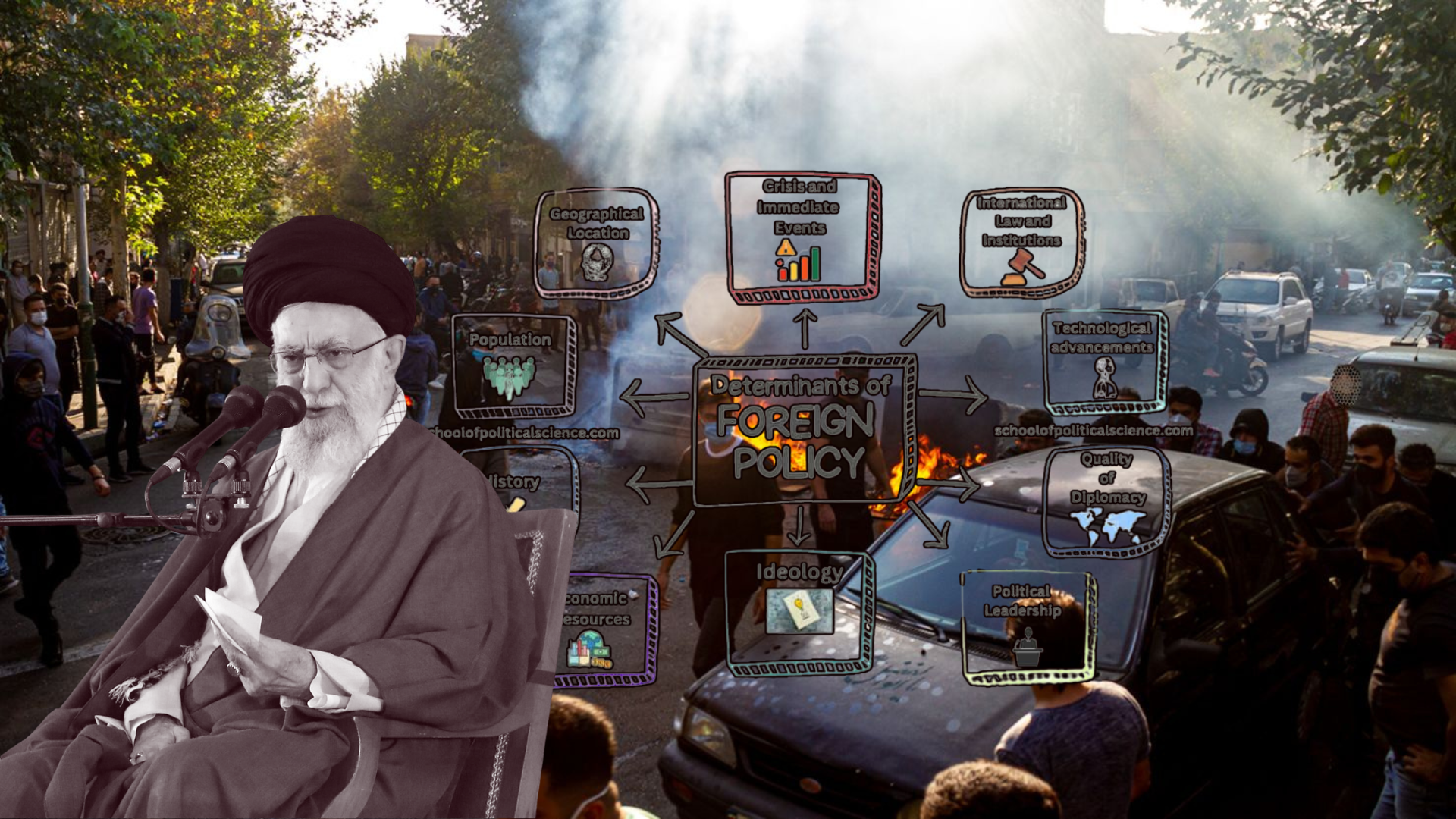
Iran today is a country caught between inward fear and outward defiance. On its streets, frustration has hardened into anger—anger over a collapsing currency, rising prices, shrinking opportunities, and a political system that seems increasingly distant from everyday life. Abroad, Tehran speaks the language of resistance, warning enemies, rejecting external pressure, and asserting strength. These two realities are not running in parallel. They are feeding into each other, reshaping Iran’s foreign policy in ways that reveal how deeply domestic unrest now defines the country’s global posture.
The current wave of unrest did not begin as a revolutionary moment. It began, as so many protests do, with economic despair. Years of sanctions, compounded by mismanagement and corruption, have steadily eroded living standards. For many Iranians, survival itself has become a daily calculation. When protests spread across cities and social classes, they quickly crossed a dangerous threshold for the regime. This was no longer a localized disturbance that could be isolated and pacified. It was a reminder that the social contract underpinning the Islamic Republic has weakened.
The state’s response was immediate and severe. Security forces moved to crush demonstrations, arrests mounted, and courts were mobilized to make examples of dissenters. Yet the most revealing response was not visible on the streets but in the digital realm. Iran imposed a near-total internet blackout, cutting off millions from the outside world. This was not merely a tactical move to disrupt protest coordination. It was a strategic choice that exposed the regime’s priorities. Tehran decided that isolation was preferable to transparency, silence safer than scrutiny.
In the modern international system, information is power. By shutting down the internet, Iran sought to reclaim control over narrative and perception, both domestically and internationally. The blackout signaled that the leadership perceives uncontrolled communication as an existential threat. It also suggested a willingness to absorb international criticism if it meant restoring internal order. In that sense, domestic insecurity has already overridden concerns about global image.
This inward pressure has inevitably reshaped Iran’s outward behavior. Faced with unrest, the regime has revived a familiar narrative: that protests are not organic expressions of public discontent but the product of foreign interference. The United States and Israel are cast once again as invisible hands manipulating internal chaos. This framing serves an important function. It delegitimizes protesters by recasting them as agents of hostile powers, and it attempts to rally nationalist sentiment around the state.
But this strategy also pushes Iran’s foreign policy into a more confrontational register. When domestic dissent is framed as a foreign plot, diplomacy becomes suspicion-driven. Every external statement, sanction, or condemnation reinforces the regime’s siege mentality. Tehran’s increasingly sharp rhetoric toward Washington and its allies reflects not confidence, but vulnerability. It is the voice of a state that fears pressure from outside could embolden resistance from within.
Historically, Iran’s foreign policy has been marked by patience and calculation. Through proxy networks and indirect engagement, it expanded influence while avoiding full-scale confrontation. Today, that balance appears strained. The language of deterrence has grown louder, and red lines are drawn more publicly. This is not the posture of a state planning long-term regional dominance. It is the posture of a regime determined to project strength at a moment of internal fragility.
Domestic unrest has also altered Iran’s strategic priorities. Foreign policy, once a tool for shaping the regional order, is increasingly a defensive mechanism designed to prevent external shocks. Nuclear rhetoric illustrates this shift clearly. Tehran’s renewed insistence that it does not seek nuclear weapons is less a moral declaration than a tactical one. At a time of internal volatility, the last thing the regime needs is a military confrontation or intensified sanctions. Signaling restraint is a way to reduce pressure, buy time, and keep attention focused away from domestic cracks.
Yet restraint has limits. Appearing too conciliatory carries its own risks. Concessions abroad could be interpreted at home as weakness, potentially emboldening dissent. This dilemma—de-escalate internationally without undermining authority domestically—now sits at the heart of Tehran’s foreign policy calculus. It is a precarious balance, and history suggests such balancing acts rarely hold for long.
International reactions have further complicated the picture. Western governments have condemned the crackdown and raised human rights concerns, while many countries in the Global South have opted for caution. This fragmented response reinforces Tehran’s belief that the international system is divided and manageable. But it also underscores a deeper reality: foreign pressure alone cannot resolve Iran’s internal crisis, nor can silence make it disappear.
What makes this moment distinct is not simply the scale of unrest, but its impact on state behavior. Iran’s foreign policy today feels reactive rather than strategic, shaped by fear of collapse rather than ambition for influence. External posturing has become a means of survival, not expansion. The more legitimacy erodes at home, the more defensive and brittle Tehran’s diplomacy becomes.
There is a danger embedded in this trajectory. States under pressure are more prone to miscalculation. Signals meant as deterrence can be misread as provocation. Defensive rhetoric can escalate tensions unintentionally. The risk is not necessarily that Iran seeks war, but that it stumbles into crisis while attempting to project strength under strain.
Ultimately, Iran’s current predicament underscores a fundamental truth of international relations: domestic stability is the foundation of coherent foreign policy. When that foundation cracks, diplomacy becomes constrained, erratic, and hostage to internal fears. No amount of external defiance can permanently compensate for internal legitimacy deficits.
Iran stands at a crossroads. If unrest continues, Tehran’s engagement with the world will remain shaped by anxiety rather than vision. The state may tighten control further, deepen isolation, and harden narratives of resistance. Or it may eventually recognize that repression and posturing cannot substitute for legitimacy.
For now, one thing is certain. To understand Iran’s foreign policy today, one must look inward—toward the streets, the silenced networks, and the growing distance between ruler and ruled. Iran is under pressure, and its diplomacy bears the unmistakable marks of a regime fighting to hold itself together.
Mahmud Newaz Joy is a graduate of the Department of Mass Communication and Journalism at the University of Dhaka.
