

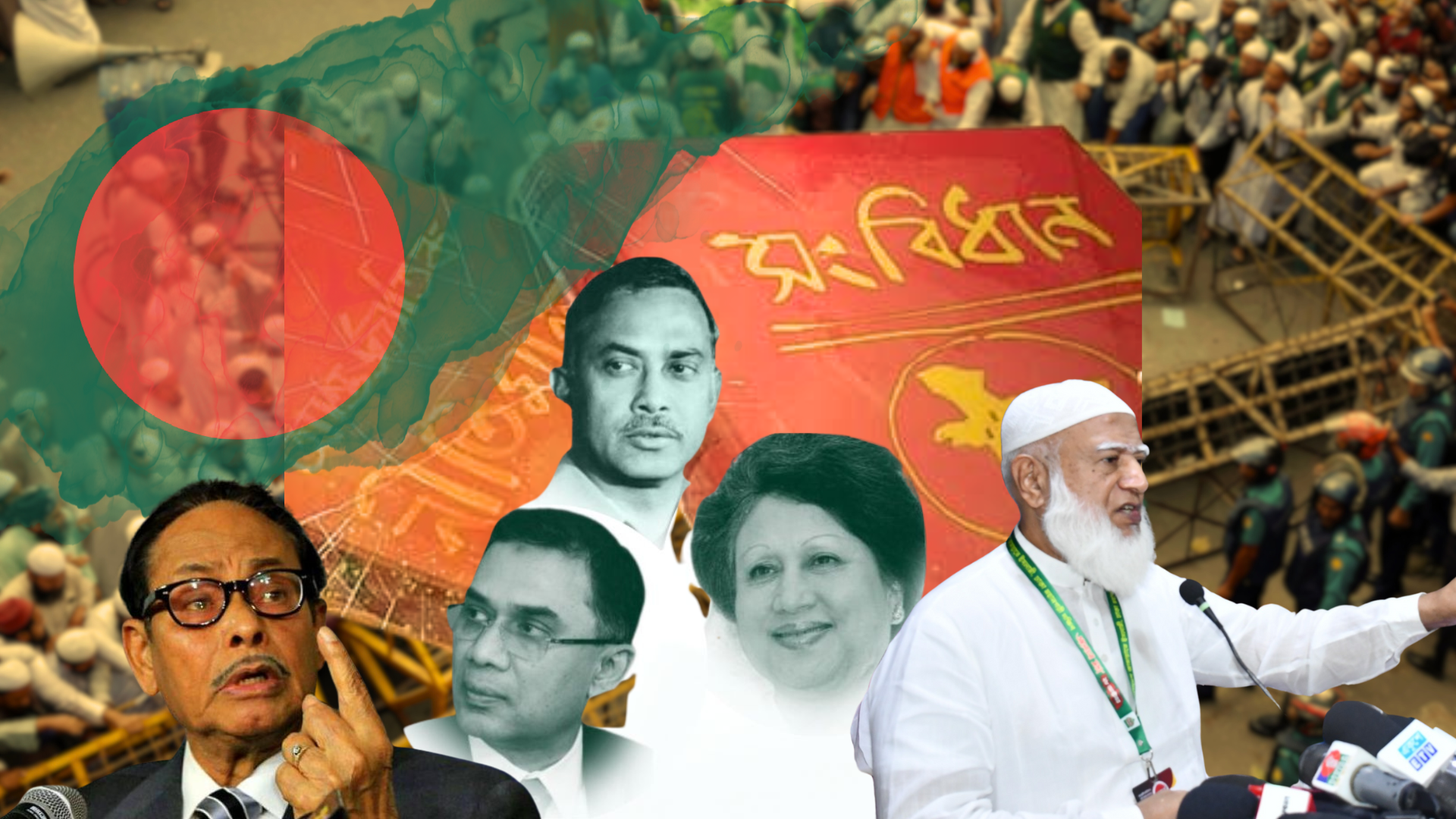
The 13th National Parliamentary Election in Bangladesh is due within 18 days. Getting a green signal from the Election Commission, major political parties have begun campaigning for the upcoming election. What has stood out is the use of Islamic terminology and ideas by political leaders while making pledges to the people. While Tarique Rahman, leader of Bangladesh Nationalist Party (BNP), asked his supporters to pray both Tahajjud and Fajr prayers outside polling booths on the day of the election, Jamaat-e-Islami Ameer Shafiqur Rahman promised to the crowd that Bangladesh will be run according to the Madina Charter if they are elected to power. Such an Islamic touch to Bangladeshi politics, which has been known as liberal and secular for a long time, should not be seen as a surprise. Bangladeshi politics has been going through a process of Islamisation since the beginning of its history, and what’s new is that a genie has come out of the bottle, ready to take everything.
The Beginning of Islamisation
Right after gaining independence from Pakistan in 1971, the first Bangladesh government led by Sheikh Mujibur Rahman appeared anti-Islamist at first, incorporating secularism and socialism in the 1972 constitution and banning all types of Islamist politics in the country, due to the existing influence of India and Russia, two countries whose support helped Bangladesh to emerge as an independent state.
However, the balance was tilted soon, and Mujib began the Islamisation process by trying to forge an amicable relationship with the Muslim world. Mujib forgave the 195 war criminals held by India and let them return to Pakistan, invited Pakistan’s prime minister Zulfikar Ali Bhutto to Bangladesh, and finally joined the Organization for Islamic Cooperation (OIC) meeting in 1974. With these steps, Bangladesh began to come out of the clutch of secularism and socialism and inched closer to Islam.
Cementing Islamic Ideals
The Islamisation process of Bangladeshi politics continued after the killing of Sheikh Mujibur Rahman in 1975. Ziaur Rahman, a freedom fighter and an army officer, arose as the new leader after multiple dramatic turns of events, and although he first began as a military ruler, he soon turned to democracy and initiated multi-party politics in the country. Zia formed the Bangladesh Nationalist Party (BNP) and was elected in 1978, forming a government in the process. The first thing that he did was lifting the ban on Islamist politics, letting all the Islamist parties to join his government. Later, he included “Bismillahir Rahmanir Rahim” and “Absolute Trust in Allah” in the constitution through an amendment, discarding secularism and socialism from the constitution. During Zia’s time, oil-rich middle eastern countries lent their hands to Bangladesh, resulting in investment, aid and grants, which opened the country to the world. Bangladesh, which was long seen as a cluster of India and under the shadow of anti-Islamic ideals like secularism, finally emerged to the world as one of the largest Muslim countries.
Using Islam for Political Gains
After Ziaur Rahman was killed in 1981, another military officer, Hussain Muhammad Ershad, assumed state power, first as a military ruler and later becoming president through a sham election. Ershad moved one step further towards Islamisation of the country’s politics, by incorporating Islam the state religion in the constitution through an amendment in 1988. According to political analysts, Ershad did this to gain people’s support and sympathy, as his era was marked as unconstitutional and repressive, which ended through a mass uprising in 1990, putting an end to the era of military rule for the time being.
Outcome of Islamisation
The outcome of the Islamisation process that Bangladeshi politics went through under Mujib, Zia and Ershad became evident during the second term of BNP, this time led by Khaleda Zia, the widow of Ziaur Rahman. Extremist groups like Jamaatul Mujahideen Bangladesh (JMB) and Huji-B came to the public and made demonstrations through simultaneous bomb attacks in various parts of the country. Another development was the rise of Bangladesh Jamaat-e-Islami, the Islamist political party which won 17 seats in the 2001 election and its two leaders became ministers, which was appalling given the stigma with which the party is still infested, which is the allegation that Jamaat opposed the Liberation War of Bangladesh in 1971 and helped the Pakistan army in carrying out war crimes.
During the second term of BNP, Islam found both political and violent footing in Bangladesh, which helped Awami League, the party which was sent to the backburner in 1975 through Mujib’s killing, to gain landslide victory in the 2008 election and establish the most heinous and brutal regime that Bangladesh has ever seen, only to be overthrown again.
War Against Islamisation
Although Sheikh Hasina did not remove Islam as the state religion from the constitution, she restored secularism as a state principle through an amendment in 2011, trying to go back to the legacy that her father, Sheikh Mujib, had begun.
Hasina’s war against Islamisation began with the indictment of top leaders of Jamaat-e-Islami on charges of crimes against humanity committed during the 1971 war. Almost the entire top leadership of Jamaat were either hanged or died in prison, leaving the party shattered. With this, Hasina had hoped that she would be able to kill the potential of the largest Islamist party of Bangladesh, only to be fooled later.
Another frontline of Hasina’s war against Islamist politics was the repression on Hefazat-e-Islam, an Islamist outfit formed by Qawmi madrasa-based members, after they gathered in the Motijheel area of the capital seeking punishment for the writers who had insulted Prophet Muhammad and Islam on the internet in 2013. Following Hasina’s command, the law enforcers attacked the unarmed religious members at the dead of the night, killing at least a dozen of them. This was the most brutal attack on the Islamist forces in Bangladesh so far.
However, as the Shahbagh movement died out following the passing of top Jamaat leaders, Hasina took another tactic. While keeping her secular friends by the side, she tried to patch up with the Hefazat leadership, trying to tap on the people who follow Qawmi-based Islamic scholars and their rulings by heart and constitute such a large number that they hold the potential to change the outcome of the result of any election. Hasina tried to lure Hefazat by giving their top educational tier the same recognition as a master’s, and Hefazat leaders were so fooled by the offer that they even called Hasina the “Mother of Qawmi”, the same woman who had ordered the attack on them a few years before.
Resurgence of Islamist Politics
After ruling Bangladesh with an iron-fist for 15 years, Sheikh Hasina was finally ousted and forced to flee to India through a student uprising in August, 2024. An interim government soon took over state affairs under the leadership of Nobel laureate Muhammad Yunus. Right after taking over the mantle, the interim government withdrew all the cases against Jamaat-e-Islami leaders and activists, and also lifted the ban on their political activity, giving Jamaat a fresh start to initiate Islamist politics in Bangladesh once again.
Fast forward to 2026, and we are witnessing the fruit that this clemency has borne. Throughout Hasina’s time, Jamaat couldn’t operate overtly, but their covert operation continued, gaining strength for future needs. They regrouped, organised, and waited for the right moment. And that moment has finally come.
Although the 2024 Uprising was a movement where students and people from all backgrounds had participated, the biggest winner to come out of this event was Jamaat. In the past, Jamaat had only 5% to 10% vote bank in the country. But now, they are seen as the second biggest political party of Bangladesh, challenging the foothold of BNP, led by another apt leader, Tarique Rahman, son of late president Ziaur Rahman and late prime minister Khaleda Zia.
In 2024, the Bangladeshi people had decided to get rid of the Mujib dynasty, and overthrew Sheikh Hasina from power. A new election is coming, and if the people of Bangladesh decide to get rid of the Zia dynasty and initiate the birth of a new political reality through electing Jamaat to power, then the Islamisation of Bangladeshi politics will come full circle.
All eyes are on the 12 February Bangladesh election now.
Muhammad A. Bashed is a Dhaka-based journalist. He can be reached at: bashed.muhammad@gmail.com
