

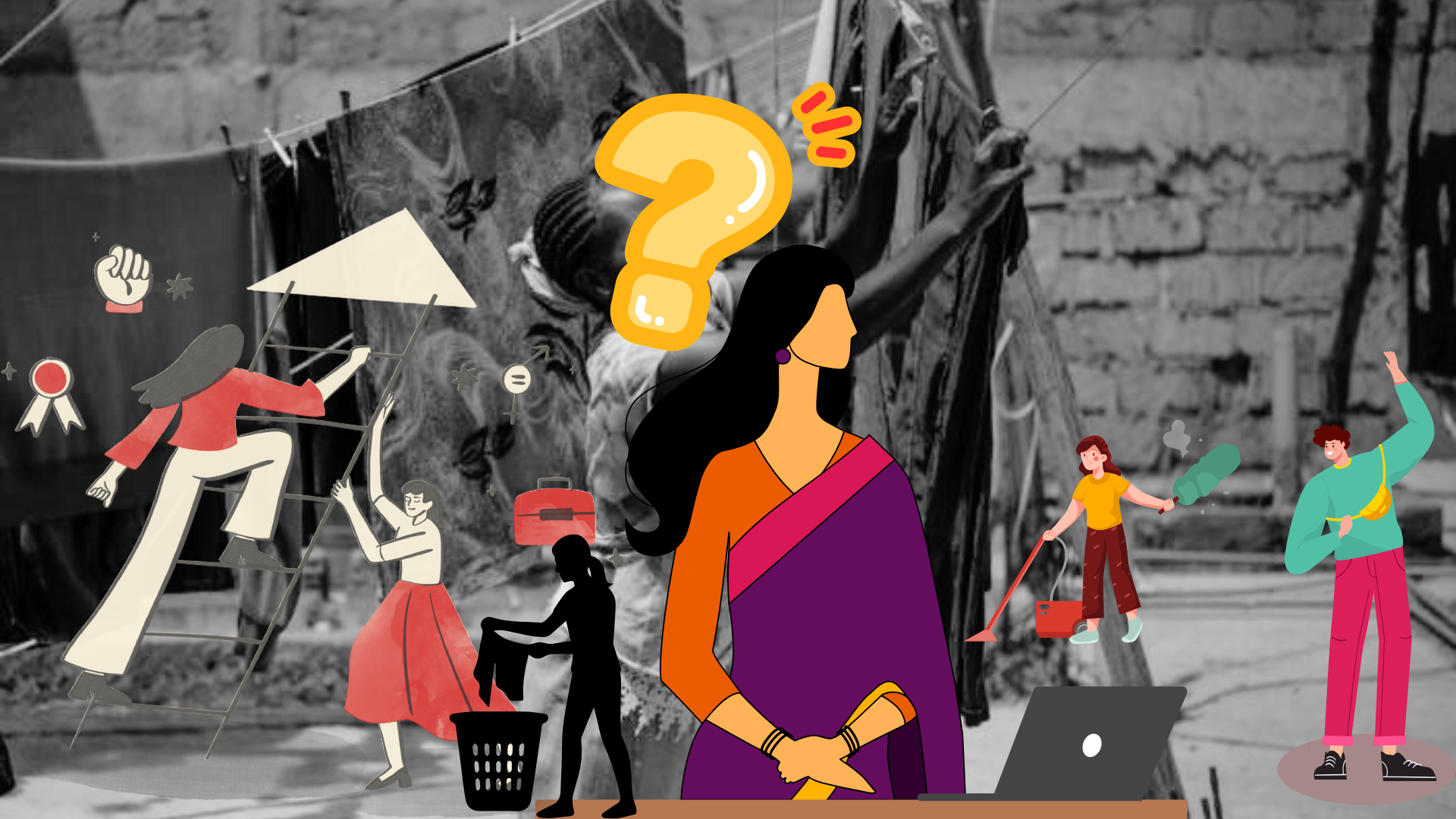
Consider Roksana. She is thirty-one years old, lives in a two-room tin-roofed house in Gazipur, and until two years ago she was a quality-control checker at a readymade garment (RMG) factory on the Dhaka-Mymensingh highway. She could sew faster than most of her line, she had never missed a production target, and she earned Tk 9,500 a month – not wealth, but enough to buy her daughter new shoes before Eid. Then her mother-in-law’s diabetes worsened and her second child arrived in the same season, and suddenly Roksana’s labor was needed somewhere else: at home, unpaid, around the clock. Her supervisor found a replacement within the week. The factory kept running. Roksana did too, she ran back and forth from her newborn’s crib to the kitchen.
Roksana’s story is not exceptional. Her story is repeated countless times in studies, only to end up as statistics on a piece of paper. According to the Bangladesh Bureau of Statistics, female labor force participation sits at approximately 36 percent- a figure that has stubbornly stalled despite decades of export-led growth and development rhetoric [(BBS), 2022]. The standard economic explanation is that women simply ‘choose’ domesticity, or that structural barriers like transportation and workplace harassment keep them out of formal employment. Both are partially true, both are incomplete. What is missing from these accounts is a class analysis of the unpaid labor that absorbs women the moment the market no longer needs them or the moment their families do. This essay argues, drawing on Marxist-feminist theory and empirical data from Bangladesh’s labor landscape, that the patriarchal family unit functions as a mechanism of capitalist surplus extraction, conscripting women’s reproductive labor as an unpaid subsidy to capital while simultaneously disciplining their access to wage work. The ‘care drain’, this structural hemorrhage of women’s productive capacity from the formal economy into the invisible economy of the household, is not a cultural residue waiting to be swept away by modernity. It is a feature, not a bug, of Bangladesh’s integration into global capitalism.
I. Reproducing capital: The marxist-feminist framework
Marx understood labor-power as a commodity, but he was largely silent on how that commodity is reproduced each day: the cooking, bathing, nursing, and emotional care that sends workers back to the factory gates refreshed and exploitable. It was socialist feminists of the 1970s, particularly Silvia Federici and Maria Mies, who forced this silence open. Federici’s foundational argument in Caliban and the Witch (1998) is that the transition to capitalism required the violent enclosure not only of land but also of women’s bodies, transforming housework into a ‘natural’
feminine attribute rather than recognizing it as the productive labor it unmistakably is [Federici, 1998]. Capital, she argued, depends on a hidden subsidy: the free appropriation of reproductive labor, primarily performed by women, which replenishes the workforce at no cost to employers.
Maria Mies extended this analysis to the Global South in Patriarchy and Accumulation on a World Scale (1986), arguing that women in postcolonial economies occupy a structurally analogous position to colonized peoples, with their labor incorporated into accumulation processes precisely by being defined as outside ‘the economy’ altogether [Mies, 1986]. In Bangladesh’s context, this framework translates with uncomfortable precision. The RMG sector that accounts for over 84 percent of the country’s export earnings and employs roughly 4 million workers, approximately 60 percent of them women, is built on a wage structure that presupposes female workers will return home to be reproduced by female relatives [World Bank, 2020; BGMEA, 2023]. The young, single, dormitory-housed garment worker is capital’s ideal subject: maximally exploitable precisely because her care costs are externalized onto a family network back in the village.
More recently, the concept of social reproduction theory (SRT), elaborated by Tithi Bhattacharya in Social Reproduction Theory: Remapping Class, Recentering Oppression (2017), has refined this argument. Bhattacharya insists that life-making activities such as childbearing, eldercare, cooking, emotional sustenance are not merely parallel to capitalist production but are its necessary condition [Bhattacharya, 2017]. From this vantage point, the question is not why women are absent from the Bangladeshi formal economy, but how the economy manages to extract so much from them while paying for so little.
II. The architecture of the care drain in Bangladesh
The statistics are stark but require interpretation beyond their surface. Bangladesh’s female labor force participation rate of 36.3 percent (2022) conceals enormous internal variation: it is highest among young, unmarried women in urban manufacturing, and collapses sharply after marriage and the birth of a first child [BBS, 2022]. A study by the International Labour Organization found that 79 percent of women who exit formal employment in Bangladesh cite “family responsibilities” as the primary reason. A category that, disaggregated, means childcare (47%), eldercare (21%), and spousal prohibition (11%) [ILO, 2020]. These are not individual choices made in a vacuum. They are the predictable outputs of a system in which the state provides virtually no public childcare infrastructure, in which the joint family system concentrates care responsibilities in daughters-in-law, and in which wages remain too low to commodify care even when women want to.
The demographic architecture of care work in Bangladesh follows a recognizable Marxist-feminist logic. According to the 2022 Time Use Survey conducted by BBS, women in Bangladesh perform an average of 5.3 hours of unpaid domestic work per day, compared to 1.2 hours for men [BBS, 2022]. This gap of 4.1 hours daily represents an enormous transfer of value from women to households, and from households to capital. If one applies the ILO’s suggested replacement cost methodology (using the market wage for equivalent care services), unpaid care work in Bangladesh amounts to approximately 28 percent of GDP, with women performing roughly 89 percent of it [ILO, 2018], this is not a peripheral footnote to Bangladesh’s development story. It is the infrastructure upon which that story runs.
The spatial dimensions of this care drain follow class lines in revealing ways. In Dhaka’s garment districts, young women from Sylhet, Rangpur, and Barisal are recruited into factory work in their teens and early twenties, years when their care obligations are minimal and their bodies are at peak productivity. The industry’s notorious preference for young, unmarried workers is not accidental. As Naila Kabeer observed in her landmark study of Dhaka’s garment industry, factory owners explicitly prefer women who are ‘unencumbered’ by domestic responsibilities [Kabeer, 2000]. The factory absorbs their labor; when care obligations accumulate, the family absorbs it back. The market externalizes the cost of aging, pregnancy, and dependents onto the patriarchal household, which in turn externalizes it onto women.
III. The joint family system as a labor-discipline mechanism
The Bangladeshi joint family system is typically discussed in cultural or anthropological terms, as a kinship arrangement rooted in South Asian tradition. But read through Mies’s lens of “housewifization,” the joint family appears as something more structurally significant: a privatized welfare state that disciplines women’s labor through normative obligation, extracting unpaid work under the ideological cover of devotion, duty, love and feminine virtue [Mies, 1986].
The institution is explicitly hierarchical. The daughter-in-law occupies the lowest position in the household’s care-labor hierarchy and is typically responsible for the most physically demanding domestic tasks: cooking for extended family, managing household water and fuel, and providing primary care for children and elderly family members. A study by BRAC’s Institute of Governance and Development found that in rural Bangladesh, daughters-in-law contribute an average of 6.2 hours of domestic labor daily, rising to 8.4 hours during periods of family illness or newborn care [BRAC IGD, 2019]. This is not freely given. It is labor extracted under the threat of social sanction, the withholding of respect and marital security.
What makes this mechanism specifically capitalist rather than merely patriarchal is its articulation with the wage labor market. When RMG factories in Bangladesh slashed their female workforce during the COVID-19 pandemic, laying off an estimated 350,000 garment workers, 72 percent of them women, there was no public outcry, no unemployment infrastructure to speak of, because the patriarchal household was presumed to absorb the shock [Centre for Policy Dialogue, 2020]. The family was the social safety net. And as always, women paid for it. This dynamic confirms what Lise Vogel theorized in Marxism and the Oppression of Women (1983): that women’s oppression is not incidental to capitalism but is structurally reproduced through the separation of ‘necessary labor’ (wage work) from ‘surplus labor’ at the household level, a separation that naturalizes women’s domestic role by rendering it economically invisible [Vogel, 1983].
IV. The state’s role: absent infrastructure, present ideology
No account of the care drain in Bangladesh is complete without examining the state’s active role in sustaining it. Bangladesh has made internationally celebrated gains in girls’ education and maternal health. Yet its investment in public care infrastructure remains startlingly inadequate. As of 2022, Bangladesh had fewer than 3,000 registered childcare centers for a working-age female population of approximately 28 million, with the vast majority concentrated in Dhaka and
Chittagong [UNICEF Bangladesh, 2022]. In the rural areas where 62 percent of Bangladesh’s population lives, public childcare is functionally nonexistent [World Bank, 2021].
This absence is not neutral. It is, in effect, a policy choice that delegates the cost of social reproduction to families, which is to say, to women. As Diane Elson argued in her work on gender and macroeconomics, state austerity does not eliminate care needs; it simply transfers them from the public sector to the unpaid female body [Elson, 1998]. Bangladesh’s commitment to export-led growth and foreign direct investment has been accompanied by persistent underfunding of the social services that would allow women to sustain formal employment through the life course. The result is an economy that is structurally dependent on women’s labor at two levels simultaneously: their cheap wage labor in garments, and their free care labor at home. Capital collects at both ends.
Ideological reproduction plays an equally important role. The dominant discourse of the “good woman” in Bangladesh – pious, self-sacrificing, domestic – is not a relic of pre-capitalist tradition. It is actively reproduced through state institutions, religious authority, and media in ways that legitimate the extraction of care labor. As Dina Siddiqui has argued, development NGOs have themselves participated in this ideological work, framing women’s empowerment primarily through micro-credit and export labor while leaving the patriarchal household and the care work it demands fundamentally unchallenged [Siddiqui, 2009]. Women are empowered enough to work in factories; they are not empowered enough to stop doing the unpaid work that makes the factory possible.
This ideological project has found its most recent and politically explicit expression in a proposal by Bangladesh Jamaat-e-Islami (JI) ameer Dr. Shafiqur Rahman, who announced in October 2025 – first at a diaspora event in New York, then at a follow-up event in Dhaka – that a Jamaat-led government would reduce women’s official working hours from eight to five per day, framed as an act of “honouring mothers” [Prothom Alo, 2025]. The proposal, formally incorporated into Jamaat’s election manifesto, nominally offered to compensate the three-hour shortfall through a combination of employer and state subsidy. It was condemned swiftly and widely: labor advisers dismissed it as a political slogan, feminist commentators identified it as a manoeuvre to reorient women toward the home, and rival political parties including the BNP attacked it as unimplementable [The Business Standard, 2025]. The economic mechanism of harm is not subtle. In a private sector structured around full-time eight-hour shifts and already operating on thin margins – particularly in the RMG industry – mandating a differential, shorter working day exclusively for female employees would make women measurably more expensive and operationally inconvenient to retain, providing rational cover for employers to quietly preference male workers in hiring, promotion, and retention decisions [BDDigest, 2025]. The proposal does not need to be implemented as written to cause harm; its very existence normalizes the idea that women’s primary obligation is reproductive labor, and that their wage labor is supplementary, contingent, and available for curtailment. The BBS’ own estimates already show that unpaid domestic work overwhelmingly performed by women is equivalent to 18.9 percent of GDP, with women contributing 85 percent of this invisible output [BBS and UN Women, 2021]. A policy that structurally pushes women out of formal employment deepens the load. Understood through a Marxist-feminist lens, the Jamaat proposal is not electoral noise. It is an ideological state apparatus functioning in textbook form [Althusser, 1971]: a political program that naturalizes women’s relegation to unwaged reproductive labor, wraps it in the language of maternal dignity and Islamic welfare, and delivers to capital a workforce further sorted and
cheapened by gender. The care drain, in this reading, isn’t just a structural consequence of existing economic arrangements. It is also an active political project with electoral mandates and religious legitimation behind it.
V. Toward a political economy of care justice
The care drain is not inevitable. Its particular form in Bangladesh – high female entry into wage labor, sharp exit at marriage and childbirth, near-total absence of public care infrastructure, normative concentration of domestic work in daughters-in-law – is the product of specific historical and political choices. It can, in principle, be unmade.
The Marxist-feminist tradition points to several structural demands. First, the recognition and redistribution of care work, what Nancy Fraser calls the “universal caregiver” model, in which care responsibilities are shared across gender and supported by public infrastructure requires, at minimum, a publicly funded national childcare program, paid parental leave that is genuinely available to men, and formal recognition of unpaid domestic labor in national accounting systems [Fraser, 1997]. Second, and more radically, it requires challenging the ideological separation between productive and reproductive labor, dismantling the fiction that the household is a space of love rather than labor, and demanding that the social value of care be reflected in wages, social insurance, and political representation.
These demands have begun to find organizational expression. The Bangladesh Garment Workers Solidarity movement and several independent trade unions affiliated with IndustriALL Global Union have begun, cautiously, to link wage demands with demands for workplace childcare facilities and paid menstrual and maternity leave [IndustriALL, 2022]. These are embryonic, but they are significant: they mark the beginning of a political consciousness that refuses to treat care as a private problem and insists on naming it as a labor question.
Conclusion
Roksana did not leave her factory job because she was weak, or irrational, or insufficiently committed to economic independence. She left because a system built on her double exploitation, as a wage worker and as an unpaid care worker, finally called in its second debt. Her departure was not a personal failure. It was a structural inevitability, written into the architecture of Bangladesh’s political economy long before she was born.
The care drain describes the systematic hemorrhage of women’s productive capacity from the formal economy into the unpaid household, a process driven not by culture alone but by the conscious and unconscious collusion of capital, state, and patriarchal family structures in externalizing the costs of social reproduction onto women’s bodies and time. Understood through the Marxist-feminist tradition from Federici’s historical materialism to Bhattacharya’s social reproduction theory, this process is not peripheral to Bangladesh’s development story. It is, in a very real sense, what makes that story possible.
The question that opened this essay – what does it cost a woman to keep a family alive? – turns out to have a precise, if devastating, answer. It costs her time, her wages, her career trajectory, and frequently her participation in the public life of her society. Until that cost is redistributed through public investment in care infrastructure, through the reorganization of domestic labor
across gender, and through the political recognition that reproductive work is work, Bangladesh’s celebrated development gains will remain built on a foundation that is, at its core, extracted from women.
Bibliography
Bangladesh Bureau of Statistics (BBS). (2022). Labour Force Survey Bangladesh 2022. Bangladesh Bureau of Statistics, Ministry of Planning.
BBS. (2022). Time Use Survey of Bangladesh 2021–2022. Bangladesh Bureau of Statistics, Ministry of Planning.
Bangladesh Garment Manufacturers and Exporters Association (BGMEA). (2023). Annual Report 2022–2023. BGMEA.
Bhattacharya, T. (Ed.). (2017). Social Reproduction Theory: Remapping Class, Recentering Oppression. Pluto Press.
BRAC Institute of Governance and Development (IGD). (2019). Women’s Time Poverty and Unpaid Care Work in Rural Bangladesh. BRAC University.
Centre for Policy Dialogue (CPD). (2020). COVID-19 and the Ready-Made Garment Sector in Bangladesh: A Gender Perspective. CPD.
Elson, D. (1998). The economic, the political and the domestic: Businesses, states and households in the organisation of production. New Political Economy, 3(2), 189–208.
Federici, S. (1998). Caliban and the Witch: Women, the Body and Primitive Accumulation. Autonomedia.
Fraser, N. (1997). After the family wage: A postindustrial thought experiment. In Justice Interruptus: Critical Reflections on the ‘Postsocialist’ Condition (pp. 41–68). Routledge.
IndustriALL Global Union. (2022). Bargaining for Gender Equality in the Bangladesh Garment Sector: Progress Report. IndustriALL.
International Labour Organization (ILO). (2018). Care Work and Care Jobs for the Future of Decent Work. ILO.
ILO. (2020). Women in the Bangladesh Labour Market: Trends, Challenges and Policy Directions. ILO Bangladesh Country Office.
Kabeer, N. (2000). The Power to Choose: Bangladeshi Women and Labour Market Decisions in London and Dhaka. Verso.
Mies, M. (1986). Patriarchy and Accumulation on a World Scale: Women in the International Division of Labour. Zed Books.
Siddiqui, D. M. (2009). Do Bangladeshi factory workers need saving? Sisterhood in the post-sweatshop era. Feminist Review, 91(1), 154–174.
UNICEF Bangladesh. (2022). Early Childhood Care and Education: Country Programme Document 2022–2026. UNICEF.
Vogel, L. (1983). Marxism and the Oppression of Women: Toward a Unitary Theory. Rutgers University Press.
World Bank. (2020). Bangladesh: Female Labor Force Participation. World Bank Open Data.
World Bank. (2021). Rural Population (% of Total Population) — Bangladesh. World Bank Open Data.
Althusser, L. (1971). Ideology and ideological state apparatuses. In Lenin and Philosophy and Other Essays. New York: Monthly Review Press. pp. 127–186.
BDDigest (2025, November 19). Five-hour work chain: Jamaat’s proposal a blueprint to drive women out of the workforce. BDDigest English. https://en.bddigest.com/28981-2/
Prothom Alo (2025, February). Manifesto unveiled: Women’s working hours will be reduced: Jamaat ameer. Prothom Alo English. https://en.prothomalo.com/bangladesh/politics/zbivapu68w
The Business Standard (2025, December 8). Jamaat’s pledge to cut women’s work-hour is nothing but ‘political slogan’: Labour adviser. TBS News.
Fatema Biswas , University of Rajshahi
