

Education is often perceived as a neutral process through which knowledge is transmitted from one generation to the next. In reality, however, educational materials are embedded within social and ideological structures. Textbooks do not merely communicate facts; they construct social meanings, shape identities, and subtly reinforce cultural expectations. One of the earliest lessons children learn about society may not come from a teacher’s lecture or a family conversation; it comes from the pages of a textbook. A child reading a lesson about a doctor saving life, a farmer cultivating land, or a parent caring for a family gradually forms mental images of who performs these roles in society. If the doctor is consistently male and the caregiver consistently female or a male CEO and female subordinates, these representations quietly shape the child’s understanding of gender and power. In this way, textbooks do far more than teach language or history-they shape social imagination, they shape young people’s perceptions of society, identity, and gender.
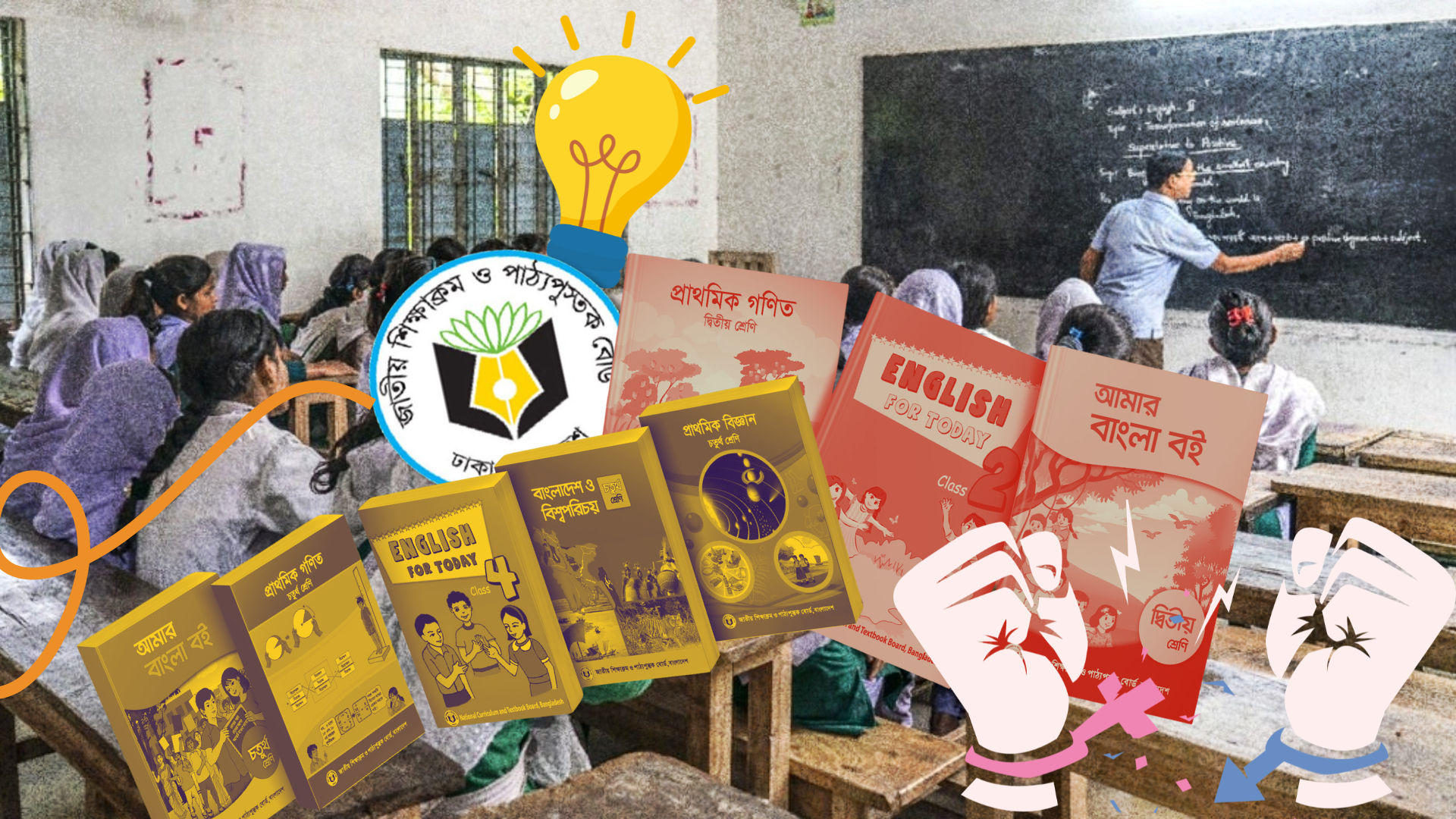
In Bangladesh, textbooks produced by the National Curriculum and Textbook Board (NCTB) constitute the primary learning materials for millions of students across the country. These texts are therefore not merely pedagogical tools but influential cultural artifacts. The narratives, examples, and linguistic structures embedded within them participate in the broader process through which social norms are reproduced. A closer examination of these materials reveals that gender representation within Bangladeshi textbooks remains uneven and, in several instances, reflects traditional stereotypes. More significantly, beyond the imbalance between male and female representation lies a deeper structural issue: the near-complete absence of the Hijra community, officially recognized as the third gender in Bangladesh.
The study of language and representation has long demonstrated that discourse is never neutral. According to the framework of critical discourse analysis developed by Norman Fairclough, language functions as a site where social power and ideology are produced and reproduced. The words used in educational materials, the roles assigned to characters, and the narratives that frame social interactions all contribute to shaping how individuals perceive the social world. When particular identities appear repeatedly in positions of authority while others remain marginal or invisible, these patterns gradually become normalized. To be precise, when textbooks repeatedly portray men and women in particular roles, these representations become normalized within students’ cognitive frameworks. Over time, such patterns contribute to the reproduction of social expectations about masculinity, femininity, and authority.
A systematic analysis of NCTB textbooks reveals that male characters appear more frequently than female characters in narratives, dialogues, and illustrative examples. Men are typically associated with professions such as doctors, engineers, scientists, politicians, or community leaders. Women, by contrast, appear more commonly in domestic settings or in supportive roles.
Although the reality of gender depiction in textbooks has been changing in recent times, the changes seem inadequate. While female characters do appear in educational narratives, their presence often lacks the agency and diversity afforded to male characters, to be specific, their agency is frequently limited to supportive or secondary roles.
These patterns are rarely overt (not always explicit) Instead, they emerge through subtle linguistic choices. Occupational examples often feature male pronouns, while female characters appear primarily in contexts involving caregiving or household responsibilities. Even seemingly neutral exercises-such as reading passages or sentence examples-can reinforce gendered assumptions about who performs particular tasks in society. Generic pronouns, occupational examples, and narrative framing often privilege male characters as active participants in society. Girls and women, meanwhile, appear less frequently in contexts involving decision-making, innovation, or leadership.
Such representational patterns are significant because they shape the cognitive frameworks through which children or teens interpret social roles. Educational sociologists have long argued that schooling plays a crucial role in the process of socialization. Through repeated exposure to particular narratives, students gradually internalize cultural expectations about gender, authority, and social participation. When textbooks consistently depict men as decision-makers and women as supporters, these representations contribute to the reproduction of gender hierarchies within society. And simply, the mere absence of Hijra Community in textbooks is something policymakers should really be concerned about as the vulnerability is more than real in the socio-cultural context of Bangladesh corresponding to their living standard or daily life.
Closer examination of individual lessons further illustrates how gendered representations are embedded within everyday textbook narratives. IFor example, reading passages often describe fathers working outside the home while mothers are portrayed managing household responsibilities or caring for children. Similarly, occupational examples used in grammar exercises disproportionately feature male figures in positions requiring authority or expertise. These seemingly minor narrative patterns collectively reinforce an implicit hierarchy in which public leadership and professional competence appear as masculine attributes, while caregiving and domestic labor are framed as feminine responsibilities. Such representations may appear ordinary, yet their repetition across grade levels contributes to a powerful cultural narrative about gender roles.
Empirical analysis reinforces these observations. A linguistic examination of NCTB textbooks conducted by the writer identified a noticeable imbalance in gender representation within narratives, examples, and illustrative contexts. Male characters appeared significantly more frequently in occupational roles associated with authority and expertise, whereas female characters were often depicted within familial or supportive contexts. Moreover, the study found little evidence of representation for gender-diverse identities, including the Hijra community. These findings suggest that the discourse of educational materials continues to operate largely within a traditional gender binary, despite broader societal changes that increasingly acknowledge gender diversity.
The implications of these representations extend beyond symbolic concerns. Research across multiple contexts suggests that representation within educational materials influences students’ aspirations and self-perception. Girls who rarely encounter female figures in leadership or scientific roles may find it more difficult to imagine themselves in such positions. Similarly, boys who repeatedly encounter narratives emphasizing male authority may internalize assumptions about gendered entitlement to leadership.
Yet the issue of representation within Bangladeshi textbooks extends beyond the imbalance between male and female characters. One of the most striking aspects of the curriculum is the near absence of the Hijra community. Despite the official recognition of Hijras as a third gender by the government in 2013, educational texts continue to operate almost exclusively within a binary framework of male and female identities.
From the perspective of discourse theory, absence can be as meaningful as presence. When certain identities are consistently excluded from representation, this silence communicates powerful social messages. As feminist discourse analyst Sara Mills argues, discourse not only shapes how identities are represented but also determines which identities are deemed worthy of recognition. In this sense, the absence of gender-diverse identities in textbooks reflects a broader pattern of symbolic marginalization.
For members of the Hijra community, such invisibility reinforces longstanding social exclusion. Without representation in educational narratives, Hijra individuals remain outside the symbolic framework through which young citizens understand society. For students who do not belong to
the community, the absence contributes to ignorance and stigma, making it more difficult to challenge stereotypes that persist in public discourse. And in Bangladesh, the education for the Hijra community seems somewhat difficult due to social constraints.
This contradiction is particularly striking when considered in relation to Bangladesh’s evolving policy landscape. The recognition of the third gender represented a significant step toward acknowledging gender diversity within the legal framework of the state. However, when educational materials fail to reflect this recognition, a gap emerges between official policy and everyday pedagogy.
Gender theorists have long argued that gender identities are not simply biological realities but are constructed and maintained through social discourse. The work of Judith Butler, for instance, emphasizes that gender is performed and reinforced through repeated social practices. Educational institutions play a central role in this process because they provide some of the earliest structured narratives through which children interpret social identities. If textbooks continue to reproduce rigid gender binaries, they risk reinforcing outdated assumptions even within a society that is gradually recognizing greater diversity.
The challenge of gender representation in textbooks is not unique to Bangladesh. Studies conducted across different countries have documented similar patterns of imbalance and stereotyping within educational materials. Historically, curriculum development has focused primarily on academic content while paying less attention to the symbolic implications of
representation. However, contemporary educational research increasingly recognizes that inclusive narratives are essential for fostering equitable societies.
Addressing these challenges requires both analytical awareness and institutional reform. One of the most effective steps would be the introduction of systematic gender audits during the textbook development process. Such audits would examine the frequency of male and female representation, the diversity of roles assigned to characters, and the presence—or absence—of gender-diverse identities.
Curriculum designers could also adopt gender-inclusive language guidelines to ensure balanced representation in examples, dialogues, and illustrations. Even relatively minor adjustments-such as depicting women in leadership positions comparatively more or equal in number or portraying men participating in caregiving roles-can significantly reshape the symbolic environment of educational materials.
More importantly, educational texts should begin to acknowledge the existence and experiences of gender-diverse communities within Bangladesh. Representation does not require extensive curricular restructuring; even limited inclusion through social studies discussions, narratives, or contextual examples could help students develop a more nuanced understanding of gender diversity.
Teacher training represents another crucial dimension of reform. Educators who are aware of issues related to gender representation can encourage students to engage critically with the materials they read. Rather than accepting textbook narratives as unquestionable truths, students can learn to analyze how language shapes social perceptions.
Such critical engagement is particularly important in a world where young people encounter diverse perspectives through digital media and global communication. Education should equip students not only with knowledge but also with the ability to question and interpret the narratives that shape their understanding of society.
Ultimately, the purpose of education extends beyond the transmission of information. It involves cultivating the intellectual and ethical capacities necessary for participation in a democratic and inclusive society. Textbooks play a foundational role in shaping how future citizens imagine their communities and their own potential within them.
International Women’s Day provides an opportunity to reflect on the progress that has been made toward gender equality as well as the challenges that remain. Bangladesh has achieved remarkable advancements in areas such as female education, female participation in political
leadership paradigm, and economic participation. Yet structural inequalities and social stereotypes continue to shape everyday experiences.
Educational discourse must evolve alongside these social transformations. If textbooks continue to reflect outdated gender norms, they risk undermining the very progress that national policies seek to achieve. Conversely, inclusive representation can inspire students to imagine a society where opportunities are not constrained by gendered expectations.
The stories children encounter in their textbooks today will influence the society they build tomorrow. By ensuring balanced and inclusive representation within educational materials, Bangladesh has the opportunity to nurture a generation that values equality, diversity, and shared human dignity.
The pages of a textbook may appear ordinary, yet they quietly shape how a nation imagines itself. When educational narratives limit women to supporting roles and erase gender-diverse identities entirely, they do more than misrepresent reality- they narrow the horizons of possibility for the next generation. Bangladesh has demonstrated remarkable progress in expanding opportunities for women and recognizing gender diversity within public policy. The challenge now lies in ensuring that educational discourse reflects these achievements. Textbooks must evolve from merely reflecting inherited social norms to actively encouraging a more inclusive vision of society. When young students encounter stories that portray women, men, and gender diverse individuals as equal participants in social life, they begin to imagine a world defined not by hierarchy but by shared human potential. In this sense, transforming the language of education is not simply an academic exercise; it is an investment in the moral and intellectual future of the nation.
References
• Butler, J. (1990). Gender Trouble: Feminism and the Subversion of Identity. Routledge.
• Fairclough, N. (1995). Critical Discourse Analysis: The Critical Study of Language.
• Longman. Mills, S. (1997). Discourse. Routledge.
• Sakib, N. M. (2017). Gender Analysis of NCTB Textbooks Corresponding to the Usage of Language. Institute of Modern Languages, University of Dhaka.
Niaz Mahmud Sakib, Senior Lecturer at the University of
Brahmanbaria.
