

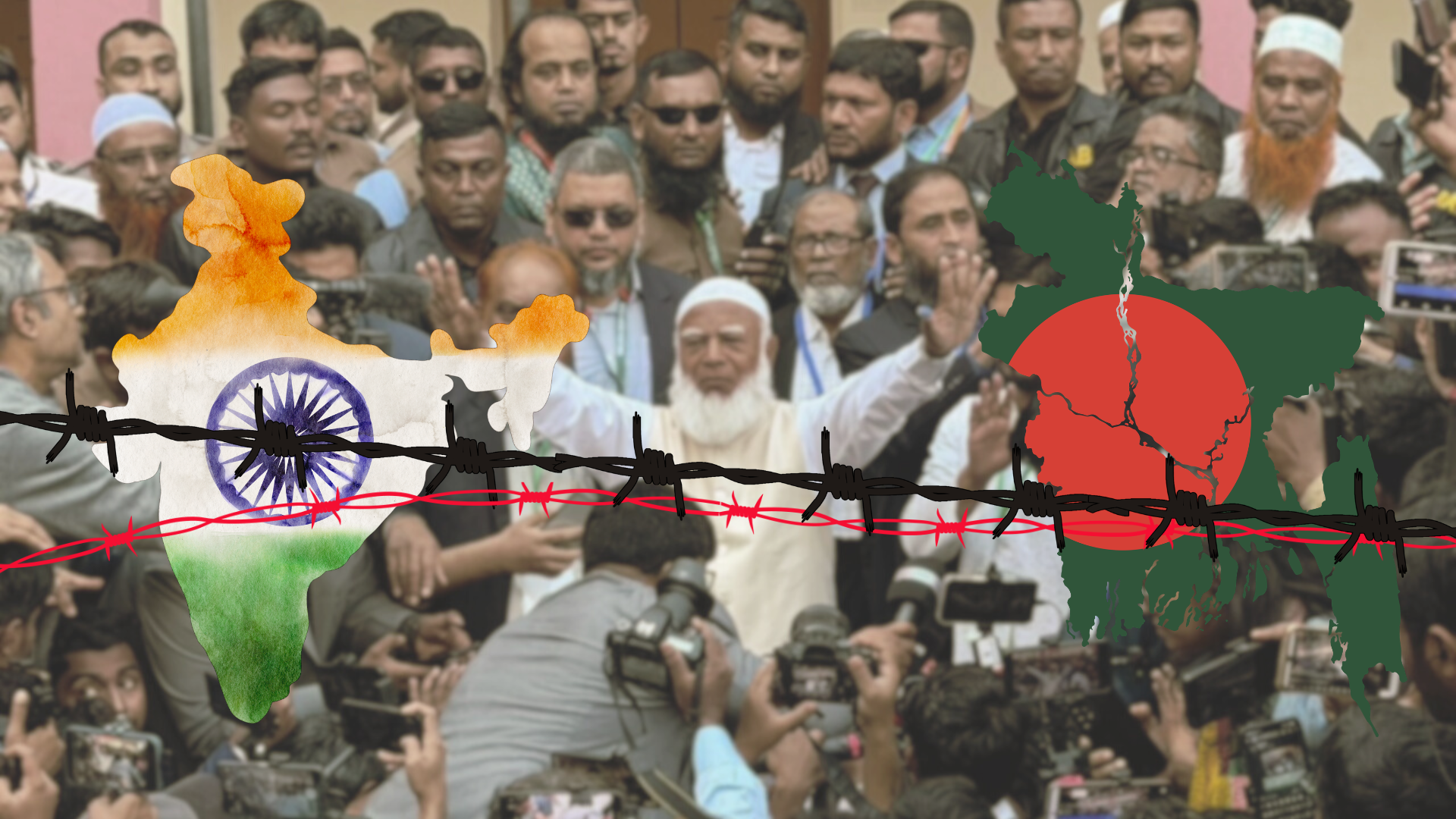
Although the BNP alliance won two-thirds of the seats in the 13th National Parliament election, Jamaat-e-Islami secured an absolute majority in the border regions, especially in the northern and western areas. Is there any direct correlation among border killings, anti-India sentiment, and Jamaat’s victory?
India and Bangladesh share nearly four thousand kilometres of border. Trade, migration (legal and illegal), arms smuggling, BGB–BSF tensions, and many other issues have long kept border politics turbulent. Although the BSF has officially pledged to bring border killings down to zero, the situation appears to be moving only in a negative direction. According to data from a human rights organization called Ain o Salish Kendra (ASK), in 2025 alone, 34 Bangladeshis were killed by the BSF. Of them, 24 died directly in crossfire and 10 died from physical abuse. New Age Daily reports that in 2025, border killings have surpassed the record of the past five years. Women, men, and children—none were spared.
Just a few months ago, a scheme was passed in the Assam parliament stating that the Assam government would provide licensed arms to indigenous people living near the Bangladesh border. At a time when unarmed, helpless people are killed at the border every year, such a decision clearly risks adding fuel to the fire. A retired Brigadier General of the Bangladesh Army expressed concern, stating that instead of bringing stability, this decision would further destabilize the Bangladesh-India border. That covers the instability at the border, the suffering of border communities, and the uncertainty of life, however, the political dynamics surrounding this issue are quite different.
North Bengal, especially Rangpur and its surrounding areas, has long been considered a stronghold of the Jatiya Party. Since its founder and former military personnel Hussain Muhammad Ershad was born there, the Jatiya Party traditionally enjoyed a clear majority in every election. However, Jamaat-e-Islami always maintained a certain vote bank in the region. In the three controversial elections of 2014, 2018, and 2024, significant demographic changes occurred in the northern region.
In Rangpur, where it was once commonly said that “even if a banana tree stood, the plough (the Jatiya Party’s symbol) would win,” people turned away from the plough after the party aligned with the Awami League, lost its identity, and became a domesticated opposition. Both Jamaat and BNP were aware of this analysis in the electoral field. Accordingly, Jamaat fielded its own candidates in 29 out of 33 seats in the northern region and achieved overwhelming dominance.
A major part of Jamaat’s election campaign focused on India’s unilateral actions regarding Teesta River water, its agricultural and irrigation plans, and anti-India sentiment. The continued border killings by the BSF further fueled that anti-India campaign.
Seemingly, border regions have always been fertile ground for right-wing politics. In Bangladesh, Jamaat-e-Islami’s unrestrained rise in the border areas parallels the expanding growth of the RSS on the Indian side of the border. For their own political needs, one form of fundamentalism often desires a corresponding form across the border. No matter how much the BJP sheds crocodile tears for domestic Hindus, the rise of Jamaat-e-Islami in Bangladesh allows it to use that “bogeyman” to further consolidate its rule.
The same applies to Jamaat. Beyond border killings, it can easily strengthen its political ground by capitalizing on the religious provocations of Hindu fundamentalism in India. Just as the Awami League’s political foundation was rooted in the spirit of the Liberation War, Jamaat-e-Islami’s politics as a religion-based party is fundamentally anchored in anti-India sentiment. From Delwar Hossain Sayeedi’s anti-India sermons long ago to Jamaat’s anti-India campaign in the 2026 election, all have been central to its political fundamentals.
However, the reality is probably not that linear. There are strong allegations that the Awami League government sold out the country to India. Yet BNP, Jamaat’s electoral competitor, also has a long legacy of anti-India rhetoric. Former BNP state minister Lutfozzaman Babar was sentenced to death in the case of supplying ten truckloads of arms to Indian separatists. Moreover, in recent times in the northern region, the “Jago Bahe, Teesta Bachao” movement stood as a bold and effective example against India’s unequal Teesta water-sharing plan.
But in the popular narrative after August 5, BNP somehow came to be portrayed as India’s agent. Meanwhile, Jamaat’s Ameer held secret meetings with Indian diplomats and still managed to retain a strong grip on the anti-India narrative. Campaigners such as Pinaki Bhattacharya and former DUCSU leader Sadik Kayem, who openly campaigned in favour of Jamaat, strongly portrayed BNP as India’s agent. It seems pushing this narrative was essential to secure border votes. And judging by the results, they were successful.
Border areas are by definition distant from the centre. Compared to other parts of the country, they have always received less attention and focus from the central government. Through the border, countless goods enter the country daily from India and Myanmar, both legally and illegally. These goods are supplied across the country for trade. Thus, although not the focal point of the national economy, border areas play a significant role in keeping the economic wheel turning. In my observation, border populations tend to be comparatively conservative. Therefore, anti-India, anti-Hindu, and Muslim nationalist sentiments find easy targets there. It is precisely in this space that Jamaat-e-Islami has made its mark.
In 2014, news reports hinted at possible collusion between India and Jamaat-e-Islami. India’s central investigative agency CBI investigated allegations that Mamata Banerjee’s Trinamool Congress had funded Jamaat. An MP from Trinamool Congress was accused of sending large sums from the Saradha chit fund scam to Jamaat-e-Islami. This allegation was reportedly communicated by Sheikh Hasina’s central government to the BJP government in India, yet that MP, Ahmed Hassan Imran, was effectively given a safe exit. When these isolated incidents are put together, it becomes apparent how Jamaat has successfully conducted its politics in border regions by capitalizing on India’s Hindutva fundamentalism and indiscriminate border killings.
Of the 4,000 kilometers of border that India shares with Bangladesh, nearly 2,500 kilometers run along West Bengal. Large parts of Khulna, Rangpur, and Rajshahi share borders with Kolkata. In these areas, beyond border violence, national economic neglect, the Teesta water crisis, border trade, and the religious conservatism of border communities have facilitated Jamaat’s politics. Otherwise, such polarization between the center and the border would not have emerged. However, Sylhet also shares a border with India. Yet in Sylhet and Srimangal, whether due to the higher proportion of Hindu minorities, the backlash from uncontrolled shrine demolitions, or other reasons, Jamaat did not win a single seat.
In this way, border politics created a nuanced dynamic in the national parliamentary election. Nevertheless, beyond all this, both the government and the opposition should avoid engaging in the politics of corpses and instead work jointly to reduce border violence and ensure the safety of hundreds of innocent lives like Felani.
Ishmam Zaman is an independent column writer.
