

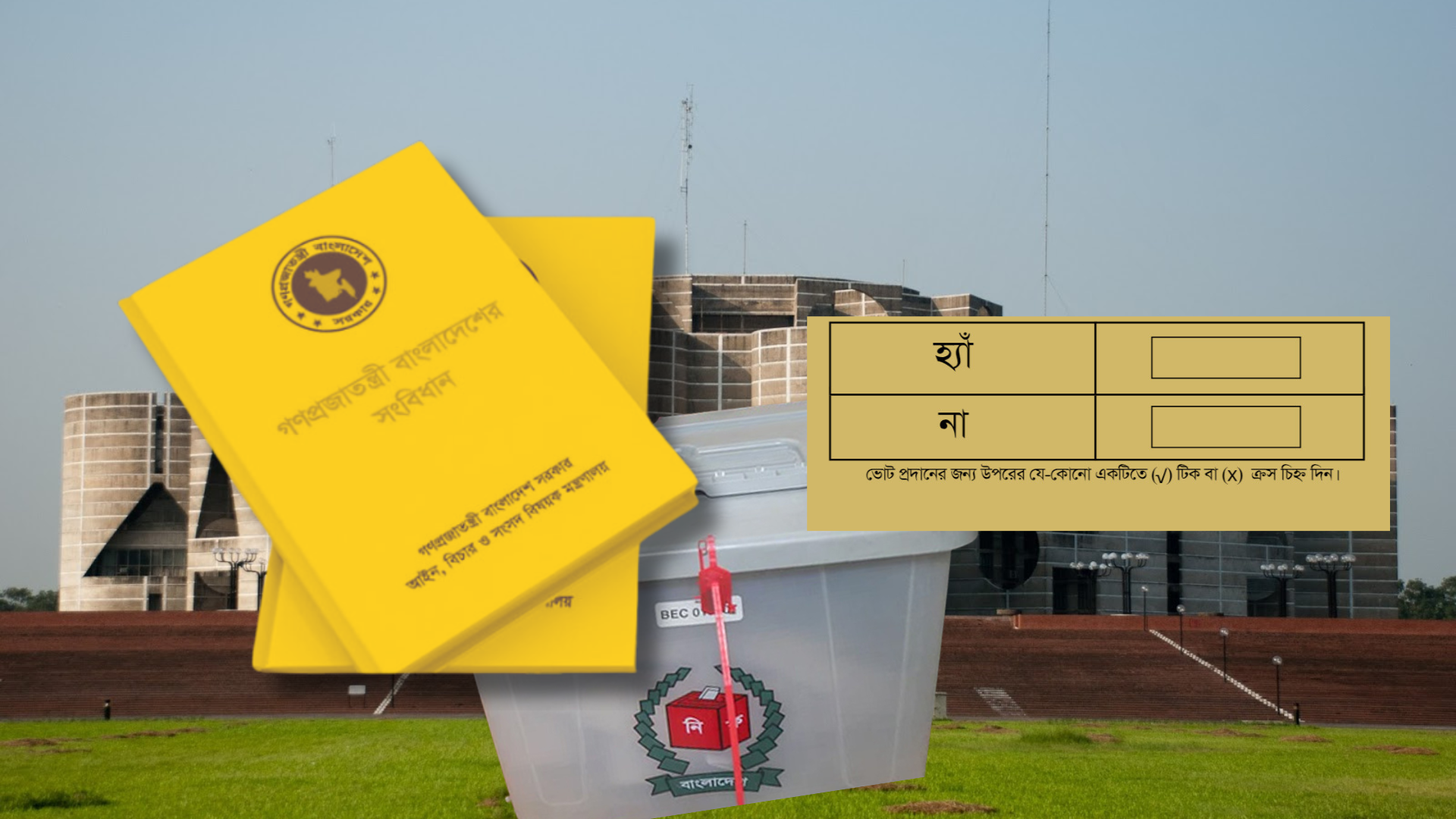
In recent times, there have been conversations around how to reform the constitution-mainly to reduce the power of the PM so that something like a PM turning a democratic Bangladesh into an autocracy never happens again. Oftentimes while mentioning such reforms a particular Article 70 is brought up which is stated to be harmful to our democratic process and gives the PM unlimited powers. Article 70 of the Bangladesh Constitution states that a person elected as a member of Parliament at an election at which he was nominated as a candidate by a political party shall vacate his seat if he votes in Parliament against that party or resigns from the party but shall not thereby be disqualified for subsequent election as a member of Parliament.
Article 70 was introduced on March 13,1972 through a presidential order as a way to keep the parliament united and parties united so that instability does not occur in the parliament. The scars of the United Front coalition from 1954-1958; whose instability led to the rise of martial law in Pakistan left a mark on most lawmakers while making this article. Another reason was the consolidation of power by the central leadership-so that the party could go on pushing their agenda while facing no opposition or the danger of breaking down into factions. From its inception, the article has had its detractors: Opposition MP Suranjit Sengupta of National Awami Party criticised the act calling it undemocratic when it first passed. Later on, the act was strengthened and clarified through the 4th and 12th amendments. Although the act had some noble intentions, this was exploited later on by each subsequent ruling party.
After the 1996 election, the scope of this act was extended to become an anti-floor crossing law when two BNP MPs switched over to Awami League mid parliament session. This caused BNP to term those two MP’s as having resigned from the parliament overall according to Article 70. After much arguing over this in court, the court finally decided to vacate their seats. Md. Akhtaruzzaman was one of the victims of this article in 2010, after he attended the parliament session back then despite his party (BNP) boycotting it.
Advocates of Article 70 emphasize on the fact it guarantees stability in a government. It prevents a person who was elected from one party during the election switching over to another party mid parliamentary session. Thus, ensuring voters voted for their desired candidate who aligned with party views. It also prevents factionalizing between parties which could prevent legislation from being passed and make the legislative process slower overall. You end up with a parliament which can’t enforce anything. To support their claim, advocates of Article 70 say many countries have healthy functioning democracies despite having similar anti defection laws or staying against the party line laws. A point also brought up is it will safeguard the existence of smaller parties since it will prevent their members to join larger party’s mid parliament.
There are a bunch of negative effects that exist because of anti-floors crossing laws in Bangladesh. When one party wins a huge majority of seats alongside a coalition which has happened in Bangladesh two times during a healthy electoral process-2001 and 2008 it prevents healthy debate in the parliament. Awami League utilized Article 70 provisions to pass amendments when they had a 230 plus seat majority from 2008-2024, amendments which included the end of caretaker government and the passing of harmful acts such as DSA which infringe on civil liberties. Another harmful consequence is it prevents the choice of a MP to voice his/her own opinion within a parliament and essentially turns the democratic system into an autocratic system. As a result, in the event of a landslide victory by a party in a parliament, diverse opinions become nonexistent.
The way Bangladesh is structured, it is easy for the government to influence the judiciary and executive branches over time thus Article 70 gives the government power to make widespread changes to ensure their power. Most democracies in the world don’t have anti flooring laws and function fine. If an MP makes such a decision mid parliament, it’s up to their constituents at the next election whether or not they want them.
Analysing the pros and cons, could someone ask the question?
“If India, Nepal, Portugal have such laws and have healthy democracies what is the problem in Bangladesh?” The answer is that after elections in Bangladesh post 1991 both BNP and AL, while having to form coalitions out of the necessity to form the majority in the 90s, started to form them in the 2000s with the prospect of huge landslide gains which both parties got. This allowed them to pass several amendments and gave them complete control over the parliament. BNP used it to increase reserve seats to further extend their power. The scrapping of the 13th amendment by AL which gave us the Caretaker Government ensured three fraud elections in a row which is a mockery of democracy. The judiciary and executive both can be manipulated easily by the ruling party in Bangladesh and thus having an all-powerful legislature leads a country to the path of autocracy. Also in the case of smaller parties, they tend to form coalitions in the current system and often toe along party lines. Not having Article 70 would in theory give them more independence. Recent scenarios in India and Nepal- question the narrative of whether or not they are healthy democracies as well whilst having anti-floor crossing laws.
While Awami League has become a thing of the past for now, Bangladesh is once back again to a two-party system on the eve of elections- Jamaat e Islami and Bangladesh Nationalist Party are the two main contenders to be in the position of ruling the country.
If Article 70 persists, whichever party gets a majority in the parliament has a way easier chance to rule as they wish while the other party can only voice out opposition in protest. In the July Referendum vote on February 12,2026 -if the Yes option wins the floor crossing law will be modified to make voting mandatory for all MP’s of a particular party for budget related laws and vote of no confidence. In every other case MP’s will be free enough to vote however they wish. This will be a great change for Bangladeshi politics, as MP’s will be free to vote as their constituents want while not being bound to a particular party. If the “No” option wins, then Article 70 will remain as it is and the same old system of anti-floor crossing laws will persist in Bangladesh.
While Article 70 has been misused and abused by ruling parties and the need to remove such an act is necessary in order to limit the power of the PM and the ruling party and to prevent future autocracies to pop up; another thing that must be noted is that the whole constitution as a whole needs to be redone since analysing the political framework of Bangladesh-it’s not Article 70 which is single handedly at fault but a lot of other laws in the current constitution give the legislature ways to enact uncontrolled power. A new constitution which ensures the independence of all three branches should be made.
Azwad Abdullah Ayan is an undergraduate student at BRAC University.
