

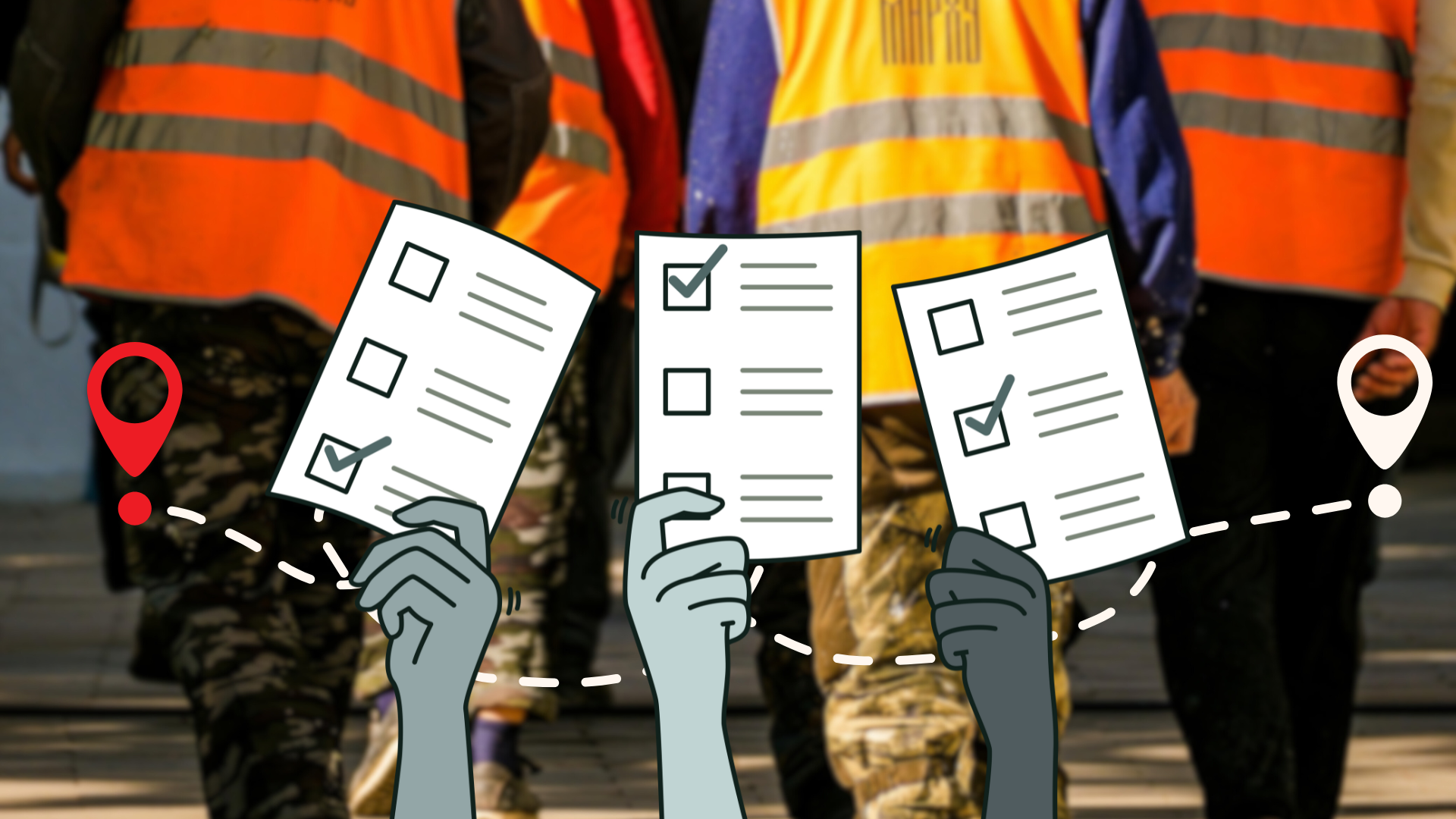
The political parties are revealing their manifestos targeting the upcoming 13th National Election of Bangladesh on 12th February 2026. The date is coming nearer, and the streets are becoming louder through marches for different nominees of a specific constituency. In this festivity and the verbal war we are witnessing among the different leaders of different political parties, it is easy to forget that there are large sections of the population who are not being counted in these speeches.
In the unfortunate hierarchies that exist between the rights of labourers in Bangladesh, migrant workers probably sit at the bottom, even though their remittance is one of the key contributors to the growth of the Bangladeshi economy; around 5-6% of the country’s GDP comes from remittance. Even in July 2024, it was after the declaration that the migrants would stop sending remittances that the July Uprising got a boost. 57 migrant workers were detained in the United Arab Emirates while protesting against the dictatorship and murder spree of Sheikh Hasina. But how much have they been repaid?
According to experts, Bangladeshi migrant workers have to bear the highest migration cost among the South Asian countries (Challenges that our migrant workers face, 18 December 2023). The gap between the state-set cost of migration and the effective cost is huge, and the high migration costs eat up 13% of remittance income (High migration cost eats up 13% of remittance income, 05 May 2022). This gap largely stems from the fact that workers have to go through middlemen to actually migrate abroad and work, which should be considered a failure by the state. These statistics are from the regime of Hasina, and there hasn’t been any improvement in this sector. According to a 2020 report by the Bangladesh Bureau of Statistics, a worker, on average, might take 17 months to recover the migration cost. All of these numbers are from the Hasina regime. It would have been better if the numbers were available for the Interim Government to compare them. But regardless, the fact is that the plight of migrant workers has received no attention from the political parties.
The situation is worse for female migrant workers, who regularly become victims of physical and mental abuse in countries abroad. A study from OKUP(Ovibashi Karmi Unnayan Program) found that a staggering 94% of migrant women who return have experienced physical and mental abuse abroad. These tortures can take different forms – overworking and denial of medical care to sexual assault, which in many cases result in unwanted pregnancy. There have been multiple instances where the workers have been forced to cut off contact with their family members back home. Suicide rates are, on average, 20%. Due to all of these reasons, the female worker migration has actually halved in the last decade.
Lack of healthcare has been a pivotal issue for both male and female migrant workers. The sudden climate change from Bangladesh to Gulf countries requires the workers to adapt rapidly, but for many, that becomes fatal. Death by heart attacks and strokes abounds. The mental health issues also plague the male workers as well. The deaths caused by this lack of healthcare are not properly compensated in many cases; the policy experts reckon that the causes are not always even correctly documented.
These concerns aren’t new. They have been voiced by intellectuals and researchers who have worked here. But surprisingly, the situation hasn’t changed. Due to the lack of new industries and the diversification of the economy, migrant work often becomes the only opportunity for a large population of Bangladesh to change the fate of unskilled workers and their families. Otherwise, it is very difficult to explain the urge to leave Bangladesh as illegal immigrants in the Mediterranean Sea. And as mentioned earlier, remittance contributes a lot to the economy of Bangladesh, along with the garment industry.
The labourers in the garments sector are slightly better in terms of acquiring their rights due to their unionisation and the pressure from the international market. But no such incentive exists in the migrant workforce. The refusal of the Government of Bangladesh to ensure a system where workers can legally migrate and receive justice is tiring at this point. The basic rights as enshrined in the Overseas Employment and Emigration Act, 2013 and the various clauses to protect worker rights aren’t implemented properly, which include the right to be protected from fraud, passport confiscation and access to labour welfare wings. These wings need to be strengthened so that the workers can take action against their employers who don’t abide by labour laws.
As it stands, the political parties are unwilling to do any better as well. Each political party pledges different benefits for the working class in every election, and this election has not been different. The promises consist of making the situation “better” and “more updated” while the basic rights are not ensured.
If the election manifestos for the 9th National Election in 2008 of Bangladesh Awami League, Bangladesh Nationalist Party and Jamaat-E-Islami are analysed, they include a pledge to properly invest the remittance earnings by the expatriate workers. The assurance of proper investment is indeed a vital issue, but these manifestos didn’t feature the well-being of the workers themselves. Without ensuring the well-being of workers, their legal migration and legal protection, is it conceivable that they will earn more remittance? As the data shows, due to lack of these protections, female worker migration has decreased. Still the welfare of the migrant workers wasn’t discussed back then and not discussed now.
Even though some words have been said about farmers, the parties have mostly remained silent about the crisis migrant workers face. They have almost no place in the manifestos. This is unfortunate, given the role of migrant workers in the uprising of July 2024, which promised an inclusive Bangladesh. The only noteworthy achievement has been the introduction of postal ballots, which have enabled expatriates to exercise their right to vote and participate in the electoral process.
But the political parties need to do better in terms of their pledge to the lower-class voters. They need to include the migrant citizens of Bangladesh, promise a better future for them and their families and act on it. It is unfortunate to see such a section of Bangladesh simply excluded from the election discourse, while the party officials engage in ambitious and often unrealistic goals. July 2024 promised a Bangladesh which speaks for everyone, and the spirit of that promise shouldn’t only be limited to the signing of a charter – rather, it should be reflected in the practice of the political culture of the country as well.
Sadman Ahmed Siam is an independent columnist and a student at the Islamic University of Technology.
