

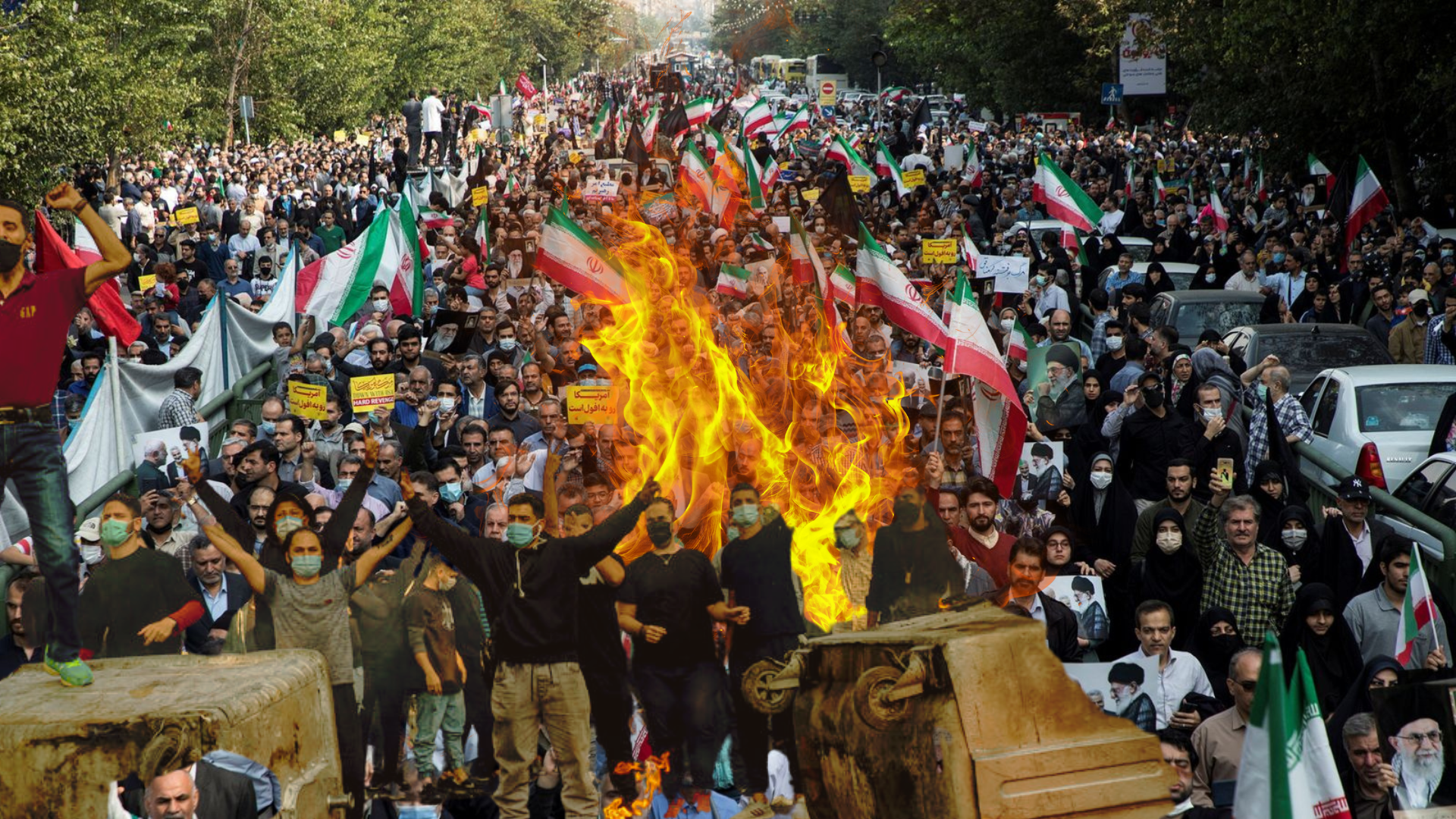
Sarah is a 50‑year‑old entrepreneur. Over a long span of her life, she has watched her personal freedoms shrink day by day, while the prices of her daily essentials have soared beyond imagination. It feels as if the price of one liter of cooking oil now outweighs the value of her freedom. To fulfill just her basic nutritional needs, the price of 1 kilogram of beef has reached 10 million rials. On the other hand, 500 grams of boneless chicken breast costs nearly 2,256,390 rials. This isn’t fiction—these numbers came from the testimonies of Iranian protesters interviewed by The Guardian. Sarah’s story is not hers alone; hundreds of thousands of Iranians face the same reality.
On August 8, when Iran saw the worst inflation in its 40‑year history, citizens could no longer control their anger. They gradually began to gather on the streets. Soon the protests spread across the general population. As the demonstrations neared a point of mass explosion, the Revolutionary Guard descended upon the protesters. A peaceful protest turned into a blood-soaked chapter. Internet shutdowns have become a popular tool to suppress dissent, and Iran was no exception. In just one night, 232 Iranians were killed, and many more were arrested.
“According to recent reports from the Iranian government, more than 5,000 people have been killed during this movement. The majority of those who lost their lives were under 20 years old.”
From the very beginning of the protests, Iran’s prime minister and the regime repeatedly claimed that “this movement is nothing but a U.S.-sponsored conspiracy.” They attempted to conceal their government’s failures, corruption, and shattered economic condition behind this narrative. In today’s column, I aim to highlight the economic factors behind this uprising—how economic exploitation and inequality gave birth to this movement.
In the over 40‑year history of the Khamenei regime, inflation has reached a peak this year. In December alone, the currency depreciated by 16% compared to the previous month—and by 82% compared to last year. Food inflation has risen to nearly 72%.
Since 2011, when international sanctions were imposed on Iranian oil, the economy has suffered terribly. Previously, Iran’s annual growth hovered between 5–9%. After sanctions halted oil exports, foreign exchange earnings plummeted, causing growth to fall below 3%. As a result, today 1 U.S. dollar equals 1.42 million Iranian rials—a staggering figure.
If we see “July 24” as a reference for this – we can see the people of Bangladesh were very angry with the Hasina regime due to the unbearable rise in commodity prices, which crushed the middle and lower classes. Also lack of government services, lack of freedom of individuals. Their collective desperation unified people to take this Quota Reform Movement across all walks of life.
Despite holding 12% of the world’s oil reserves, Iranians struggled to afford their own fuel, spending their last savings on essential goods. In such conditions, how could they sit quietly at home?
At the same time, small and medium-sized businesses in Tehran and other cities grew increasingly frustrated, causing this business to be highly dependent on fuel. Due to the collapsed economy, business owners faced continuous losses. Even after the regime introduced structural reforms— due to a new taxation system raising average business costs from 42% to 57%—entrepreneurs’ anger toward the regime only intensified.
Poor people in a country usually focus on basic survival, while the rich focus on keeping their power. But middle class and small business owners are the real link between the people and the government. They follow the rules, pay taxes, and trust the system—so they play a big role in giving a government its legitimacy. When this group starts to suffer, pressure on the government increases.
That is what happened in Iran. The middle class became angry with the government. They wanted to change and simply hoped the government would solve their problems. These same people once supported the government, but now they were unhappy and no longer trusted it.
A country cannot survive by force alone. Real legitimacy comes from people. And when the people believe the system no longer works for them, protests are bound to happen. This is exactly what occurred in Iran. According to Transparency International, Iran ranked 78th out of 134 countries in 2003. By 2010, it had fallen to 154th out of 178. Today, it ranks 149th. Despite Ayatollah Khomeini’s repeated promises to curb corruption, in reality, corruption has become a political tool that sustains the current regime.
Historically, Iran’s major industries—such as oil, gas, and electricity—were controlled by the monarchy. These privileges were granted exclusively to loyal elites, a system known in Persian as “Tayoul.” Although the Constitutional Revolution of 1905–1911 abolished Tayoul, the monarchy regained control of these resources once the revolution weakened.
After the 1979 Islamic Revolution, Khomeini gave this exploitative system a religious façade by transferring these critical assets to a body known as “Anfal.” Anfal was placed under the authority of the Prophet’s successors and, in their absence, Iran’s supreme religious leadership. From here, all major resources were distributed.
Khomeini intentionally built a loyal class that would safeguard his regime, reviving the Tayoul system under a new religious name—Anfal.
Khamenei considered an independent private sector a threat. Yet in 2005, he reinterpreted economic policy to promote liberalization and privatization. In practice, this was not a free market transformation, but the rise of a massive semi‑public sector dominated by the Supreme Leader’s network. This sector includes around 120 major organizations such as Setad, which is directly controlled by the Supreme Leader. Since these bodies are neither fully public nor private, they escape parliamentary oversight, are exempt from taxes, and face no audits. This opaque system has massively intensified corruption.
Due to the government intervening, no private entrepreneur wants to invest in this. This discourages the private sector.
On the other hand, Iran government responses to corruption have been two-faced. Loyalists receive protection and privileges, while “anti-corruption campaigns” are used as weapons against political opponents. For example, former Tehran mayor Mohammad Bagher Ghalibaf has faced allegations of embezzling billions of dollars but has never been brought to trial—whereas journalists who exposed his corruption ended up in jail.
Conversely, reformists and moderates, such as those associated with Rafsanjani, Khatami, and Rouhani, have repeatedly been targeted under anti-corruption laws as a form of political pressure.
Ultimately, the question is no longer about “foreign conspiracy vs. national security.” The real question is: How long can a state dismiss its people’s hunger, deprivation, and humiliation as foreign plots?
Sarah and thousands like her took to the streets simply for economic relief. Instead, at least 1500+ people have lost their lives so far. Iran’s uprising was not a sudden outburst—it was the inevitable result of four decades of economic injustice and state hypocrisy. The question is no longer why people protested. The real question is: Does the state still have a path back to its people?
Kazi Md. Aldin Fardin is an independent columnist.
