

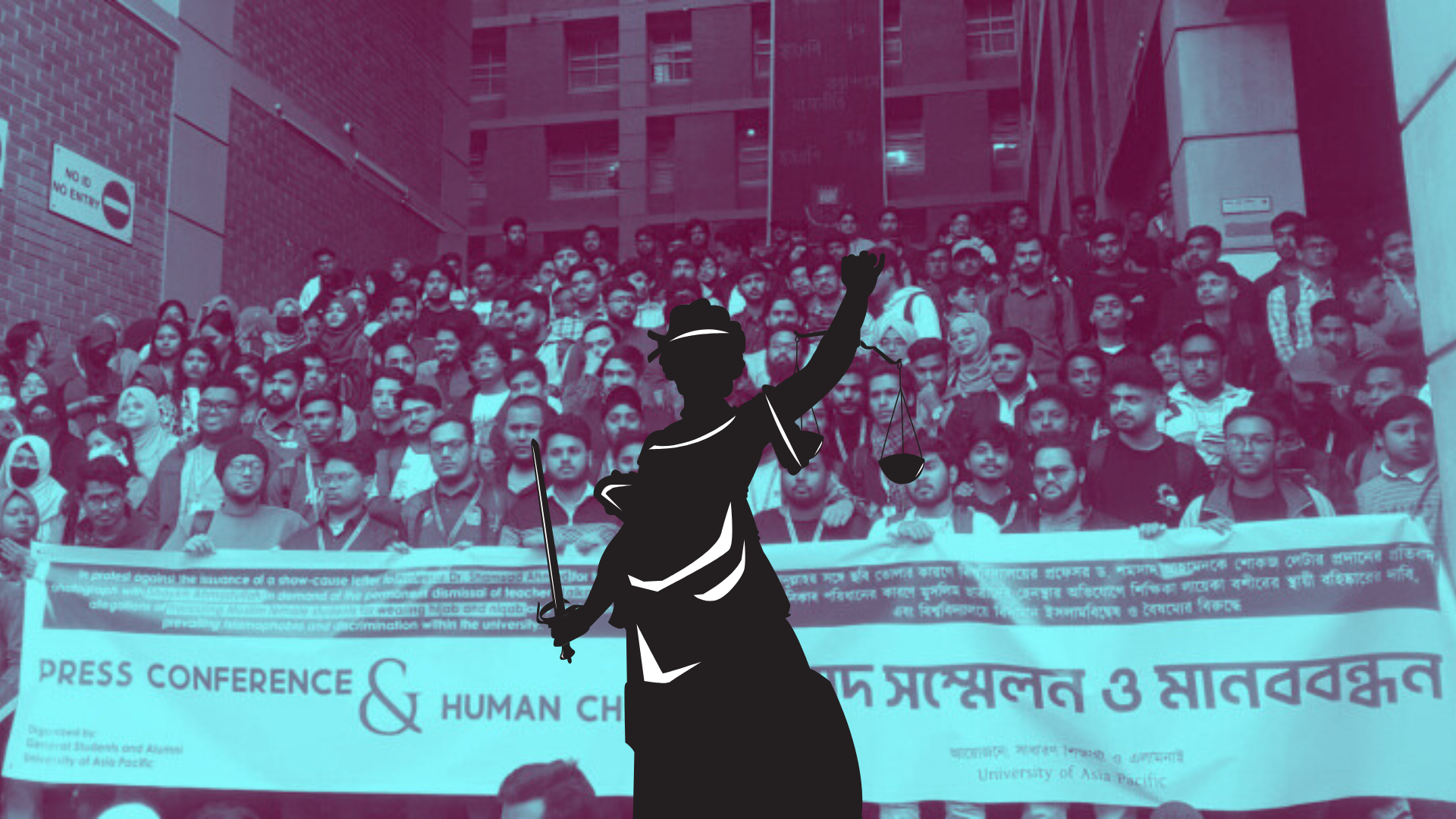
Assistant Professor Layeka Bashir of the University of Asia Pacific was dismissed from her job following student protests accusing her of Islamophobia. Although the allegations brought against her were extremely shallow, we often see that many Islamic scholars and political figures who have made far more explicitly anti Islamic statements never face any such questioning. If one observes the misuse of the blasphemy law in post–5 August Bangladesh, a clear pattern becomes visible. The political weaponization of blasphemy laws to silence dissenting voices is impossible to ignore.
The allegations raised against Layeka Bashir can be broadly summarized into a few points: while teaching the origin of religion in a sociology class, she allegedly made derogatory remarks about Islam; she stated that Islam does not grant equal inheritance rights to women; and during an examination, she asked a student to remove her niqab for identification purposes. These incidents were enough to create an organized, collective, and pre-planned mob against her, eventually forcing her dismissal through pressure. Viewing this incident in isolation would be a serious mistake.
Let us go back about a year and a half, to October 2024. Hefazat-e-Islam, Islamic scholar Ahmadullah, and several Jamaat-aligned right-wing groups centered around Dhaka University jointly demanded the immediate removal of Samina Luthfa and Kamrul Hasan Mamun from the textbook revision committee. Their accusation? That they were Islamophobic. The allegation was framed as extremely serious—how could children of Muslim families be taught through a curriculum designed by “Islamophobes”? And once again, the outcome was similar. Just as UAP authorities removed Layeka Bashir without any proper discussion, legal investigation or chance for self-defense, the government bowed to the ‘pressure group’ and removed Samina Luthfa and Kamrul Hasan Mamun under threats from right-wing mobs.
It is crucial to understand who is labeling whom as “Islamophobic.” When a known harasser and sexual predator is bailed from jail by a mob, garlanded with flowers, and made to hold the Quran, the religious sentiments of the so-called “Tawhidi Janata” remain untouched. When Jamaat campaigns for votes by selling “tickets to heaven,” no devout Muslim seems to question whether that constitutes shirk. When a Jamaat leader claims Allah will stop the sun for him, no outrage follows. But the primary targets of this so-called religious outrage are always progressive, left-leaning, liberal voices like Samina Luthfa and Layeka Bashir—women who wear sarees, tip (small round paint put on the forehead), practise culture and represent critical, secular values. This makes it evident that blasphemy and religious offense have become deeply politicised tools, selectively used to suppress dissent and political opposition. The organised mob coercion against Layeka Bashir was highly politically motivated as well.
You may recall how Baul singer Abul Sarkar performed folk traditions for years without any issue. But the moment he began campaigning for BNP, he was framed as an Islamophobe, got arrested and faced violence from the wahabi-salafists, in front of state police. Or the horrifying case of labourer Dipu Chandra Das, who was burned alive on a highway under the pretext of blasphemy due to a personal dispute. These incidents show how accusations of religious offense are weaponized for personal and political gain.
The way Layeka Bashir was terminated is a direct attack on academic freedom. Denying her any opportunity to defend herself and removing her without notice is unjust and a violation of basic human rights. A university is meant to be a space for higher studies—where knowledge, beliefs, and assumptions are constantly questioned. That is how intellectual growth occurs. In sociology and anthropology, society, state, and religion are continuously examined through critical lenses. From Karl Marx to Sigmund Freud, no theory is treated as sacred or beyond critique. Comparative religious studies exist to better understand society. It should not be a concern if students do not agree with their lecturer. It’s healthy for students and teachers to engage in argument and thus contributing to establishing a welcoming knowledge production. But disagreeing to your faculty about a social theory and later labelling her as blasphemous is pure evil – to say the least. Attempting to confine such academic inquiry within the boundaries of a single religious worldview is deeply limiting.
This is not new in Bangladesh. Even during the pre 5 August period under the Awami League’s Hasina regime, we saw similar patterns: adding veils to illustrations in primary textbooks, removing Baul songs like “Shomoy Gele Sadhon Hobe Na”, removing stories from the Ramayana, and persistent attempts to remove ‘Evolution’ from science textbooks—all under pressure from Islamic fundamentalist groups. These examples show how religious fundamentalists have repeatedly attempted to dictate education and curriculum.
Therefore, the UAP incident must not be seen as an isolated event. It is part of a broader pattern. The politicisation of blasphemy laws, the systematic erosion of academic freedom, the use of mobs as tools of intimidation and the gradual suffocation of intellectual discourse. If this continues like this, the future of academic inquiry and critical thinking in Bangladesh will be in grave danger.
The removal of evolution from textbooks, the mob-led expulsion of Samina Luthfa, and the branding of Layeka Bashir as Islamophobic are all threads of the same fabric. When free thought, critical reasoning and intellectual independence are eliminated, cultivating fundamentalism becomes easier. That is why progressive thinkers need to be stopped, removed and eradicated – by any means, even though lies, manipulation, and injustice if necessary.
Layeka Bashir is not the only victim of this incident. Associate Professor A. S. M. Mohsin was also terminated from UAP without any prior notice. The protesting students alleged that he was a “soft Awami Leaguer.” Although he claimed that he had supported students from his own position during the July movement, he was still branded a collaborator of fascism and dismissed without being given any opportunity to respond. He learned about his termination through social media. This raises a deeply troubling question about the practice of political vengeance within academia. We have seen DUCSU member AB Zubair physically assault an “Awami-leaning” teacher in an attempt to force administrative action. We have seen RUCSU leader Salahuddin Ammar publicly drag a senior professor, labeling him a collaborator of fascism. The question is: even if someone were a “soft Awami Leaguer,” do students have the right to form mobs and deliver punishment instead of allowing the administration to handle the matter through due process? Such actions severely damage the teacher–student relationship and undermine the academic environment. Moreover, UAP is a private university where not only local but also international students’ study. Following the termination of two faculty members and the ongoing unrest fueled by student protests, UAP has been declared closed indefinitely. This sends an extremely negative message about academic safety and freedom in Bangladesh.
This culture of fear discourages international students from choosing Bangladesh as a destination for higher education. At the same time, it signals to competent and qualified academics that Bangladesh—and UAP in particular—is an unsafe environment for academics. Ultimately, this damages Bangladesh’s international image and weakens its position in the global academic community.
Bangladesh’s universities must now ask themselves whether they stand to encourage critical thinking and intellectual bravery, or to please religious sentiments and political rivalry. If the latter is true, then academic integrity in this country is already in retreat.
Ishmam Zaman is an independent column writer
