

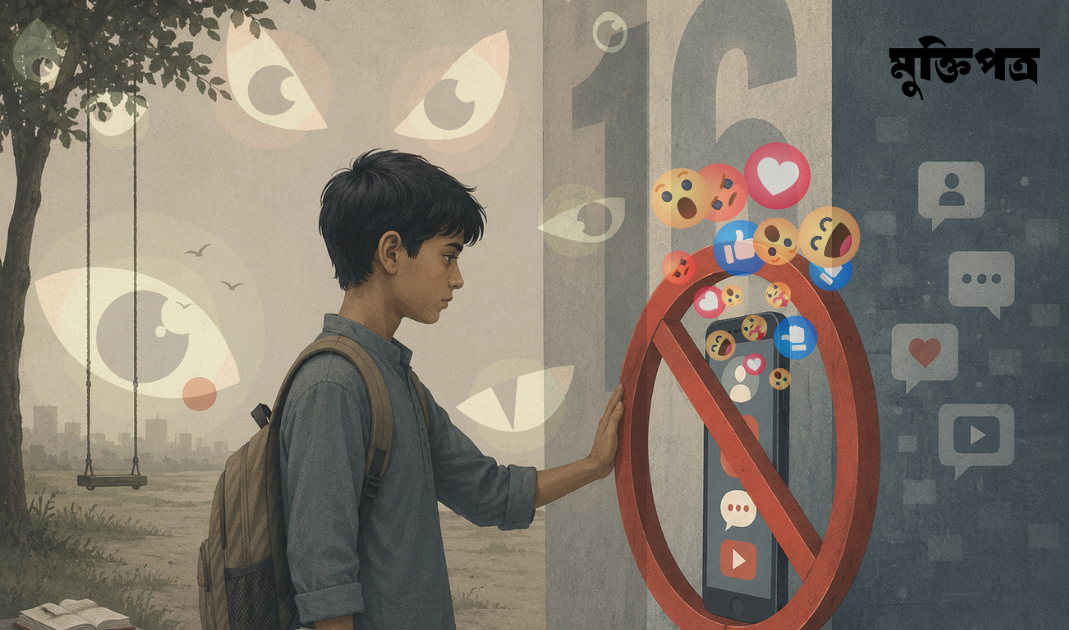
Bangladesh should seriously consider banning children under 16 from using social media. Although children should learn digital skills, use the internet for education, and grow up prepared for a modern world. But social media is not the same as digital education. TikTok, Facebook, Instagram, YouTube Shorts and algorithm-driven feeds are not suitable for the underaged kids. These platforms are designed to capture attention, collect data, and keep users scrolling for unlimited time. A child’s developing brain should not be left alone inside that machine. In recent times, the children in Bangladesh are very prone to use social media in their early childhood. Some even start using smartphones even before they start school. In a study of internet-using children aged 10–17, about 25% began accessing the digital world before age 11, 63% primarily used the internet from their own room, and many reported befriending unknown people online. Unfortunately, some parents don’t understand the severity of this problem, and often feel proud that their kids can navigate through the smartphone at this young age. But this has multiple effects on the children’s brain development as well as harming their eyesight.
In many urban families, the smartphone has become a ‘digital babysitter’. When parents are busy working or attending household chores, they hand over a phone to keep the child occupied. The child becomes silent, but behind that silence, the child may be moving from cartoons to violent clips, from comedy to vulgar content, from innocent games to gambling, from children’s songs to influencer culture, body-shaming, abusive language and adult anxieties. This is dangerous because childhood is the most important stage of human life when we develop moral, emotional and linguistic qualities. If that stage is dominated by screens, the child’s habits are shaped by algorithms rather than family, school, books, playgrounds, neighbourhood and community.
Bangladesh has faced a similar cultural phenomenon before. A couple years ago, many Bangladeshi children became deeply attached to a Japanese cartoon named ‘Doraemon’, especially the Hindi-dubbed version aired on television. Parents noticed that some children were becoming more fluent speaking Hindi than Bangla. The government eventually moved against the broadcast because it feared that children’s educational and linguistic environment was being harmed. Whether one agreed with that decision or not, the logic was clear: the state recognized that children’s media consumption is not a private matter only. It affects language, culture and development.
Today the pattern of keeping children busy has shifted from the television to the smartphones. Social media has taken over the forms of entertainment through personal screens; at all hours, inside bedrooms, often without supervision. The risk of coming across to crime videos, political hatred, violent “pranks,” pornography, misogynistic content, extremist propaganda, gambling promotions and scams to a children’s feed is extremely high. Repeated exposure can normalize cruelty, teach dangerous methods, and weaken a child’s sense of consequence. When teenagers commit unusually brutal acts, we cannot ignore the possibility that the internet gives immature minds access to such scripts of violence, deception and humiliation that they are not ready to process yet. Children do not yet have the judgement required to navigate these adult digital spaces.
Social media can place children in the direct line of predators, blackmailers and fake friends; specially girls face a lot more additional stress in this context. One private photo can become a weapon to blackmail them. One wrong move can cost their life. This is why the global practice of banning social media comes into existence. Australia is the first country to introduce the strongest social media restrictions in the world, legally barring under-16s from holding accounts on major platforms including Facebook, Instagram, TikTok, Snapchat, X, YouTube and others. The United Kingdom has announced plans to follow an Australian-style model for under-16s, expected to come into force in Spring 2027. The United Arab Emirates has also moved in the same direction,recently setting 15 as the minimum age for social media use and requiring stronger age verification. These countries are smart enough to admit that children need protection from business models that profit from their attention.
Bangladesh should learn from these examples and introduce a clear legal rule: no social media account for children under 16. Platforms must be legally required to prevent underage accounts, remove accounts they know belong to children, stop targeted advertising to minors, and provide real ID to create an account. The law should cover addictive platforms such as Facebook, TikTok, Instagram, Snapchat, X and similar services. However, it should not block educational websites, online classes, school portals, child-safe learning apps, or supervised communication with friends and family. But a ban alone will not solve the problem. The responsibility should also be placed on the parents. They should not hand over a smartphone to a child to occupy them with something. Rather, parents need to engage the child in meaningful and relaxing activities which eventually strangers their bonding as well.
At a larger scale, Bangladesh needs to develop a cultural policy for children. Schools should revive debates, recitation, theatre, music, art, science clubs, sports and reading competitions. District-level cultural programmes through institutions such as Bangladesh Shilpakala Academy should be strengthened. The 90’s decade had a stronger public culture of reading books, school competitions, libraries, sports and neighbourhood play. That world was not perfect, but it gave children more ways to grow than sitting alone with a screen. We also need to rebuild the habit of reading for pleasure. Children should enter libraries not only for textbooks, but for stories, comics, science books, biographies, poetry and adventure. Reading teaches patience while doom-scrolling increases impatience.
Urban planning is also part of child protection. In cities like Dhaka, children often have no field, no park, no safe cycling lane, no swimming pool, no open space for recreation. When all playgrounds disappear, the screen becomes their playground. Developers and the state cannot keep taking away physical space and then blame children for becoming screen-addicted. Every ward should have safe playgrounds, parks, sports facilities and affordable swimming opportunities specially for children and growing adults. These initiatives collectively can contribute to the change of the brain and mind development of the new generation. We should give them an intellectual or physical exercise-based form of entertainment rather than just sitting at home scrolling through the screen and using social media for hours. We should act before the damage becomes irreversible.
