

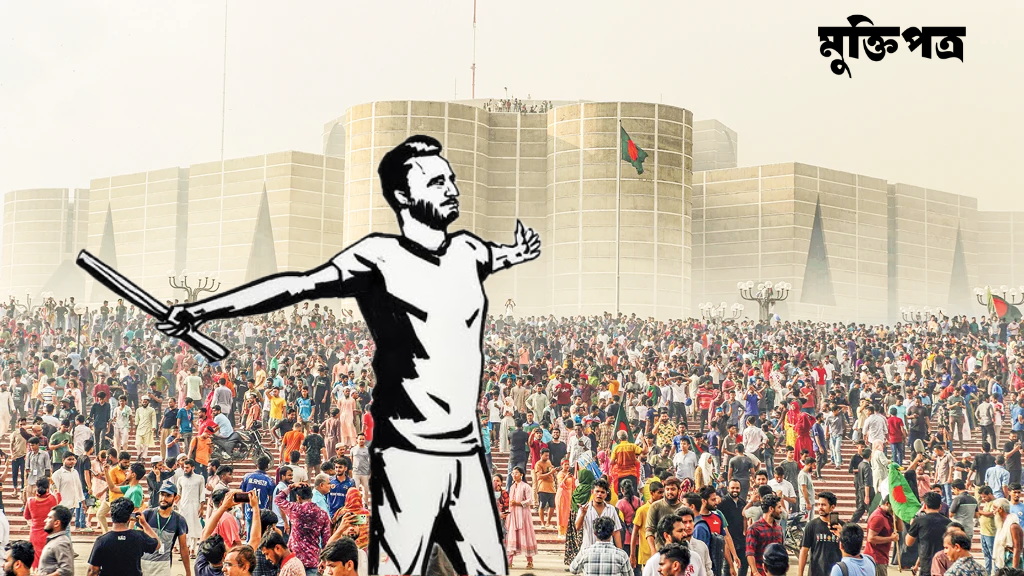
The queue outside the polling booth in Bogura on the morning of February 12 stretched past the school gate, past a tea stall where the kettle had been going since five, past a row of rickshaws parked at angles that suggested their drivers had abandoned them mid-fare to come stand in line themselves. An old man
near the front kept checking his shirt pocket for his voter slip, patting it every few minutes like it might have evaporated. Nobody in that line was composing an argument about a movement. They were thinking about the ballot, about whether their knees would hold up for another hour of standing, about getting back before the shop opened. That’s the place to start, because every argument about what July gave Bangladesh eventually has to walk back through this — a queue, a slip of paper in someone’s shirt pocket, a count that turned out to matter.
It’s fashionable now, a year and a half out, to tally the uprising’s disappointments, and there’s no shortage of material. The reforms sit half- finished. The killings from the movement itself remain only partly answered by tribunals that move at their own glacial pace. Political violence didn’t end with Hasina’s departure — it just found new addresses to visit. Somebody will always be ready to tell you July failed, and they won’t be entirely wrong. But underneath all of that sits one fact that doesn’t come with an asterisk: Bangladesh voted, the vote was counted, and the people who lost accepted that they had lost. Fifteen years is a long time to go without being able to say that sentence.
For a decade and a half, elections here had quietly stopped functioning as anything except theater. The Awami League won the 2024 general election amid a boycott by major opposition parties, following a record low voter turnout and a controversial vote — the fourth act in an arrangement where power no longer moved through the ballot box, it just got renewed. Everyone knew this. People voted anyway, the way you keep watering a plant you suspect is already dead, because the alternative is admitting there’s nothing left to do with a Sunday in January.
In June 2024, the Supreme Court reinstated a 30 percent job quota for descendants of freedom fighters, undoing a reform students had already won back in 2018, and university students went back into the streets over it. What might have stayed a narrow argument about hiring rules turned into something
else after Hasina, addressing the protesters, referred to them as grandchildren of “Razakars” — a word that in Bangladesh means collaborator, traitor, and carries the full weight of 1971. The state’s response to the protests that followed was a crackdown so brutal it produced a name of its own — the July massacre. By August the demand had outgrown its origin. A non-cooperation movement swelled until Hasina resigned and fled the country on August 5, and by the next morning the president had dissolved parliament. Within days Muhammad Yunus had been installed as Chief Adviser, tasked with the vague and enormous job of getting the country back to an election that would count.
None of it moved cleanly. Yunus spent the better part of two years being accused, from every direction at once, of dragging his feet — he avoided naming a firm date for months, floated one timeline and then another, and only committed, on the first anniversary of the uprising, to holding the vote in February 2026, before Ramadan. The legal reckoning crawled forward on its own separate clock in the meantime: in November 2025 a tribunal convicted Hasina and her former home minister of war crimes and sentenced them to death in absentia, a verdict delivered to a woman who by then had spent over a
year in Delhi drinking someone else’s tea. Weeks later, almost as if the calendar wanted symmetry, Khaleda Zia — acquitted of her own charges after the uprising — died after a long illness, and one dynasty’s chapter closed just as the country was learning to count votes again without flinching.
Even the number of dead from July refuses to settle. Official figures crept from an initial 215, to a government gazette listing 834, to a UN human rights office estimate of as many as 1,400 killed between mid-July and early August, most by security forces firing on unarmed people at close range. Student groups tallying their own numbers have put the figure higher still, past 1,500. And in May of this year, lawyers acting for Hasina wrote to the UN itself demanding a retraction, arguing the 1,400 figure had been manufactured to justify her removal and that the real toll was closer to the government’s own lower count.
Whichever number turns out to hold up under scrutiny that hasn’t finished yet, the dispute is itself a kind of measure — a fallen leader’s lawyers now have to argue with a UN report in writing, in public, instead of simply making the report disappear, which is closer to how accountability is supposed to work than to
how it worked here for the fifteen years before. The election itself did not arrive gently. At least sixteen political activists were killed before polling day, most of them BNP men, alongside shootings and
arson attacks numbering in the hundreds. Nine more people died on the day itself. Somewhere in an Election Commission office, analysts were reportedly flagging tens of thousands of pieces of AI-generated disinformation, more than a third of it violent, most of it aimed at the two men who wanted to be prime
minister. This is not what a finished democracy looks like. It is what a democracy still under construction looks like — parties that could actually lose something, rumors built to move votes that would actually be tallied.
And they were tallied, with more outside eyes on the count than Bangladesh has allowed in years. Over 50,000 domestic and 500 international observers registered to watch the vote; the European Union sent a full observation mission months ahead of polling day, and the Commonwealth accepted an invitation too, even as the UN itself declined to send observers. Turnout landed at 59.44 percent of nearly 127 million eligible voters, a number that would barely register as news in most countries and here was the first turnout figure in sixteen years nobody could credibly wave away. The BNP, under Tarique Rahman, won two-thirds of the seats and just under half the popular vote; the Jamaat-led alliance took second with roughly a third; and off in a corner of the result sheet, in its first national election ever, the National Citizen Party — built from the same students who’d led the protests two years earlier — took six seats, with 27- year-old Nahid Islam becoming one of the youngest MPs the country has ever sent to parliament. A referendum on the July Charter passed alongside it with nearly 73 percent approval, folding into the constitution some of the same promises that got shouted in Shahbagh in 2024 — term limits, a second parliamentary chamber, real limits on any single party’s ability to rewrite the rules alone next time. Read as a column of numbers, this is the record of an ordinary country having an ordinary, somewhat bruising election. That sentence had not been true here since roughly 2008.
Rahman took his oath at the South Plaza of the parliament complex, administered by a president appointed under the old order, a day after Yunus resigned to clear the room for him. No coup. No midnight annulment. A man who’d spent seventeen years in London exile, his convictions quashed only after the uprising made it possible, stood in the open air and swore an oath the previous government would never have let him near. The losing parties grumbled about irregularities — the NCP and BNP both alleged some, without much to show for it — and stayed inside the system instead of outside it. Losers
here haven’t always done that.
None of this balances the ledger. The Charter’s reform promises now depend on the goodwill of a party that resisted parts of them while they were being drafted. The dead from 2024 are still, for most of their families, unanswered by any court that means anything to them, and now even the count of how many died is being fought over by lawyers instead of settled by grief. Political violence just changed which party’s supporters end up in the casualty count. Six seats for the NCP is both proof that a protest generation can walk straight into formal politics and proof of how much formal politics still isn’t built to hold them. But strip away every one of those complaints, hold them all at once as true, and something still remains standing that wasn’t standing before: a government that could be voted out was voted out, and the mechanism that did it didn’t break afterward. That is a lower bar than the students chanting in Shahbagh in 2024 would have accepted, and it is also, it turns out, the bar most countries spend
generations trying to clear. Other uprisings have toppled a leader and delivered a colonel in his place, or delivered chaos with no leader at all, or delivered a caretaker who never quite got around to caretaking anyone out of office.
Bangladesh’s interim government dragged its feet for the better part of two years and still, in the end, held an election, published a result nobody’s fraud allegations could actually overturn, and handed power to people who could genuinely lose it again in five years. If July had produced nothing else — no charter, no tribunal, no reserved seats for a new party of twenty-somethings — the fact that a vote now removes a government here would still be the rarest thing the country has manufactured in living memory.
The old man in Bogura patted his shirt pocket, and voted, and his vote went somewhere real, and nobody with a badge came to tell him otherwise afterward. Whether that was worth what it cost is a question the families of the dead have far more right to answer than anyone typing at a desk. But the ballot came back
into people’s hands.
