

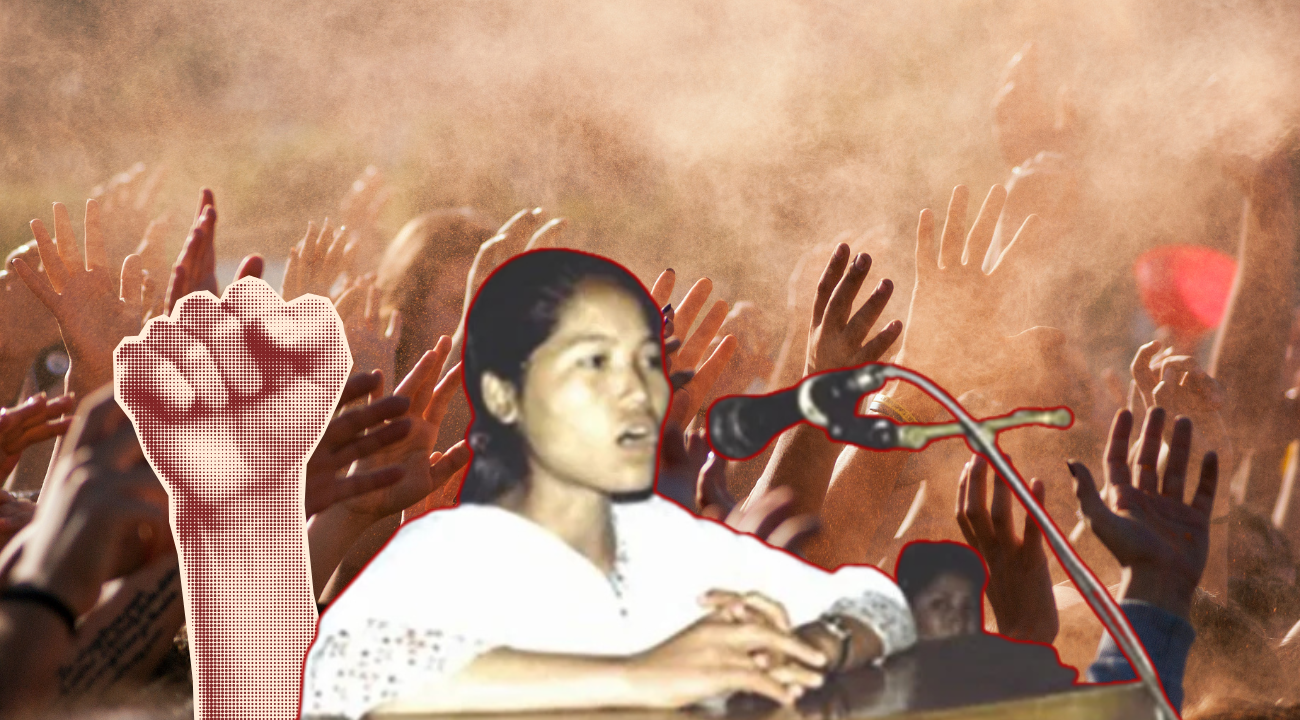
“Everything that is experimented on the Hills, will be implemented on the plain lands.”- Kalpana Chakma.
In July 2024, Bangladesh saw one of the most brutal instances of state violence it has seen in
decades. According to the UN Report, around 1400 citizens were murdered by the armed forces,
and at least 20,000 were wounded. After 18th July 2024, the Internet was forcefully shut down
by the then autocratic government of Sheikh Hasina. As the days went by, more and more civil
liberties were curtailed. There were reports of citizens’ phones being seized and checked illegally
by the armed forces as well. These measures and more were done to restrict the movement of
citizens so that they cannot organise protests against the state.
This series of actions was indeed a shock for the urban middle-class students and citizens who
had been largely apolitical till then, and came down to the streets only to protest the unjust
actions of the state. The violent nature of the state apparatus was new to them, which traumatised
many students who were active in the protests.
But the state did not become violent overnight. In 2023, during the protest of garment workers in
Ashulia, 4 workers were murdered by the state. Gun violence by the armed forces was a common
occurrence to disperse the protests by garment workers as well. In October 2023, during the mass
rally organised by the Bangladesh Nationalist Party, the Internet was shut down as well. The
civil liberty restriction was not novel at all; the indigenous population living in Chittagong Hill
Tracts have faced similar restrictions for years. In May 2024, hundreds of Bawm citizens were
mass-arrested following a bank robbery, allegedly done by KNF. There have been allegations of
food rationing in these areas as well.
Fast forward to July 2026, Jantar Mantar in India. During the recent protests against the
Education Minister, Dharmendra Pradhan, the urban youth were beaten heavily by the police.
Luckily, there were no casualties. But for the first time, the urban youth faced state repression,
and it was a shock for many. On social media, the rightfully frustrated and angry youth declared
the death of democracy.
But as different commentators pointed out, democracy did not die in July 2026. It has been in a
critical stage for a long time. The Modi government has enacted similar measures before. The
state has been actively pushing to make the muslim population second-class citizens through
legal procedures, laws such as the CAA (Citizenship Amendment Act) and recently the
SIR (Special Intensive Revision) in the West Bengal elections. The state has acted violently
against the farmer protests over the years and crushed down resistance by workers as well.
Indigenous populations have been systematically disadvantaged in different parts of the country,
and their voices have remained unheard. Citizens of Jammu and Kashmir have suffered human
rights abuses and state violence for decades.
In both of the cases, the urban youth wake up to a reality which is completely unexpected to
them – the state does not consider them as its citizens with dignity. This sudden realisation
generates frustration and humiliation, and eventually leads to revolt. But before the violence is
imposed upon them specifically, it garners no attention. In India, Muslims, indigenous activists,
workers and farmers – all have been accused of being funded by foreign agencies by the Modi
government before. The urban middle class simply did not care, or at times were participatory in
the propaganda machine. Only when they themselves were accused of being ‘anti-national’ did
they realise the playbook of the state.
Badruddin Umar, in his seminal book titled “The Emergence of Bangladesh”, recounted a similar
sequence of events. After the partition of 1947, the primary sections of the population who
encountered the state repression were the indigenous communities who lived around the borders
of the country. The Pakistani state apparatus practised its violence on them before it targeted
more urban populations, which culminated on 21st February 1952.
This is why Kalpana Chakma haunts us. Kalpana prophesied these exact conditions when she
herself was fighting for the rights of indigenous communities. In essence, her words are a call for
radical solidarity and understanding the fact that freedom does not erode overnight.
Authoritarianism does not get rooted in a single day; it gets built by micro-actions of the state
and the citizen’s inadequate response to it.
The state starts by abusing the human rights of minority populations, because usually it does not
breed reactions from the majority section. In fact, the ethnic or religious majority even justify the
fact that the minorities are being persecuted through their bigotry. The muslims and indigenous
communities in India and the indigenous communities in Bangladesh both have been the victims
of this. The Bengali ethnic majority often support the military administration of the CHT, in the
name of national threats; similarly, Indian Hindutva adherents have treated Muslims with the
same logic. The language of repression that is often associated with the minorities becomes
normalised, and the effect of this normalisation is realised by the majority only when the gun or
baton is pointed towards them.
In this way, Kalpana’s statement becomes one of the most vital political lessons of our time. The
majority section of the population must keep a vigilant eye on how the state is treating the
minorities, and how it justifies its abuse of human rights. It must be wary of the exclusionary
logic of the state. If the state is not resisted in its micro-manifestations of authoritarianism,
sooner or later it is going to be the majority section of the population facing bullets. This is a
lesson for both Bangladeshi and Indian youth, who have been unaware of systemic injustices
towards their minorities and woke up only when the same structures of injustice faced them.
For Bangladeshi youth, the duty is to not repeat this mistake again after 2024. Unfortunately,
different minority populations have already been affected by the state after 2024 at different
times, including the indigenous community and the mazar-believer community. In some
instances, communal language has been used against Hindu citizens as well. These must be
resisted early on.
The best litmus test for a government is its treatment towards minorities, and this cannot be
overlooked. Bangladesh must honour Kalpana Chakma and get free of its discriminatory policies
regarding the indigenous community, and create a just state for all citizens regardless of religion,
gender or ethnicity. And our civic duty as citizens is to ensure that the state does work
accordingly, and resist when necessary.
Sadman Ahmed Siam is an independent columnist and a student at the Islamic University of Technology.
