

The Sheikh Hasina government which was infamous for forced disappearances , extra judicial killings had fallen. An interim government took control of Bangladesh in the following days led by Dr. Mohammad Yunus. There was hope that this would usher in a new era of reform in Bangladesh but what followed next was nothing but a tragedy in the blood of those who sacrificed themselves. The tyrant was removed but the systems she left behind remained intact and thus the July Revolution became the July Uprising.
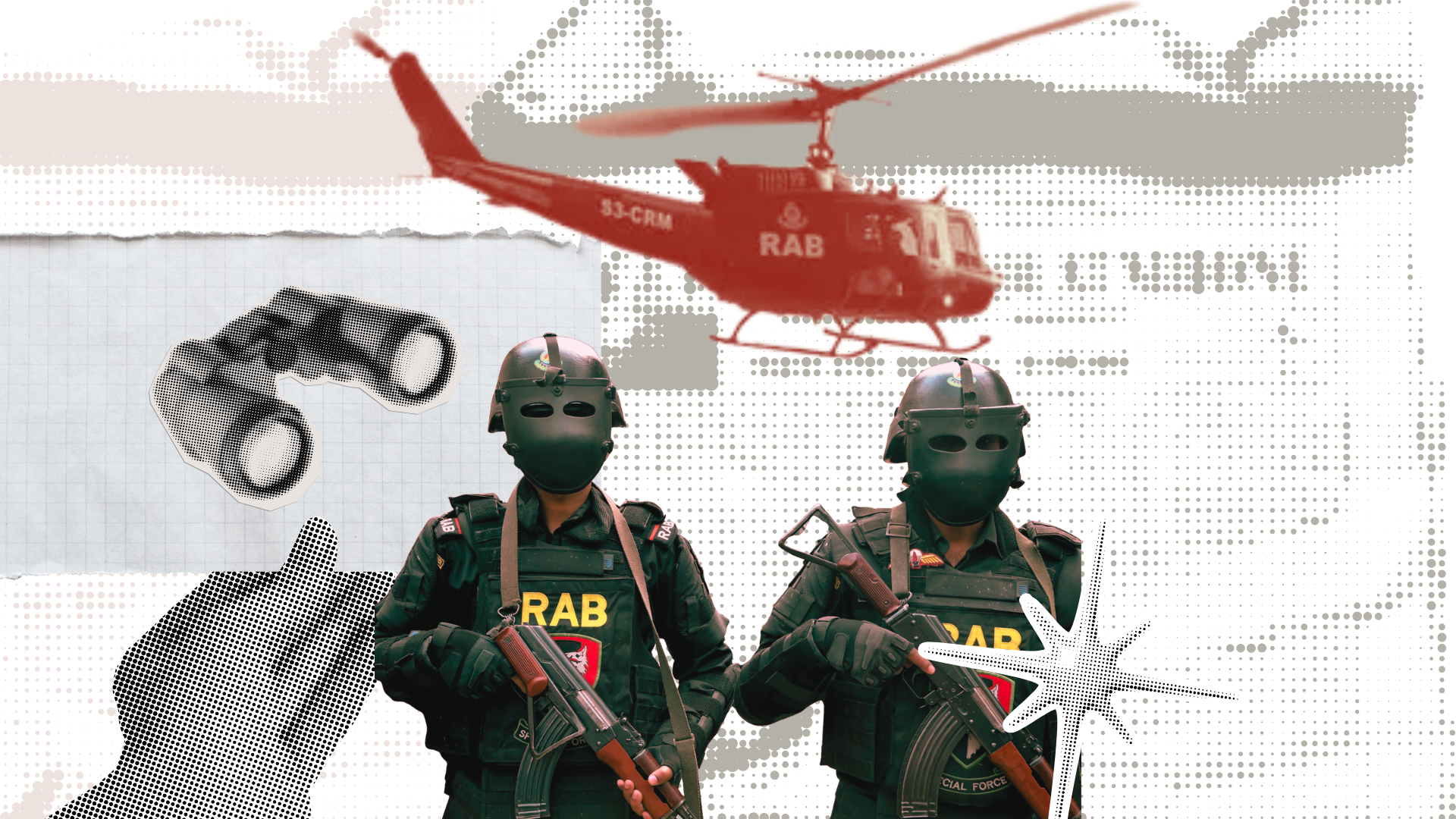
Which leads us to this news. Instead of the total abolition of RAB we get a proposal for it to be renamed to SRB while gloating about why proper reform did not happen. How did we get here in the first place?
The answer lies in an institution which has held power in Bangladesh ever since its birth in both direct and indirect ways- the Bangladesh Army. When 5 August 2024 happened , it happened swiftly. Sheikh Hasina got to escape the country alive and free while the army took power for a temporary amount of time. General Waqar made an announcement to the public announcing the end of the previous regime and eventually the power was handed to the interim government. Yet , the army lingered on in the background, often serving as spokesperson for the government itself when it should have transitioned to a more civilian outfit. The bureaucrats of the past regime stayed on as well, not being purged and being allowed to continue in the same systems.
It would be a lie to say not anyone was purged from the previous regime. There were several transfers , arrest of high profile individuals like Major General Ziaul Ahsan who was a key figure in the forced disappearances of Bangladesh. The problem however is that the arrest of individuals doesn’t remove the systems they used over night. Forced disappearance facilities like Aynaghor serve the army and any government regardless of the regime, so does an extra judicial outfit like RAB( now currently proposed to be known as SRB) as it allows the government to target individuals without making them go through a process of a proper trial- which should be the right of every citizen in a democratic country.
The idea and philosophy of RAB being useful outfits to any government comes from the origin of RAB itself. It was the 2000s, Bangladesh was facing terrorist attacks and threats from JMB and other outfits , in the Southwestern region the government wanted to crack down on Maoist insurgent outfits. The solution to this BNP came up with was to create an organization with members of the military and law enforcement agencies which would carry out extra judicial killings and arrests as a quick way to remedy this problem. Thus , RAB was born in 2004. There was a precedent for carrying out extra judicial operations in Bangladesh before. The Khaleda Zia government early on in its existence did carry out the dreaded Operation Cleanheart and was cheered by the general public for it since the crackdown was portrayed as cleansing Bangladesh of drug dealers, insurgents and terrorists. So with public applause and government approval , RAB came into existence.
There is rarely transparency involved in extra judicial killings and nobody knows whether or not the person who was killed was an actual criminal or a political or government enemy as no investigation is carried out in court of the one who has been killed, arrested, accused or disappeared. As time went on , RAB became the most organized unit in Bangladesh to be tasked with performing things outside the law which would naturally result in human rights abuses all justified under the government in the name of greater good.
As the government in Bangladesh changed from the Khaleda Zia led BNP regime to the caretaker government that was supposed to hold the next elections , Bangladesh faced a military coup and the army took power. The same RAB that BNP patronized had turned on it as it served a new government and a new purpose. BNP , AL and other political party leaders were arrested. RAB would kill numerous student wing leaders of mainstream political parties during this time period as well as continuing crackdowns on Maoist insurgents and other outfits. Oftentimes, the death was attributed to crossfires or trying to resist arrest instead of taking full accountability for the killings.
As the Hasina regime took power, RAB would enter its full potential as the Hasina regime would go on to become a 15 year long dictatorial regime with no accountability in sight. In such an environment, RAB could perform at its best and this is when actors such as Major General Ziaul Ahsan came to light. Even before the Hasina regime completed its autocratic transition, at the behest of geopolitical interests RAB carried out the abduction of BNP MP, Ilias Ali. The reasons for this while attributed to his anti India stance are still unknown. If high profile MP’s were not safe from this extra judicial outfit, common people and activists had no chance against them.
Thus, started the torture chambers and concentration cells of Bangladesh where anti government activists, common people who were suspected of anti government/anti army activity were all taken to these infamous torture cells which would be later known as “Aynaghor”. This would be later uncovered through investigative reports by outlets such as Netra News but there was always a public knowledge that several high profile people in Bangladesh suddenly disappeared and there would be reports of people disappearing after posting/ participating against the government. All of these were meticulously done by RAB.
Which begs the question? Why is this extra judicial outfit allowed to exist? Here are the possible reasons:-
- The need to counteract terrorism quickly
When incidents related to terrorism increase in the country, the public usually demands swift action. Having an organization like that helps to carry out quick operations to satisfy public demand, whether or not they have been effective or not.
- The situation in the hill tracts
The government and the armed forces have an active incentive to curb the insurgencies in the hill tracts whether or not said insurgencies have been the result of policies by the government itself or human rights abuses by the army. The policy of Bangladesh regarding the hill tracts has always been one of restrictiveness on the indigenous people of the land.
- The government’s watchdogs to control the populace
While a lot of the current crop of BNP ministers and their local leaders survived atrocities from RAB, once in power this institution allows them to micromanage targeting those who think could be harmful to their regime in an efficient way. The rebranding is an intentional part to avoid the current US sanctions placed on RAB and its members, sanctions which were meant to curb the activities of RAB. From home minister Salahuddin Ahmad himself: “The US sanctions are still in place. However, if Rab is renamed or a new elite force is raised, they might reconsider the sanctions.”
Human rights activist and a leading contributor of the Commission of Inquiry on Enforced Disappearances in Bangladesh Nabila Idris had this to say about the rebranding of RAB:
“During our investigation, we observed that after the United States imposed sanctions in late 2021, the incidence of crimes involving RAB declined, although it was never completely eliminated. The sanctions made the force’s brand so controversial that some officers were no longer interested in serving there. So RAB’s decision to adopt a new identity is not merely a coincidence.”
Although the name is being changed, the new force is inheriting everything from RAB. This is explicitly stated in the cabinet-approved draft. What it does not automatically inherit, however, is the US sanctions, which are tied to the specific name of the force. In other words, even the deterrent effect that had been working to some extent until now could simply be wiped away.
- The army and the intelligence services
The existence of RAB allows the army and the intelligence services such as DGFI to maintain another layer of power hierarchy in Bangladesh. Throughout Bangladesh’s repeated transitions to democracy and autocracy and back to democracy again, the army has tried to exert both its hard and soft influence on the politics of the country. An extrajudicial outfit consisting of some of its members who work with intelligence provided by the DGFI and under patronage of the government, achieves this aim exactly. The ones in the army who seek to eliminate anyone they perceive as a threat can do so with the help of such an outfit in the name of maintaining civilian peace.
A solution to the increasing human rights abuses of an outfit like this has been suggested to reform RAB altogether. That however raises the question: “Knowing all we have learnt, why should an outfit like this be allowed to exist in the first place?” The correct answer is it shouldn’t. On principle alone, instead of structurally finding out the causes of why terrorists and insurgents occur in the first place, targeting them extra judicially is something wrong. Over time, this extra judicial action not only extends to those who are branded as criminals but ordinary citizens as well. The plight of ordinary citizens is only known when they are exposed after a long time. The damage has already been done due to the media retorting law enforcement narratives in the name of anti-terrorist journalism, things that happened in the Hasina era.
The UN human rights office, OHCHR, recommended in their report after the July Uprising in 2024 to abolish RAB. Proponents of keeping RAB in place argue how else would the government target rising terrorism in the country. Yet, can the government be trusted with this much power when civilians also get the burnt of such “anti terrorism” operations? Special task forces could be made for a temporary period to root out the insurgents and terrorists, structural problems could be addressed on why terrorists and insurgents are born in the country. The networks of recruiters could be targeted even before they manage to recruit young purposeless teenagers into their act. Yet, the BNP government seems to have no interest in doing any of these and wants to enjoy the power of a sanction-less extra judicial outfit for their own ends. They have been letting past ISIS recruiters like Asif Adnan roam around in the wild, have done nothing regarding mob violence in the country and their networks- indicating their desire of a sanction less extra judicial outfit is not about keeping the country safe but to preserve their own power.
Azwad Abdullah Ayan is a contributor at Muktipotro.
