

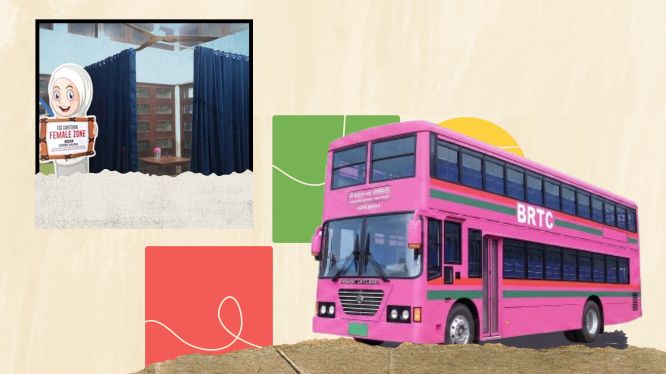
On 18th August 2026, Bangladesh Road Transport Corporation (BRTC) marked a historic milestone by launching 14 female-only bus services across Dhaka, Bogura, and Chattogram, staffed entirely by female drivers and conductors. The project is expected to be launched in other areas of the country as well. It has been enthusiastically welcomed by many women who have to use bus services regularly, and not without reason.
On conventional public buses, the standard policy is to designate nine seats in a bus for women, children and the persons with disabilities, to ensure inclusion. But multiple instances have shown that, in practice, these spaces are often filled by men who do not care enough to leave the seat for the citizens of the designated groups. On different routes, when buses are overloaded with passengers, the conductors usually refuse to take women on board. Even if, after all the hurdles, women do get seats, sexual harassment cases make buses incredibly unsafe for them. To avoid these issues, many women simply take private vehicles such as CNG, Uber, or Pathao, which are too costly. Considering all of this, it is no surprise that this ‘Pink Bus’ project has been immensely popular among women who desire safe and harassment-free bus rides. But does it address the chief culprit of women’s insecurity, or does it sidestep it completely?
While gender-segregated public spaces (public transport, parks or cafeterias) are useful in reducing cases of sexual harassment and allow women to exist without constantly being judged by men, they do not address the patriarchal structure that create these issues in the first place.
Perpetrators, who are mostly men, are not being held accountable for their behaviour in public spaces, and it perpetuates the idea that safe and secure cohabitation between men and women is not possible. It has the potential to turn into a more sophisticated version of the “men will be men” argument: that because male nature is immutable, women need to be isolated. Even under the nine-seat rule, if a woman tries to sit on any other seat, she is often challenged on the grounds that it is not “her seat”. She already has a designated one; why is she trying to sit in another? When harassment occurs outside that section, in many cases the victim is blamed for sitting outside the designated female zone.
These segregationist policies also treat safety as an extra privilege. Why would a woman have to find a seat in the ‘Pink Bus’ to avoid harassment? Why cannot the state and the legal order ensure her safety in the public sphere? The price a woman has to pay for not being able to get on a Pink Bus should never be that she is harassed on a general bus.Yet gender-segregated buses, if framed as the solution to harassment, imply this conclusion. The state must assume its responsibility to ensure women’s safety everywhere. Amid the celebration of the Pink Bus, it is necessary not to forget the caveats these gender segregationist policies have produced previously.
Gender-segregated transit reinforces the dangerous myth that general public space naturally belongs to men, while women are temporary trespassers who require special containment. Eradicating sexual harassment requires a painful, multi-generational overhaul: reforming law enforcement, restructuring judicial proceedings so victims aren’t re-traumatized, dismantling patriarchal social conditioning, and retraining an entire male population to view women as equal human beings. That work takes decades and massive expenditure. A pink bus, by contrast, requires only a coat of paint, a ribbon-cutting ceremony, and a press release that can be executed in a single election cycle to project the illusion of progress.
There has been a trend among authorities in different institutions to uphold women-only spaces as a measure to curb harassment and ensure safe spaces. A notable example recently came in the form of the “Female Zone” inaugurated by DUCSU at the cafeteria of TSC, Dhaka University. While a portion of students celebrated the zone, there was significant opposition to it as well. Many saw the Female Zone as a tokenistic gesture toward women. Female students pointed out that while TSC had far more pressing issues such as the lack of hygiene and maintenance in female washrooms, DUCSU had deliberately decided to focus on the Female Zone.
These have further implications for women practising their agency as well. In a 2025 study titled “Demand for ‘Safe Space’: Avoiding harassment and complying with norms”, Kondylis et al. surveyed women from Rio De Janeiro in general and women-only public spaces. They found that while harassment decreased, it came at the cost of reinforcing harmful patriarchal norms. Women who do not use women-only spaces are judged more harshly than women who do, by both men and women. This restricts women’s agency in public spaces due to the fear of being perceived as morally inferior.
In her essay “Women shouldn’t need special train cars to avoid harassers. Men need to leave women in peace”, feminist writer Jessica Valenti explores the idea of segregation policies taken to their extreme. She writes, “Street harassment is a huge problem, so should we designate women-only city blocks where we can walk free from whistles and catcalls?” Indeed, if harassment is the primary motivation for having women-only buses, it raises the question of where such segregation ends, because harassment neither begins nor ends on public buses.
Therefore, it is important to identify the root cause of why pink buses are deemed necessary: patriarchy. Patriarchy makes the streets and public spaces unsafe for women, and to tackle that insecurity, it is not enough to designate female-only spaces. The perpetrators have to be brought to justice and made accountable for their actions. Only then will it be possible for women to exist safely and freely in public spaces without fear of harassment or moral policing.
The point of this essay is not to oppose the Pink Bus. In a time when women’s safety in public spaces is at an all-time low and misogyny–both online and offline–keeps rising, projects such as Pink Bus are definitely laudable and worthy of appreciation. But while celebrating, we must not forget that it is the state’s duty to ensure the safety of all women regardless of their class, ethnicity or religion. The goal must be to build a society where women choose a specialized service out of convenience and preference, not out of fear of harassment on general buses.
Sadman Ahmed Siam is an independent columnist and a student at the Islamic University of Technology.
