

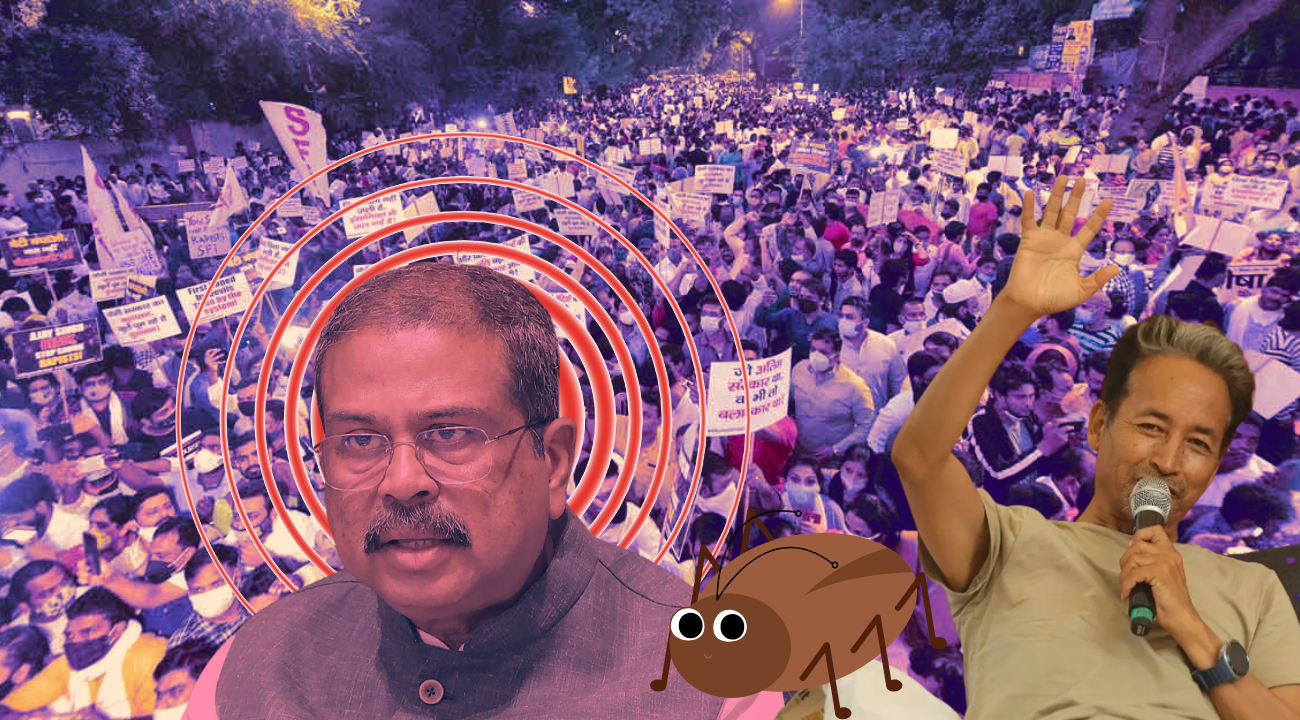
When India’s Chief Justice Surya Kant referred to fraudulent degree holders as “cockroaches” and “parasites,” he probably did not imagine that the insult would become a political identity. But it did.
Abhijeet Dipke embraced the metaphor and turned it into the Cockroach Janta Party (CJP), a satirical parody of the ruling Bharatiya Janata Party. What began as an online joke in May quickly became a mass youth movement. Protesters began calling themselves cockroaches. Some even dressed as them. The joke became serious because the insult resonated. For many young Indians, the “cockroach” was not simply a reference to one judicial remark. It represented how institutions had come to treat an entire generation: as disposable, insignificant, and politically irrelevant. The cockroach, however, has one particular quality it survives. It is difficult to eliminate completely.
The immediate grievance was the NEET examination crisis. India’s National Eligibility-cum-Entrance Test determines admission to the country’s medical colleges and is comparable in importance to Bangladesh’s medical admission examination. Millions of students spend years preparing for it. When allegations of question-paper leaks and irregularities emerged, the damage was not merely administrative. For many students, it felt as though the last institution that was supposed to reward effort, and merit had also become vulnerable to corruption and manipulation. The examination was cancelled and conducted again. Around a dozen students reportedly died by suicide during the turmoil. The crisis became a symbol of a much deeper generational frustration.
The movement received a significant moral boost from Sonam Wangchuk’s hunger strike. For 26 days, the well-known Ladakhi engineer and education reformer fasted in solidarity with the protesters. When Wangchuk was forcibly removed from the protest site and taken to hospital, the movement gained further momentum. The CJP’s demands were clear: accountability, reforms to the examination system, compensation for affected families and the resignation of Union Education Minister Dharmendra Pradhan.
Then, on July 20, more than 10,000 students and young people marched from Jantar Mantar towards Parliament. Police responded with tear gas and batons, injuring protesters and detaining many. Despite the crackdown and heavy rain, hundreds returned the next day for an indefinite sit-in.
The images were strangely familiar to those of us in Bangladesh.
In July 2024, we too went out into the streets with the rain falling over our heads and our lives in our hands. Many of us prayed before leaving home. Parents told their children to be careful. Nobody knew whether they would return that night. Bangladesh’s monsoon became the backdrop of our uprising. Wet roads, soaked clothes, fear of police violence, fear of bullets–and still, people went out. Watching Indian students protest in the rain brings back that memory. The demands are different. The countries are different. But the experience of protest is familiar: when the state refuses to listen, people are forced to speak louder.
And, as always, the movement was accused of being funded by foreign powers. Some attempted to portray CJP as an American- or Chinese-funded conspiracy. But one protester held up a placard with the perfect response: “I am not funded by anyone. I just hate this corrupt government for free.”
The same logic was used in Bangladesh to dismiss the July Uprising as an American-funded conspiracy. As if citizens cannot become angry enough to protest without being paid. As if corruption, repression, unemployment, and humiliation are not sufficient reasons for people to take to the streets. Sometimes people protest because their future has been stolen. And sometimes they simply hate a fascist government for free.
“If my name were Khalid today, I would be in jail.”
When Abhijeet Dipke, a Dalit activist and one of the principal faces of India’s Cockroach Janta Party (CJP) movement, said this, he was not merely making a personal observation. He was making a political statement about India. In a country where the ruling Bharatiya Janata Party has increasingly relied on Hindu majoritarian identity politics, a Dalit leader publicly identifying his own vulnerability with that of a Muslim man is significant. It rejects the politics of division. It rejects the idea that India’s marginalised communities must remain politically separate from one another. And it suggests the possibility of an alternative politics–one built not around Hindu versus Muslim, upper caste versus Dalit, or majority versus minority, but around a more fundamental question: who is being failed by the state?
Many had hoped that, after forcing Dharmendra Pradhan to resign, CJP would go even further. They expected the movement to challenge Narendra Modi himself and demand his resignation. That did not happen. Modi did not resign. The BJP government did not fall. But this does not diminish the movement’s achievement. In fact, the resignation of a Union minister makes the larger lesson more powerful. The movement proved that a government that appears politically untouchable can be forced to retreat. And this is where CJP offers hope beyond India.
Political upheavals in South Asia often begin with something that appears small. Bangladesh’s 2024 uprising began with a quota movement. Sri Lanka’s Aragalaya began amid fuel shortages and the rising cost of essential goods. Nepal’s recent youth protests emerged from anger over restrictions on social media and wider frustration with political elites. The immediate trigger is often only the spark. Beneath it lie years of accumulated anger. Bangladesh’s quota movement became a revolt against authoritarianism, corruption, repression, and democratic backsliding. Sri Lanka’s fuel crisis became a revolt against political privilege and economic collapse. In India, the NEET crisis has become a vessel for the anger of a generation that feels that education, hard work, and merit no longer guarantee a future.
This is why the CJP movement matters even if it never topples Modi. The point is that the BJP cannot simply assume that it can do anything and remain beyond challenge. Institutions that appear untouchable can be questioned. Governments that appear invincible can be confronted. And leaders who appear politically unshakeable can, in fact, be shaken. The CJP movement has already done something remarkable. It began as satire. It became a mass movement.
And perhaps that is where hope begins. Because the first sign that a throne may someday fall is not necessarily that the ruler has fallen. Sometimes, it is simply that the chair has begun to shake.
Ishmam Zaman is a contributor at Muktipotro.
