

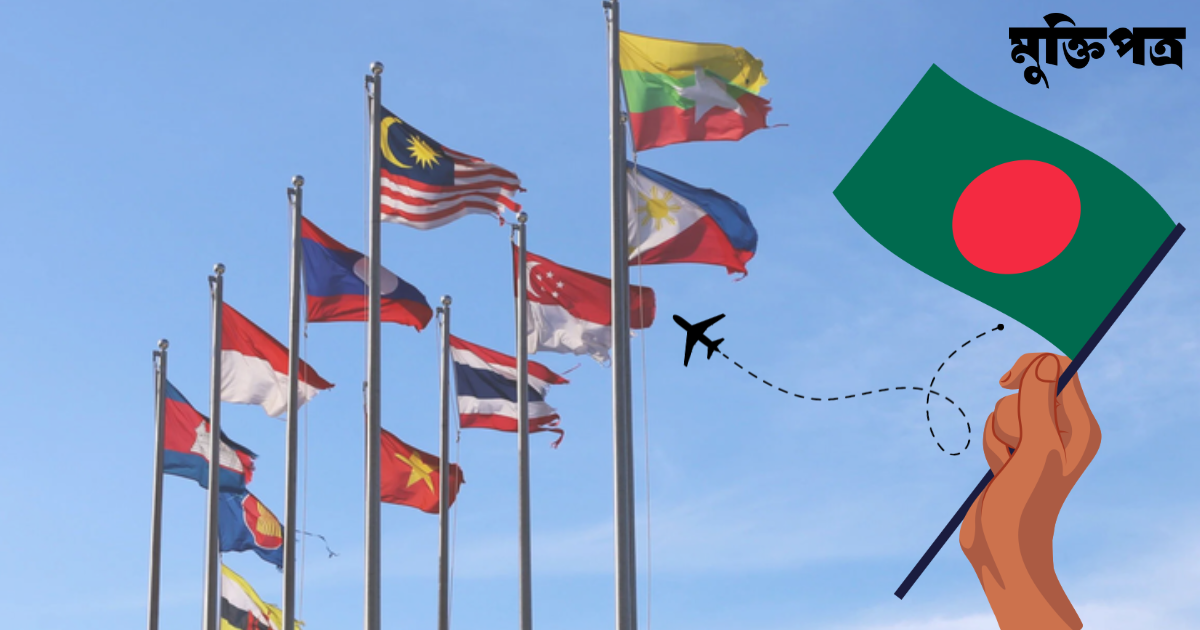
On 21 June 2026, Prime Minister Tarique Rahman left Bangladesh with a small number of entourage for his maiden foreign visit after the BNP government came to power. For years, the traditional maiden destination of the country’s prime ministers has either been New Delhi or Beijing. However, Tarique was not bound for either of the two. Rather, the delegation bypassed both the capitals to land in Kuala Lumpur, the capital city of Malaysia. Academicians, policy-makers and citizens, no one imagined that the new Prime Minister’s ultimate destination would be Malaysia until it was announced by the government. This was not a mere scheduling accident. Rather, It was a manifestation of a structural shift, the implementation of Dhaka’s new ‘Bangladesh First’ stance. Bangladesh is moving towards a ‘Looking East Policy’ (LEP), something that first emerged during the premiership of Begum Khaleda Zia (2001-2005).
The idea of ‘looking East’ is not necessarily a new one. Mahathir Mohamad of Malaysia and P.V. Narasimha Rao of India also implemented ‘looking East’ policies for their respective countries. One of the main reasons for these is the miraculous emergence of East Asian and Southeast Asian nations in the world economy. But Bangladesh’s LEP started with a problem with its neighbour. The Bangladesh Nationalist Party – BNP didn’t have the warmest of relations. Khaleda Zia’s government has faced delicate situations with India over several issues including border management, security allegations and trade barriers. As a result, the early LEP tried to find an alternative orbit for Bangladesh. One of its significant milestones was the Bangladesh-China Defence Cooperation Agreement of 2002, a bilateral military agreement encompassing training, equipment supplies and joint exercises which established Beijing as a security anchor for Dhaka. As this early LEP was a counterweight against Delhi, it succeeded in that purpose but failed to deliver a balanced economic integration with other Eastern and Southeastern states.
Regardless of some regime changes since then, Bangladesh didn’t move away from looking to the East. During the long rule of Awami League, the specific wording of ‘Look East Policy’ was dropped from state rhetoric as it was closely aligned with the policy of BNP. Over the last decade, Southeast Asia has become a large destination for Bangladeshi labourers and a possible destination for other sectors such as pharmaceuticals and in the meantime Bangladesh can increase energy imports from Indonesia and Brunei.
The contemporary importance of ‘Looking East’ cannot be understood without looking at the decay of the bond among South Asian nations. According to the data of the World Bank, intraregional trade accounts for only 5 percent of South Asia’s total trade where the ASEAN’s is 25 percent. Furthermore, the estimated value of trade among South Asian states is $67 billion but totals at only $23 billion. That said, it is easier for a company in India to trade with Brazil rather than trading with a neighbouring South Asian country. As a result, the decay of South Asian organisations has been apparent. SAARC has been functionally defunct since the middle of 2010s and alternative sub-regional organisations such as BIMSTEC and BBIN have struggled as well, frequently held hostage by regional disputes.
Bangladesh’s strategic calculation has evolved following this vacuum in South Asia, from a passive desire to ‘look east’ to actively pursuing it. Bangladesh has been pushing for Sectoral Dialogue Partner (SDP) status with ASEAN since the interim period. During his bilateral talks with the Malaysian PM, Tarique Rahman reiterated Dhaka’s desire to secure the SDP status while simultaneously expressing strong interest to join the Regional Comprehensive Economic Partnership (RCEP), the largest free-trade bloc in the world.
While the Article 6 of the ASEAN Charter dictates that only Southeast Asian states might join the organisation, Dhaka’s diplomatic push portrays Bangladesh not as an outsider but as a critical maritime and logistical bridge connecting the markets of South Asia and Southeast Asia. Bangladesh is the central state geographically when it comes to the Bay of Bengal. Both Bangladesh and Southeast Asia have a lot to offer to each other. For example, Timor-Leste became the 11th member of ASEAN after waiting for 14 years. If Bangladesh can prove its worth to the community, it will be an outstanding diplomatic victory which can open many doors we barely think of today. Bcaked by the UN Committee for Development Policy (CDP), Bangladesh might graduate from the LDC in 2029′, it can be the most important step Bangladesh can take for its economy, citizens, and for future generations.
