

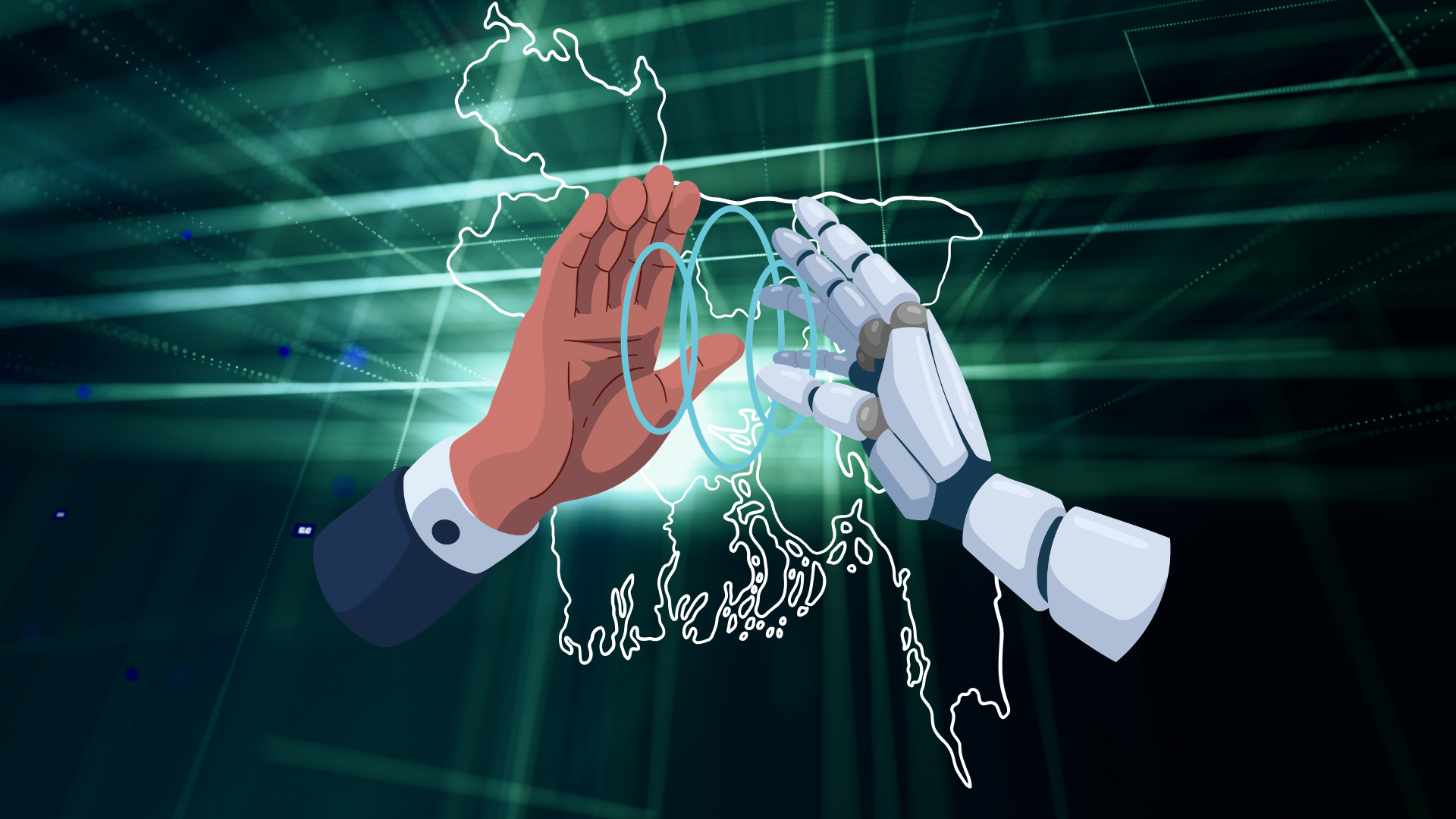
The “miracle” of the modern artificial intelligence model has a human face, and it looks remarkably like a sleep-deprived graduate in a rented room in Uttara, clicking a mouse at 3:00 AM. While Silicon Valley venture capitalists toast to a future of “autonomous” labor and artificial intelligence, the quiet, uncomfortable truth is that their algorithms are currently being potty-trained by a hidden army of youth in the Global South. We are told we are part of a digital revolution; in reality, we have been recruited into a global cognitive sweatshop. For years, the national narrative has pivoted on the “Digital Bangladesh” success story, a vision of a tech-savvy generation leaping over the hurdles of traditional, sweat-stained industry to claim a stake in the global digital frontier. Government press releases frequently boast of our demographic dividend, pointing to data from the ICT Division that Bangladesh has over 650,000 registered freelance workers. The Oxford Internet Institute’s Online Labour Index regularly ranks Bangladesh as the second-largest supplier of online labor in the world, currently accounting for a 16% share of the total global workforce.
But strip away the glossy LinkedIn testimonials and the state-sponsored entrepreneurship awards, and a darker architecture emerges. The frontier has arrived, and it looks remarkably like the East India Company, just rendered in high-resolution pixels. We are not building a tech revolution; we are running a digital plantation. Our youth are not being hired as architects of the future; they are being utilized as “data janitors”. A vast majority of our celebrated freelancers are not writing sophisticated code or designing global platforms. Instead, they are performing the invisible, low-wage “ghost work” of data labeling, content moderation, and algorithmic training. They spend their prime intellectual years performing the repetitive, soul-crushing labor of drawing tiny digital boxes around pedestrians, stop signs, and traffic lights on video feeds recorded halfway across the world. This is the HITL (Human-in-the-Loop) economy, a system where human intelligence (HI) is extracted at scale to minimize the error rates of machine learning models for a trillion-dollar software industry.
The economic irony here is not just cruel; it is cannibalistic. We are celebrating a freelance “boom” that is actually a race to the bottom. When a Bangladeshi graduate with a degree in finance or engineering spends ten hours a day teaching a neural network how to recognize a spreadsheet, they are essentially being paid a few cents to sharpen the very blade that will eventually render their own professional future obsolete. This isn’t skill development; it is a fire sale of our national brainpower. We are trading our demographic dividend for a few million dollars in remittance, while the intellectual property—the actual “intelligence” in the AI—is locked away in the black boxes of Northern California.
To call this “entrepreneurship” is a form of state-sponsored gaslighting. By framing precarious, piece-rate labor as “freelance liberation,” we absolve ourselves of the need to build a domestic industry that actually values human thought. The worker in the Silicon Sweatshop has no labor rights, no medical benefits, and no upward mobility. They exist in a state of cognitive serfdom, where their only value is providing the “raw material” of human logic to be processed, patented, and sold back to the world as a premium subscription.
If we continue to measure our tech success by the number of young people clicking boxes for pennies, we are merely repeating the mistakes of the garment era on a digital scale. We are selling our labor cheap, ignoring the environmental and mental toll, and failing to capture any of the value we create. The Western AI industry doesn’t want our innovation; it wants our “humanity” at a discount.
The “over-education trap” represents a massive misallocation of human capital. When a graduate with a degree in finance or engineering spends ten hours a day teaching a neural network how to recognize a spreadsheet, the nation loses the potential innovation that these individuals could have contributed to a domestic tech sector.
Furthermore, our reliance on these digital micro-wages feeds into a broader “Remittance Paradox” that masks structural weaknesses in our economy. While remittance inflows reached a record 30 billion in FY25, providing a vital source of foreign exchange, this dependency allows policymakers to delay necessary reforms in infrastructure and education. This paradox is characterized by three key factors. First, the abundance of foreign currency can lead to an appreciation of the real exchange rate, making other exports less competitive—a phenomenon often associated with “Dutch Disease”. Second, the reliance on low-skilled migration to the Gulf region—which returns approximately 816 annually per additional worker—makes the economy highly susceptible to external labor-market disruptions and geopolitical volatility. Third, the fact that 80% of these funds are spent on survival—food, healthcare, and debt repayment—means that remittances are not being channeled into productive capital, such as domestic technology startups or high-value manufacturing.
The historical echoes are unmistakable. In the nineteenth century, the British Empire extracted jute and indigo from this delta to fuel the looms of Lancashire. Today, the extraction is intimately cognitive; the raw material is human intelligence (HI). The worker in the Silicon Sweatshop produces logic, which is then internalized by software owned entirely by trillion-dollar corporations in Northern California and sold back to the world as a premium subscription service. The Bangladeshi worker retains zero equity, zero intellectual property, and zero digital sovereignty. They are the “ghosts” in the machine—performing the labor that allows AI to appear “magical” while being denied the labor protections, healthcare, or minimum wages that the “real” world demands. To call this “freelance liberation” is a form of state-sponsored gaslighting. By framing precarious, piece-rate labor as entrepreneurship, we absolve ourselves of the monumental task of building a domestic tech industry that actually values human thought.
If we continue to measure our macroeconomic success by the sheer volume of young people clicking boxes for pennies, we are merely repeating the historical mistakes of the garment era on a digital scale. We are selling our labor cheap, ignoring the mental and environmental toll, and failing to capture any of the long-term wealth we create. The cycle of exploitation that begins in the digital sweatshop even extends to environmental degradation, as the Global South increasingly serves as the dumping ground for the world’s discarded commodities. If Bangladesh is to be more than a data sharecropper for the Global North, a fundamental pivot is required. We must move from “training the models” to “owning the models”.
Bangladesh must decide if it wants to be a nation of creators or a nation of data-sharecroppers. The current trajectory suggests we are satisfied with the latter, providing the invisible, exhausted scaffolding for a world that will eventually have no place for us. To break this cycle, a fundamental pivot is required toward true digital sovereignty. This must include the legal recognition of gig labor through a Digital Labor Law that mandates minimum wage standards indexed to the local cost of living and healthcare contributions from international platforms. We must also move from “training the models” to “owning the models,” channeling remittances into productive domestic technology innovation. It is time we stopped applauding the “resilience” of our freelancers and started questioning the geopolitical system that asks them to spend their youth training the machines that will replace them.
First, we must demand a Digital Labor Law that legally recognizes gig workers, mandating that international platforms provide minimum wage standards indexed to our local cost of living and healthcare contributions. Second, we must introduce remittance-linked finance products to channel our expatriate wealth into funding domestic technology innovation and state-of-the-art recycling infrastructure. By bypassing the informal “muscle men” and formalizing the $5 billion textile recycling market and the $500 million e-waste sector, we can create thousands of dignified jobs while mitigating toxic health impacts. Finally, we must dismantle the surveillance dragnet by replacing current laws with robust data protection legislation centered on human rights and “data minimization”.
The sun rises over Dhaka, Chittagong, and Gazipur, but for the millions of young men and women who have spent the night clicking boxes for pennies, the future does not look “digital”. It looks like the same old exploitation, rendered in high resolution. If Bangladesh is to become a nation of creators, it must stop applauding its own resilience and start demanding its own sovereignty. The global tech frontier has arrived, but without radical economic reform, we are merely providing the invisible scaffolding for a world that has no intention of making a place for us. It is time we stopped applauding the “resilience” of our freelancers and started questioning the geopolitical system that asks them to spend their youth training the machines that will replace them. The sun is rising over a new kind of factory in Dhaka, and while the sound of the looms has been replaced by the click of the mouse, the scent of exploitation remains the same.
Jannat Binte Aslam is a contributor at Muktipotro.
