

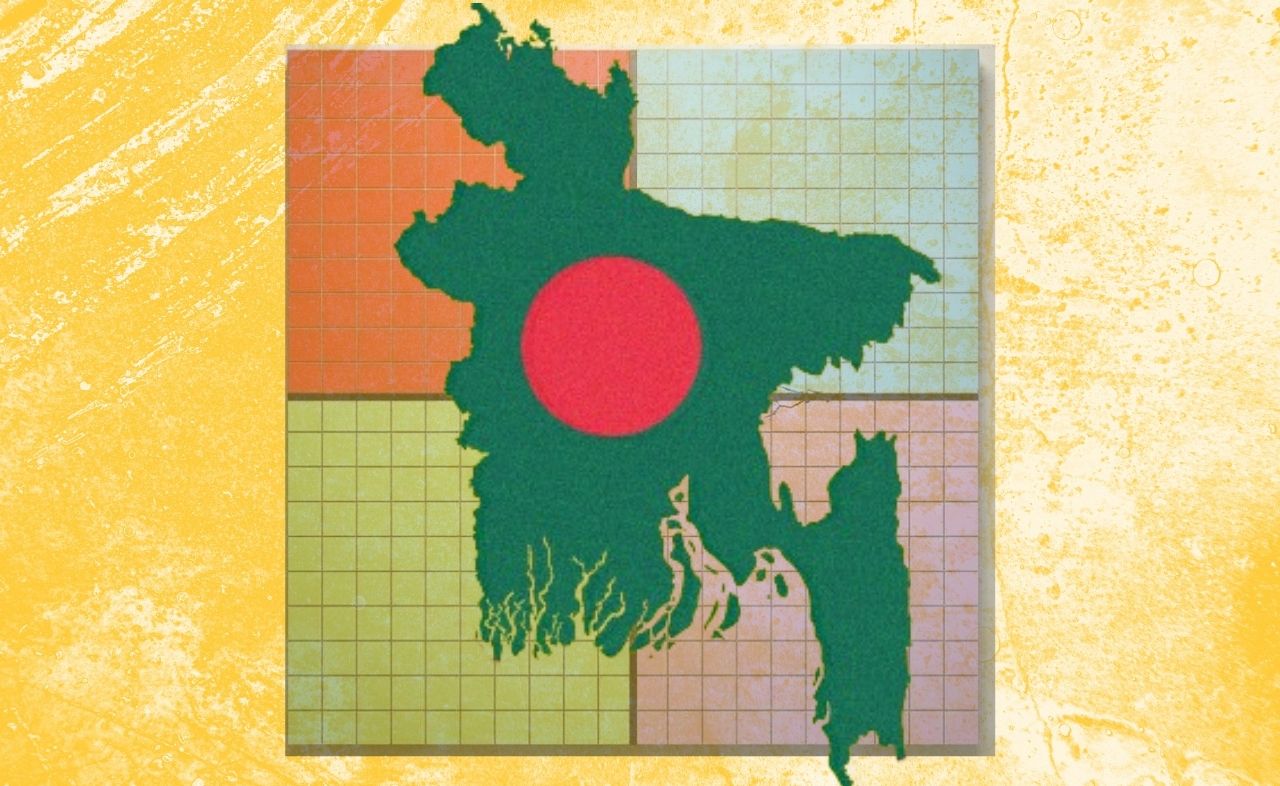
Something profound has happened to Bangladeshi society over the past two decades. It cannot adequately be described simply as political polarisation, religious revival, moral decline or democratic erosion, although elements of all four are present. What appears to be occurring is more consequential, the gradual erosion of the moderate middle—the social space in which religious belief coexists with tolerance, political disagreement without hatred, intellectual independence without social exile, and personal ambition without complete abandonment of ethical restraint. Comparative scholarship on polarisation suggests that precisely this erosion of a politically legitimate middle can transform ordinary partisan competition into a struggle between mutually distrustful social camps (McCoy, Rahman, & Somer, 2018).
At one end of society, corruption, political patronage, fraud, extortion and the normalisation of rule-breaking appear increasingly embedded in everyday institutional life. This does not necessarily mean that Bangladeshis have suddenly become more criminal, such a claim would require evidence that does not exist. Rather, unethical behaviour has become sufficiently visible and recurrent to weaken confidence that honesty is socially rewarded. Transparency International’s (2026) 2025 Corruption Perceptions Index gives Bangladesh only 24 out of 100, ranking it 150th among 182 countries. Where institutions repeatedly fail to reward rule-following behaviour, informal practices, patronage and personal networks can gradually displace confidence in impersonal rules.
At the other end, a visibly more religious public sphere has emerged. Greater religious observance is neither socially undesirable nor intrinsically connected to extremism. Indeed, authentic religiosity can be one of society’s strongest sources of compassion, self-restraint and moral responsibility. The analytical problem begins when religious appearance becomes a substitute for religious ethics, or when faith is transformed from personal conviction into an instrument for judging the citizenship, morality and legitimacy of others. This distinction resonates with José Casanova’s argument that the public resurgence of religion does not in itself determine whether its political consequences will be democratic, exclusionary or emancipatory; much depends upon the institutional and political context within which religion enters public life (Casanova, 1994).
Thus, Bangladesh confronts a paradox: conspicuous religiosity can expand at the same time as corruption remains pervasive. Mosques may become fuller without public offices becoming cleaner. Religious vocabulary may multiply while honesty, compassion, justice and restraint do not necessarily expand alongside it. This distinction between religion as ethical discipline and religion as social identity is essential. Émile Durkheim explains part of the puzzle. Religion does much more than connect individuals to the divine, it produces collective identity (Durkheim, 1912/1995). When conventional institutions become weak, people search more intensely for communities capable of providing certainty, belonging and moral meaning. Religion can fulfil that role magnificently. But under conditions of political competition, it can also become a badge distinguishing “us” from “them.”
Human beings naturally classify themselves into groups. Once political entrepreneurs convert ideological differences into moral identities, opponents cease to be merely wrong, they become corrupt, dangerous, irreligious, anti-national or enemies of society. Politics then moves from competition over policies towards competition over who possesses moral legitimacy to belong. This is where Bangladesh’s political history matters.
The Constitution of 1972 established secularism among the foundational principles of the new republic. Importantly, Bangladeshi secularism was never necessarily intended to mean hostility towards religion. It was primarily concerned with preventing the political exploitation of religion following the traumatic experience of Pakistan. Subsequent political regimes altered that settlement: secularism was removed from the constitutional framework, religion-based politics returned, and Islam was declared the state religion in 1988. Secularism was eventually restored, while Islam simultaneously remained the state religion.
The resulting ambiguity reflects something deeper than constitutional drafting. Successive political actors discovered that religious symbolism possessed electoral and legitimating power. Even ostensibly secular parties learned to negotiate with religious constituencies. Politics therefore did not simply respond to social polarisation, politics helped manufacture it.
The consequences became dramatically visible during the confrontations surrounding secular bloggers, religious activists and competing mass movements during the 2010s. A series of brutal murders of bloggers, writers, publishers and activists demonstrated how disagreement could mutate into the denial of another person’s right to exist. In 2015 alone, several secular writers were murdered by Islamist militants. These killings were part of a broader pattern of violent intolerance directed at secular and freethinking voices. Yet intolerance has never belonged exclusively to religious extremists. Authoritarian political practices, partisan intimidation, suppression of opposition, attacks on journalists, online harassment and majoritarian mob behaviour have emerged from multiple ideological directions. This is why Bangladesh’s problem cannot intelligently be reduced to religious versus secular.
The society becomes organised around two antagonistic camps, while institutions, friendships, professions and even interpretations of truth are increasingly filtered through partisan identities. Extreme polarisation frequently accompanies democratic decline because citizens eventually tolerate undemocratic behaviour from their own side simply to prevent the opposing camp from winning. Here lies perhaps Bangladesh’s greatest contemporary danger: moral judgement has become partisan rather than principled.
Corruption committed by one’s political opponent generates outrage, corruption committed by one’s ally produces explanation. Violence by the other side becomes barbarism, violence by one’s own side becomes necessity. Religious insult is condemned when directed towards one’s own beliefs but occasionally celebrated when directed towards another community. Free speech becomes sacred when protecting friends and dangerous when protecting adversaries. That is not morality. It is tribalism dressed in moral language.
Democracy requires morality, but democratic morality is not identical with imposing religious conformity. It requires self-restraint, the willingness to possess power without abusing it and to possess conviction without denying another person’s dignity. Hence, liberty requires protection not merely from governments but from the “tyranny of the majority,” whereby dominant social opinion can suffocate individuality and dissent even without formal state coercion. That warning is especially relevant to societies in which political and religious identities increasingly become tests of social acceptability.
Islamic moral philosophy points in much the same direction. The Qur’anic injunction that “there is no compulsion in religion” establishes an extraordinarily important principle about conscience. The Qur’an similarly demands justice even where judgement concerns those towards whom one feels hostility, “Let not the hatred of a people prevent you from being just” (Qur’an 5:8). The Islamic tradition also places adl—justice—at the heart of legitimate social order. A society cannot compensate for corruption merely by increasing religious symbolism; justice remains the test. Why, then, is the moderate middle shrinking?
One explanation is institutional. Universities, political parties, professional associations, cultural organisations and civil society historically produced mediating voices—teachers, writers, lawyers, religious scholars and politicians capable of speaking across ideological boundaries. When these institutions themselves become partisan, intellectual independence becomes costly. Therefore, functioning democracies require networks of trust and civic association capable of connecting citizens beyond narrow private loyalties.
A second explanation is technological. Social media rewards certainty more generously than nuance. Anger travels faster than reflection. Algorithms do not naturally reward the person who says, the other side may have a point. They reward outrage, ridicule and moral absolutism. Emotionally charged and morally outraged content can diffuse unusually rapidly through social networks, creating incentives for increasingly extreme forms of political expression.
A third explanation is political. When institutions cannot reliably deliver justice, employment, equality and dignity, citizens search elsewhere for moral order. Religious movements may then attract people not simply because society has become more theological but because existing political arrangements appear morally exhausted. In such moments, competing groups seek to fill the vacuum by offering new narratives of authority, belonging and moral restoration.
Finally, there is a leadership deficit. Bangladesh once produced politicians, intellectuals and religious personalities who could disagree profoundly while recognising intellectual sophistication in their opponents. Today’s incentive structure favours loyalists, influencers and ideological warriors. The centre does not disappear because moderate people vanish biologically; it disappears because moderation stops being rewarded. Once that capacity disappears, disagreement readily becomes dehumanisation.
Bangladesh therefore needs something more ambitious than secularisation, Islamisation or another round of partisan realignment. It needs the reconstruction of a civic middle—a society in which a devout Muslim can defend a secular citizen’s freedom, a secular intellectual can respect religious belief, an opposition supporter can acknowledge a government’s success, and a government supporter can condemn its wrongdoing.
The measure of civilisation is not whether everyone believes the same thing. It is whether profoundly different people can inhabit the same political community without wishing to silence, humiliate or eliminate one another. Our great challenge, therefore, is not that religion has become stronger or that secularism has become weaker. It is that the territory between extremes—occupied by restraint, intellectual honesty, moral consistency and tolerance—has become dangerously thin. And when the middle disappears, democracy rarely remains standing for long.
Sources
Casanova, J. (1994). Public Religions in the Modern World. Chicago: University of Chicago Press.
Durkheim, É. (1912/1995). The Elementary Forms of Religious Life. New York: Free Press.
McCoy, J., Rahman, T., & Somer, M. (2018). Polarization and the global crisis of democracy: Common patterns, dynamics, and pernicious consequences for democratic polities. American Behavioral Scientist, 62(1), 16–42. https://doi.org/10.1177/0002764218759576
Transparency International. (2026). Corruption Perceptions Index 2025.
