

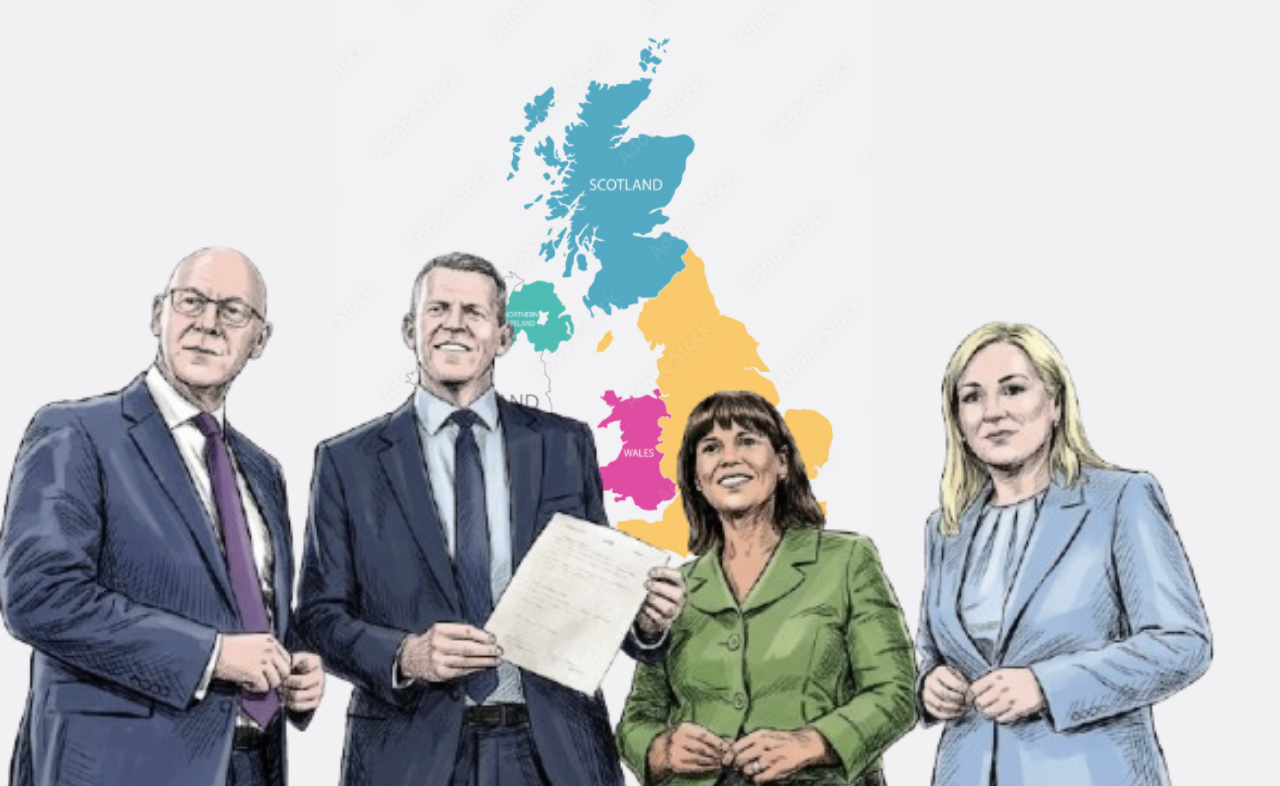
On 14 September, Cardiff, the capital of Wales, became the stage for an unusual kind of political alliance.
The leaders of Scotland’s Scottish National Party, Wales’s Plaid Cymru and Northern Ireland’s Sinn Féin came together to call for political and constitutional change across the United Kingdom. Their memorandum of understanding declared that the nations they represent have the right to determine their own futures and called on the British government to “prepare for, plan and facilitate constitutional change” in each jurisdiction.
It was easy to read the meeting as another sign that the United Kingdom is coming apart.
The imagery certainly encouraged that interpretation: three nationalist or pro-unification movements, gathered in the same city, challenging Westminster and speaking of a future in which the nations of these islands could relate to one another as equals.
There is an irony here. A political system that has long presented itself as one of the world’s most durable constitutional arrangements is increasingly being asked, from within, to explain what exactly holds it together.
There is also a problem with treating the Cardiff meeting as one movement.
Scotland wants independence from the United Kingdom. Wales has a growing debate over whether it should seek independence, alongside demands for a substantially different devolution settlement. Northern Ireland’s question is different again: its defining alternative to remaining in the UK is not an independent Northern Ireland, but reunification with Ireland.
Even the agreement recognises this. The three parties say that they have “different constitutional positions” and that each nation will determine its future “in its own way and in its own time.”
The answer to why they met may tell us more about the UK’s political crisis than the question of whether the country will actually break apart.
Beneath the different destinations lies a shared argument: that the people of Scotland, Wales and Northern Ireland should have greater control over the political future of their own nations, rather than having that future ultimately determined at Westminster.
That does not make their political projects identical. Nor does a joint memorandum make the dissolution of the United Kingdom inevitable.
What happens when different nations want different futures, but increasingly agree on who should get to decide them?
Scotland provides the clearest example of the tension between political mandate and legal authority. The 2014 independence referendum produced a 55.3 percent vote to remain in the UK, but the question did not disappear. The SNP continued to make independence central to Scottish politics, while Brexit added another layer to the debate over Scotland’s relationship with the rest of the UK.
The legal problem became sharper in 2022. The UK Supreme Court ruled that the Scottish Parliament did not have the power to legislate unilaterally for an independence referendum because the subject related to reserved matters, including the Union itself.
The question remains current. At the May 2026 Scottish Parliament election, the SNP again emerged as the largest party, winning 57 seats, although without an overall majority. A majority of MSPs subsequently endorsed another request for a Section 30 Order to enable an independence referendum, but the UK Government rejected it, leaving the same tension between political mandate and legal authority in place as the leaders gathered in Cardiff.
That created an unusual democratic tension. Scotland could debate independence, elect governments committed to it and pass resolutions supporting another referendum, while the legal route to actually holding one remained dependent on agreement with Westminster.
The issue, therefore, is larger than whether Scotland wants independence. It concerns who has the authority to initiate the process through which that preference could be formally tested.
Wales occupies a different position.
For much of the devolution era, Welsh politics was less dominated by independence than Scottish politics. The argument has instead centred on the powers of the Senedd, the distribution of resources and the question of whether Wales has enough institutional authority to shape its own future.
That debate has broadened. Independence is now one possibility within a much larger discussion that includes stronger devolution, federalism and a looser multinational arrangement.
This makes Wales particularly important to the Cardiff alliance. Its future does not have to follow Scotland’s path for the Welsh argument to challenge the existing structure of the Union. Wales can ask for more power without immediately asking for a separate state.
That distinction matters because it opens a possibility often lost in the language of “breakup”: Britain could change substantially without disappearing.
Northern Ireland follows yet another route.
The Good Friday Agreement established the principle that Northern Ireland’s constitutional status rests on consent. It can remain part of the United Kingdom for as long as a majority there wishes, while the possibility of a united Ireland remains available through democratic consent. The agreement also recognises the right of people in Northern Ireland to identify as British, Irish, or both.
This makes the Northern Irish question fundamentally different from Scotland’s. The alternative to the Union is not primarily an independent Northern Irish state. It is a different sovereign arrangement on the island of Ireland.
The three movements therefore do not share a destination. They share a principle.
That is the most interesting feature of Cardiff.
The agreement is not a blueprint for a new state. It does not explain what the post-UK arrangements would look like, how institutions would be divided or what relationship the three territories would have with one another. Instead, it creates political cooperation around the proposition that each nation should have the ability to determine its own path.
That distinction also explains why the alliance can exist despite the differences between its members.
They can cooperate on energy, economic policy, international relations and relations with Europe without agreeing on the final shape of the state. They can share an interest in increasing political autonomy without agreeing on whether autonomy should end in independence, federalism or Irish reunification.
The alliance is therefore strongest at the level of principle and weaker once principle becomes procedure.
Who authorises a referendum? Who decides when it can happen? What should the ballot question be? How would public debt and pensions be divided? What happens to defence arrangements, trade agreements, citizenship and international treaties? Which institutions continue, and which have to be rebuilt?
Those questions are not technical details that can be settled after the political argument. They are part of the political argument itself.
Political solidarity is not constitutional coordination.
The deeper difficulty comes from the structure of the United Kingdom itself. Devolution has created three national legislatures with different settlements, while Westminster remains the central Parliament. Scotland, Wales and Northern Ireland have legislative institutions, but their powers and legal frameworks are not identical. England, meanwhile, has no equivalent national parliament.
Then there is the question of parliamentary sovereignty. The UK does not have a single codified constitutional document setting out a permanent division of powers between the centre and its constituent nations. Its constitutional order has developed through legislation, conventions, judicial decisions and political practice. The House of Commons Library describes this flexibility as a defining feature of the UK’s uncodified system.
Flexibility has been one of the system’s great strengths. It has allowed institutions to evolve without requiring the kind of constitutional rupture seen in countries that operate under a single entrenched document.
The same flexibility can also become a source of uncertainty when the parties involved disagree about who has the authority to change the system.
This is where federalism enters the discussion.
A federal United Kingdom would not require Scotland, Wales and Northern Ireland to become independent states. It could involve a more entrenched distribution of powers, clearer rules between Westminster and the devolved governments, stronger fiscal authority and a more symmetrical relationship between the nations.
That would still leave difficult questions, particularly concerning England. A genuinely federal settlement would have to decide how England is represented, whether power should be devolved within England, and how an English political centre would relate to the smaller nations.
The choice facing the UK is therefore more complicated than Union versus independence. There is a wide political space between the existing settlement and complete separation.
For people who experience the UK as an everyday space rather than an abstract constitutional arrangement, the consequences become even more complicated.
Consider a student from Dhaka who moves to Edinburgh on permission to live and study in the UK. At present, travelling from Edinburgh to London does not mean crossing an international border. The same person can build a life involving Scottish universities, an English employer, relatives in Wales and family connections elsewhere.
A change in sovereignty would not automatically mean hard borders between these places. Much would depend on whatever political settlement followed. Immigration rights, movement, citizenship and access to work could remain closely connected or become subject to new rules.
The same uncertainty would affect the large South Asian communities whose lives span the different parts of the United Kingdom. Families, workplaces, universities, businesses and remittance networks do not follow constitutional boundaries neatly.
Money illustrates the point. Someone sending income from Glasgow to relatives in Dhaka does so through a financial system in which the currency is ultimately measured in Bangladeshi taka at the receiving end. If Scotland became independent, questions about currency, central banking, public debt and trade would become part of the negotiation. There is no automatic answer built into the word “independence”.
Identity is even harder to divide.
A person can be Scottish and British. Welsh and British. Irish and British. British and South Asian. Northern Irish and Irish. Northern Irish and British. These identities do not necessarily cancel one another out.
The Good Friday Agreement recognised this unusually explicitly by protecting the right of people in Northern Ireland to identify as British, Irish or both.
That is a reminder that political sovereignty and personal belonging are not the same thing. A passport can change more easily than a sense of belonging.
The monarchy presents another version of the same problem. The Crown is one of the institutions that gives continuity to the present British state, but a future transformation of the Union would not necessarily mean the disappearance of the monarchy itself. Its political meaning could change even if the institution survived.
The larger consequences would extend beyond domestic politics.
The UK is a nuclear-armed NATO member, and its nuclear submarine force is based at HM Naval Base Clyde in Scotland. The UK government continues to describe the nuclear deterrent as central to its defence policy.
A change in Scotland’s status would therefore raise questions extending well beyond Edinburgh and London: the future of the submarine base, defence arrangements, NATO relationships and the wider security architecture of the British Isles.
Relations with Europe would also be affected. The Cardiff memorandum explicitly calls for stronger European cooperation and argues that the three nations should rebuild relationships with the European Union.
The implications would not be confined to Europe. Changes to sovereignty would touch trade, diplomatic representation, international agreements and the distribution of responsibilities currently exercised by the UK as a single state.
This is why the word “breakup” can be misleading.
A breakup sounds like an event: one morning there is a United Kingdom, and later there are several countries.
Political change is rarely that clean.
It would be a process involving legislation, negotiations, institutions, debt, borders, citizenship, voting rights, pensions, trade, defence, international treaties and questions that have not yet been fully imagined.
Cardiff did not resolve any of these issues. It did something more limited, but potentially more significant. It brought together political movements that disagree about what should replace the present Union, while agreeing that the people of their respective nations should have a greater role in determining that future.
That is why the meeting should not be understood simply as a coordinated march towards the same destination.
Scotland, Wales and Northern Ireland may ultimately arrive at very different places: one seeking independence, another pursuing a radically restructured Union, another eventually facing the question of reunification with Ireland. Their cooperation does not erase those differences.
It exposes them.
The United Kingdom has survived for centuries partly because its political structure has been capable of changing without always requiring a clean constitutional break. The question now is whether that flexibility can accommodate nations whose political movements increasingly want more authority over the terms of their own futures.
Cardiff therefore leaves Britain with a question larger than whether the Union will survive.
It asks who gets to decide what the Union becomes.
