

INTRODUCTION
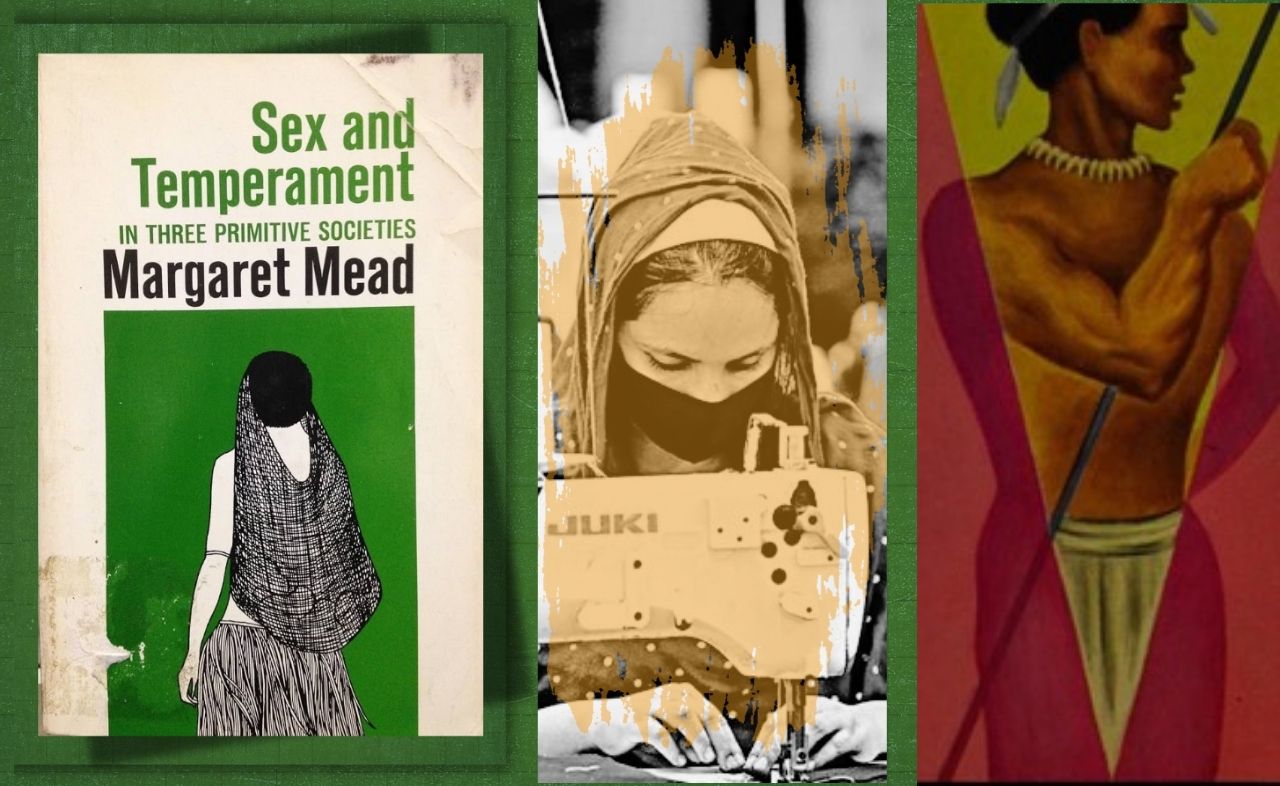
What is it that makes a man ‘masculine’ and what is it that makes a woman ‘feminine’? Generally, most of the common people would say that ‘masculine traits’ such as power, domination etc. make a man ‘masculine’, and the same goes for the woman’s identity– some feminine characteristics like submissiveness, leniency make a woman ‘feminine’. This question of gender temperament has been central within the sphere of anthropology for a long period of time and the famous American anthropologist Margaret Mead stands at the center of this debate. Mead was a student of another well-recognized American anthropologist Ruth Benedict, who was known for her work on the relation between culture and personality. Here, we will explore one of Mead’s most exciting theories about the impact of culture on personality in her book Sex and Temperament in Three Primitive Societies. In this, she argues that sexually assigned behavioural roles are not biologically inherited or passed down from generation to generation. They are shaped by the social and cultural circumstances and practices of that society. Along with exploring this argument, we will discuss its usefulness regarding issues of the structure of Bangladeshi families, division of labour, and recent social debates of contemporary Bangladesh.
MARGARET MEAD, SEX AND TEMPERAMENT IN THREE PRIMITIVE SOCIETIES
First of all, we need to know about the context and work of Mead. Sex and Temperament in Three Primitive Societies was published in 1935, and is considered a major book in anthropology and gender studies. During her fieldwork in New Guinea, she studied three neighbouring populations named Arapesh, Mundugumor, and Tschambuli. What made her interested was that despite sharing the same geographical area, they varied vastly in terms of their sex-specific behavioural roles, personality, and temperament. And along with that, she pointed out that in the same society, men and women differed in their temperament. Through her study, Mead argued that it is the cultural processes that mould the personality type of the people. These processes also differed from one society to another.
Let us look at the Arapesh. They live in such a geographical area where there is no fear of attack from outside by the enemies. Hence, they developed a sense of security. The Arapesh population is small, and even a modest yield is sufficient to feed the entire community. This results in the absence of violence, competition, or conflict. They acquire sympathetic, cooperative characteristics. The cultural pattern among them is such that both men and women are submissive. This ethnographic example directly confronts the widespread belief that submissiveness is a characteristic of women only.
There is another group of people in the same New Guinea named Mundugumor. Mead found that among them, both men and women are aggressive and children suffer the most on account of this trait. One of the reasons that both Mundugumor men and women become aggressive is that they practice polygyny. In this society, a man’s social status is measured through the number of wives he has. Among them, marriage by exchange is prevalent, where a husband can exchange his daughter for another wife. This creates conflict within the households among the women, and also within the father and the son. The son comes to know that his father will exchange one of his sisters for his own marriage, and it hinders the son’s marriage. Because, if the father goes on marrying, no daughter will be left for the son’s marriage. As a result, both men and women acquire aggressive characteristics, which, in turn, opposes the belief that only men are aggressive.
Interestingly, the third group, Tschambuli, has a cultural pattern that shows that men are submissive and women possess aggressive character. The women run the household, and the males conduct domestic work such as cooking, cleaning, and childcare. This example directly speaks against the norm that men are aggressive and women are submissive.
APPLYING MEAD TO BANGLADESH
Mead’s work on sex and temperament among three native societies– that temperament and personality are shaped by culture rather than biology– provides a critical lens to examine the norm around ‘masculinity’ and ‘femininity’ in contemporary Bangladesh. Applying Mead’s framework here does not mean searching for societies like the Arapesh, Mundugumor, or Tschambuli, as no such societies exist here. Rather, the framework is useful for understanding what Bangladeshi society has projected as ‘normal.’
Consider the average Bangladeshi family, where boys and girls are socialised into distinct expectations from childhood. Boys are given greater independence outside of home and are encouraged to assert dominance. Meanwhile girls are taught to be modest, patient, and experts in domestic work. Moreover, the recent protests by female students at the University of Dhaka regarding differential hall entry rules reflect this same projection. The gates of the male students’ residential halls are open all night, and they can roam outside their halls any time they want. But this is not the case with the female students. The university applies a strict rule that the residential students of the female halls must return to their halls within 10 P.M. This reveals the innate mentality that it has been normalised: male students appear more powerful and female ones more submissive. However, this distinction is often justified by the innate assumption that boys/men are ‘naturally’ dominant and girls/women are ‘naturally’ nurturing. Notably, this aligns with the very assumption Mead sought to destabilise. If biology determined masculinity and femininity, these traits would appear consistently across all societies. Yet, as demonstrated by the Arapesh, where both the men and women were submissive, or the Mundugumor, where both the men and women were aggressive, such traits are shaped through cultural processes. This dismantles the common notion of man/woman in Bangladesh, where it is widely believed that biology provides the distinction.
The sexual division of labour prevalent in Bangladesh offers another point to compare. In rural Bangladesh, where the main economic activity was historically based on agriculture, field work has historically been associated with men, while domestic work has been associated with women. Historically, and even today, this division has been treated as self-evident. However, there has been a shift in the economic sphere of Bangladesh. One of the country’s largest remittance-earning sectors, the ready-made garment industry, has grown tremendously over time. It has reshaped the idea of ‘acceptable’ female economic behaviour, not by any biological standard but by economic necessity. Furthermore, women now participate in almost all sectors alongside men, and in many instances, outperform their male counterparts. This directly speaks to Mead’s wider argument: what a society labels as men’s work or women’s work does not stem from biology, but from social, cultural, and economic circumstances.
Finally, recent developments regarding women in public life, leadership roles, and politics frequently challenge the notion of natural temperament– the assumption that women are inherently submissive and caring while men are dominant and suited to public roles. The Tschambuli case demonstrates the exact opposite, where women are dominant and handle the outdoor economic activities, and men handle the household work, which reverses the Bangladeshi discourse of ‘masculine’ and ‘feminine’. If temperament can be so fundamentally inverted across cultures, it cannot be biologically predetermined; rather, it remains a construct shaped by specific socio-economic environments.
CONCLUSION
Margaret Mead’s study among the Arapesh, Mundugumor, and Tschambuli provides not a template to apply to other societies, but a methodological lens: it demonstrates how traits assumed to be biologically given are actually products of social and cultural contexts. Applied to the Bangladeshi context, this reveals that what we assume to be ‘masculine’ or ‘feminine’—whether in the structure of the family, the division of labour, or public life—is the result of historical circumstances and socialisation. This does not make gender temperament in Bangladesh arbitrary, yet it renders it neither inevitable nor immutable. If such structures were shaped by circumstances, they can also be reshaped. Nearly a century after Mead conducted her study in New Guinea, her central thesis still holds: what is assumed to be ‘natural’ is often what a culture has chosen not to question.
