

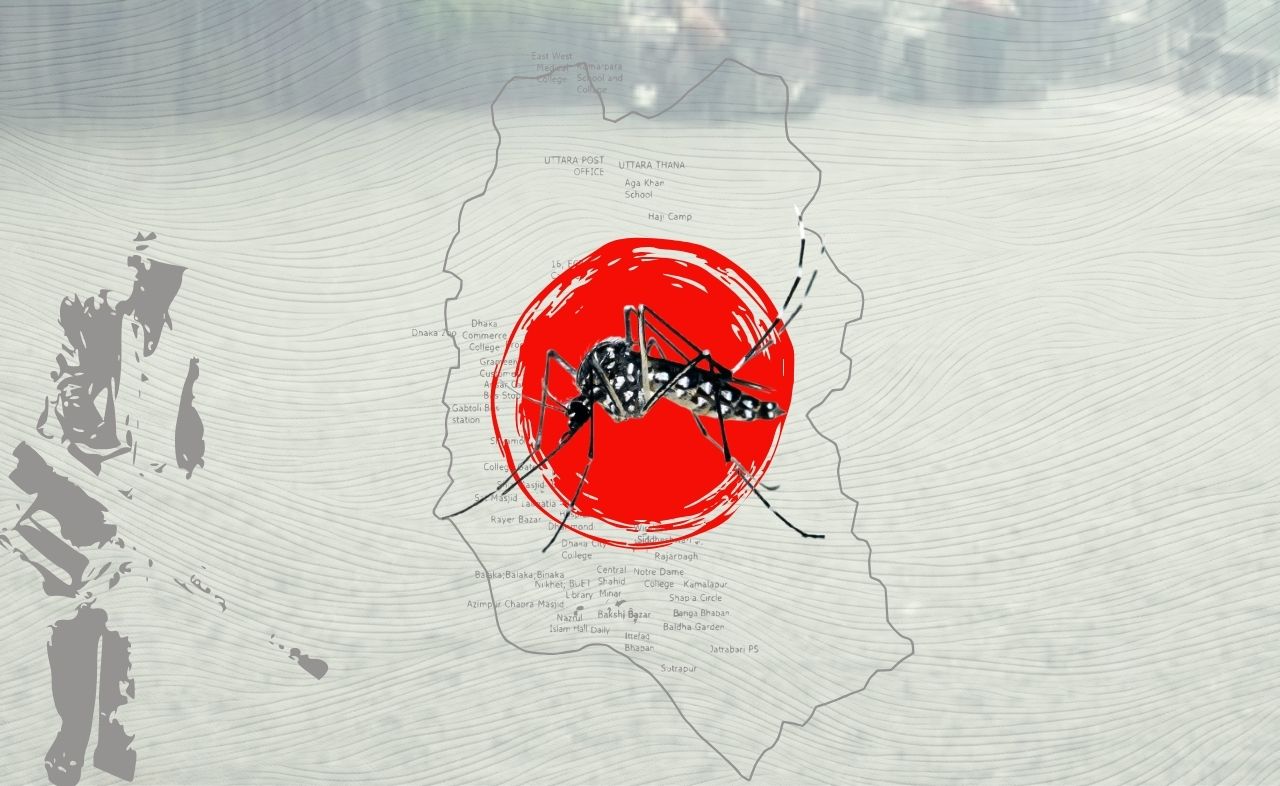
Every August, Bangladesh briefly rediscovers dengue. Newspapers publish daily case counts, television crews film fogging vans, and city corporation officials promise crackdowns. By November, when the mosquitoes retreat with the rains, so does public attention. This year, however, the numbers refuse to be forgotten quietly. As of 14 September 2026, the Directorate General of Health Services had recorded 53,570 cases and 157 deaths since January, with week 37 alone contributing 3,294 fresh infections and 14 fatalities. A disproportionate share of that toll, as in every recent year, has come from Dhaka. These are not abstractions. They are the visible surface of a much older, much deeper failure: the way Dhaka has been allowed to grow.
The temptation, every year, is to treat dengue as a health emergency with a health solution — more hospital beds, fogging, and awareness campaigns. This framing is comforting because it suggests the problem is contained and technical. It is also wrong. Dengue in Dhaka is not an epidemiological accident. It is the predictable output of a city built without functioning drainage, without reliable waste collection, and without enforced planning regulations. Treat the mosquito, and next year’s outbreak returns on schedule. Treat the city, and the outbreaks might finally start to shrink.
The trajectory was foreseeable. Professor Kabirul Bashar, a medical entomologist at Jahangirnagar University, said his surveillance and forecasting model suggested hospitalisations could exceed 30,000 for the month if current trends continued, warning as August closed out that “the peak has not been reached yet”, and that September could become the worst month of the year for infections.
A city that manufactures its own breeding grounds
The basic biology is not disputed. Aedes aegypti, the mosquito that carries dengue, breeds in small pools of stagnant, relatively clean water — a discarded tyre, a blocked rooftop drain, an uncollected plastic cup half-filled with rain. Dhaka produces these conditions at an industrial scale. Uncollected solid waste blocks drains; blocked drains create waterlogging; waterlogging breeds mosquitoes. Officials themselves have acknowledged this chain publicly. In late May 2026, Prime Minister Tarique Rahman personally toured congested commercial areas — Hatirpool, Elephant Road, Green Road, Farmgate, Karwan Bazar — and found waste piling up in each, prompting the suspension of several senior officials from Dhaka North and Dhaka South city corporations over failures in waste removal, drainage maintenance, and dengue prevention.
That such a directive was necessary at the level of the head of government says something. Waste collection is meant to be a routine municipal function, not a matter requiring prime-ministerial intervention and disciplinary threats. When basic services only move under this kind of pressure, the underlying institutional capacity is clearly the real patient— and that capacity gap is not accidental. Ward-level waste contracts in Dhaka are awarded through a political patronage chain that survives changes in government; contractors who underdeliver rarely lose contracts, as those contracts double as vehicles for allocating loyalty. The incentive to actually clear a drain competes with the incentive to keep a contractor happy, and in most wards, the second incentive wins quietly, year after year, without needing anyone to defend it out loud.
Dhaka’s physical growth has outpaced every plan meant to govern it. The city’s four corporations — DNCC, DSCC, Gazipur, and Narayanganj — together administer roughly 708 square kilometres of a metropolitan area that continues to absorb rural migrants faster than it can house or serve them. Wetlands and low-lying land that once absorbed rainwater have been filled for housing; the Detailed Area Plan meant to guide this expansion has been repeatedly violated — not through oversight, but because land conversion from wetland to buildable plot is one of the most reliable profit mechanisms in Dhaka real estate, and the officials empowered to block it are frequently the same officials with a stake in seeing it approved. Planners have been warning about this for years. At a recent seminar, members of the Bangladesh Institute of Planners argued that Dhaka’s crisis is not one failure but several interlocking ones.
“Dhaka is heading toward its worst-ever livability level due to poor implementation of existing plans and institutional weakness,” said BIP General Secretary Mohammad Mosleh Uddin Hasan. Fellow planners at the same event pointed to footpath encroachment, illegal businesses, and political interference in urban management as compounding factors, while noting that migration to Dhaka continues regardless — because the rest of the country still lacks comparable jobs and services.
This is the structural argument in its clearest form. Dengue does not exist alongside Dhaka’s housing pressure, its drainage failures, and its weak local governance. It exists because of them — and it persists because each of those failures pays someone, somewhere, to keep failing.
The numbers behind the pattern
Context helps here. In 2025, Bangladesh recorded 102,861 dengue cases and 413 deaths nationally. In 2023, the worst year on record, the DGHS logged 321,179 cases and 1,705 deaths. Dhaka’s two city corporations have historically carried a disproportionate share of this national burden. Between January and 28 October 2025, close to 28 percent of that year’s cases had come from within Dhaka’s two corporations alone, even though the city holds a much smaller share of the national population. The pattern is consistent across years: national totals move with rainfall and mosquito cycles, but Dhaka stays a near-permanent hotspot within that national picture, because its structural vulnerabilities do not switch off between seasons.
What a structural response would look like
If dengue is a symptom of urban dysfunction, then fogging campaigns and hospital preparedness — necessary as they are in the short term — cannot be the whole answer. A structural response requires confronting the incentives above, not just their symptoms.
Waste collection needs to be pulled out of the patronage economy that currently governs it — with contracts tied to measurable drain-clearance outcomes and independently audited, rather than renewed on political loyalty. DNCC’s own 2026–27 budget, at Tk 4,527.74 crore, explicitly prioritises drainage and waste management alongside dengue control, which at least signals that money is catching up with the problem; whether it escapes the same contracting logic that has hollowed out past budgets is the real test.
Enforcement of the Detailed Area Plan needs to survive contact with the land market it’s meant to restrain — which means removing approval authority from the same local bodies that profit from land conversion, not simply asking them to enforce harder. Urban planner Dr Nawshad Ahmed, a retired UN official, has argued that solid waste management requires effort “at the highest political level,” alongside the financial and technical support needed to make Dhaka environmentally liveable by 2030 — a timeline that leaves little room for further delay, or further plausible deniability about where the blockage sits.
Drainage and waste systems must be planned jointly, not separately; city authorities have begun, tentatively, to acknowledge this by pledging to work with RAJUK and WASA on waterlogging together, though a pledge is not yet a shared budget line or a shared chain of accountability.
Finally, disciplinary action against officials should follow measurable service failures automatically, not depend on a head-of-government inspection tour catching a garbage pile on camera. A system that only self-corrects when the Prime Minister is watching is a system that has quietly agreed not to correct itself the rest of the year.
None of this is glamorous. It will not produce a dramatic single announcement the way a vaccine trial or a fogging drive might. But structural problems require structural fixes, sustained over years rather than weeks — and aimed at the people who benefit from the failure, not just the failure itself. Until drainage works, waste is collected reliably, and urban planning rules survive contact with the money that wants them broken, Dhaka will keep manufacturing the very conditions dengue needs to spread. Every September, the city will be surprised again by an outbreak it built itself.
