

Every year on the 9th of August, Bangladesh celebrates the International Day of the World’s Indigenous Peoples with the usual course of roundtable seminars, cultural programmes, and official statements from the government recognising the contributions of the Adivasi communities that live within the country’s borders. However, if we look from an anthropological perspective, there is an interesting factor at play. These people have been asked to adapt to climate change despite dealing with the adaptation to harsh and shifting environments for centuries. And, their knowledge regarding the environment they live in has been built from their negotiations with everyday life. Interestingly, this knowledge, ‘ethnoecological knowledge’, remains absent from the country’s formal climate adaptation policies. This gap is just not rhetorical, it shows up in concrete ways. For example, in discussions of which forest management initiatives get funded and which practices get criminalised, whose expertise in ecology gets treated as data and whose knowledge is regarded as a development problem, and who profits when ‘traditional’ knowledge around the environment gets repackaged as an innovation. Anthropologists have argued that to make a policy implementation successful, the planners must include local knowledge into those models. This provides a new lens to look at the gap between ecological knowledge of Bangladesh’s indigenous communities and the country’s national climate adaptation policies.
THE KNOWLEDGE THAT ALREADY IS IN PLAY
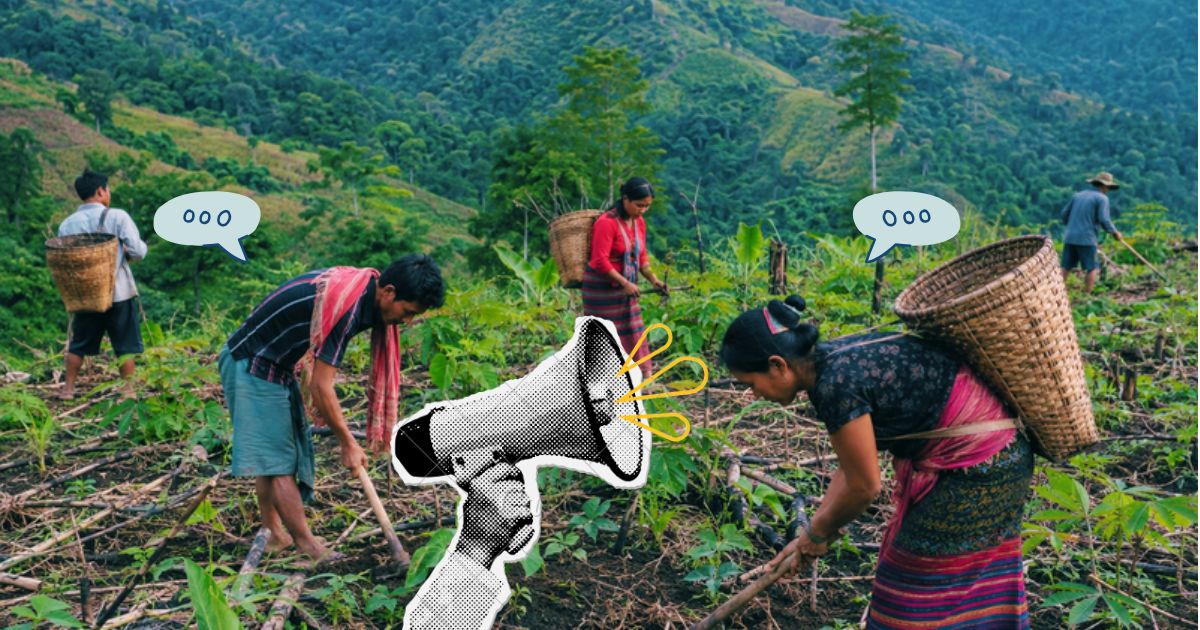
Starting with Jhum cultivation may be a viable way to get into the territory of indigenous ecological knowledge of the Adivasi communities of Bangladesh. Indigenous people living on the Chittagong Hill Tracts (CHT) – Chakma, Marma, Tripura – have been practicing Jhum cultivation for centuries. Jhum cultivation is a shifting agricultural technique practiced by these people. Before the dry season, farmers clear the land by cutting down trees and bushes. Then, once the vegetation dries, they burn it and leave the ashes into the ground. Right before the monsoon arrives, they sow seeds on the ash-enriched ground. After a few harvests, when the fertility of the soil declines, they shift to a new plot and leave the old one to recover naturally.
However, Jhum has a poor reputation in formal environmental planning of Bangladesh. These documents often portray this practice as a reason for soil erosion and deforestation. This may be partially true, but does not capture the complete picture. As we have seen, Jhum depended on long periods of fallow cycles, ten to twenty years historically, where the people left a plot to recover naturally before being used again. Studies from Khagrachhari and around the CHT region have shown that this was the entire point: the fallow period gave the land soil nutrients and time to recover, functioning as a rotational, low-input system suited to the region’s steep terrain and heavy monsoon rainfall. The environmental concerns now associated with Jhum – soil erosion, degradation, deforestation, reduced biodiversity – directly relates to the collapse of that fallow period. Lands which have been allowed to lay fallow for years previously, now get only three to five years to recover, and the reasons include population pressure and land loss to reserved forests and settlement issues. In other words, Jhum didn’t stop working because it was insufficient, it did because the land and time for it were taken away. This distinction does not get importance into policy making.
Government and donor agencies often treat Jhum as a static category on their documents, something that should be replaced with more ‘sustainable’ alternatives; rather than as a system of functioning sustainability that the state policies have helped to erode. Some of this replacement is still happening on the ground: farmers of the hill tracts are shifting to cash crop cultivation from traditional Jhum cultivation, a shift they frame as a response to ecological strain rather than state policy imposition. However, indigenous cultivators making that shift less often describe it as the abandonment of Jhum altogether, they interpret it as losing the conditions that made it viable. This distinction holds much importance: for how the story of ‘traditional’ vs ‘modern’ farming gets told, and whether the people who have been reading the hills for generations get treated as a partner in land use redesigning or a problem.
A similar picture holds true in the country’s Madhupur Sal forest belt which is located far from the CHT, the region usually associated with the indigenous issues in Bangladeshi media. The Madhupur Sal forest belt has been the home for the Garo, Koch, and Barman communities for centuries. The Garos have practiced a traditional agrosilvipastoral system for years, and researchers label it as ecologically sophisticated and biodiversity-sustaining in its own terms. Yet, they face ongoing conflict with the Forest Department for the ancestral rights over the same land. In March of 2026, hundreds of Garo students and community members gathered at the Amlitala School field to protest against a government-led eco-park and artificial lake project in the forest. The 2026 incident mirrored a 2004 one which ended in police gunfire and the death of a Garo man. After more than two decades, the debate remains unchanged: whose relationship to the forest is considered legitimate and who is held as an obstacle to development.
A third picture of the same story is provided by the Kaptai Lake. People living around the reservoir, who are themselves the product of a dam project from the 1960s which displaced around 100,000 people including Chakma and Hajong without any compensation, still make their livelihood from the lake. A 2025 study on these populations reveal that they combine traditional ecological knowledge (TEK) along with forest conservation and diverse agricultural practice to deal with environmental changes, although they identify major obstacles such as lack of institutional support. Ironically, they are expected to protect the same dam that once displaced their ancestors.
WHERE THE POLICY OVERLOOKS IT
These cases do not mean that the policymakers of Bangladesh deny the existence of indigenous communities. The area of CHT is explicitly demonstrated as a national concern in Bangladesh’s National Adaptation Plan (NAP), and its stated results include strengthened knowledge management and risk-informed-decision-making. The similar goes for the Bangladesh Delta Plan 2100, Bangladesh’s long-term land and water management initiative. It names CHT as one of its six “hotspots”, with no channel for the traditional knowledge of the people who live there. The problem here is not of invisibility; indigenous communities appear on those frameworks as a vulnerable population which needs to be protected, not as holders of valuable ecological knowledge that could be combined with those very frameworks. This gap is even sharper outside the hill tracts region. The 2025 review of Bangladesh’s Eighth Five-Year Plan and its national adolescent health strategy shows that while indigenous people are mentioned, the operational follow-through remains minimal – similarly, this pattern repeats in the climate policy space. Being mentioned in a document is not the same as being consulted, and this is where most of the erasure happens.
The clearest distance may be procedural rather than textual: who gets asked? The biggest efforts to document the indigenous environment knowledge have not come from state-run institutions, but from indigenous-led or indigenous-partnered organisations working outside them. For example, the Youth as Researchers programme has trained indigenous people across five CHT communities to document climate change and their traditional adaptation methods. This approach directly touches the premise that young people of those communities who possess both the traditional ecological knowledge (TEK) and the tools to communicate them outward, are excluded from the national policy making plans.
THE EXTRACTION PROBLEM
Even after the step that indigenous knowledge regarding climate change and adaptation is included into the conservation work, it is necessary to scrutinise the terms of that inclusion. The ‘parabiologist’ model promoted in the CHT by conservation researcher Shahriar Caesar Rahman is a good recent example. Through this model, he and his team employed retired indigenous hunters, depending on their knowledge about the forest and tracking, to locate endangered wildlife. It is a serious collaborative work. However, such initiatives also show the more common contrast: indigenous environmental knowledge often enters in the discourse to be drawn by outside forces such as governments, NGOs, universities, not as a system they themselves direct. Terms such as ‘nature-based solution’ and ‘traditional ecological knowledge’ (TEK) have become fashionable in international environment conservation discourse, they are mainly used to attract donor funding. However, the funding and authorship often do not reach the very people whose generational labour had built it in the first place.
WHAT RECOGNITION WOULD ACTUALLY REQUIRE
The point of this article is not that Jhum or any other indigenous practice should be romanticised or preserved unchanged – the ecological constraint on the fallow cycles is real and many farmers are choosing to shift from the traditional farming systems. The point of this argument is that policies should treat the ecological knowledge of these communities as expertise, not as an obstacle. That would look different from another roundtable seminar. Bangladesh certainly does not lack the evidence base to make this shift, as many researches cited here make a reasonably strong case. What is needed is an institutional recognition that the traditional ecological knowledge (TEK) can actually help policymakers plan better models to deal with environmental issues. Until that change appears, World’s Indigenous Day would simply continue to mark a day of recognition of people whose knowledge is not being used properly by the country.
Anonyo Bhattacherjee is a student of the department of Anthropology at the University of Dhaka.
