

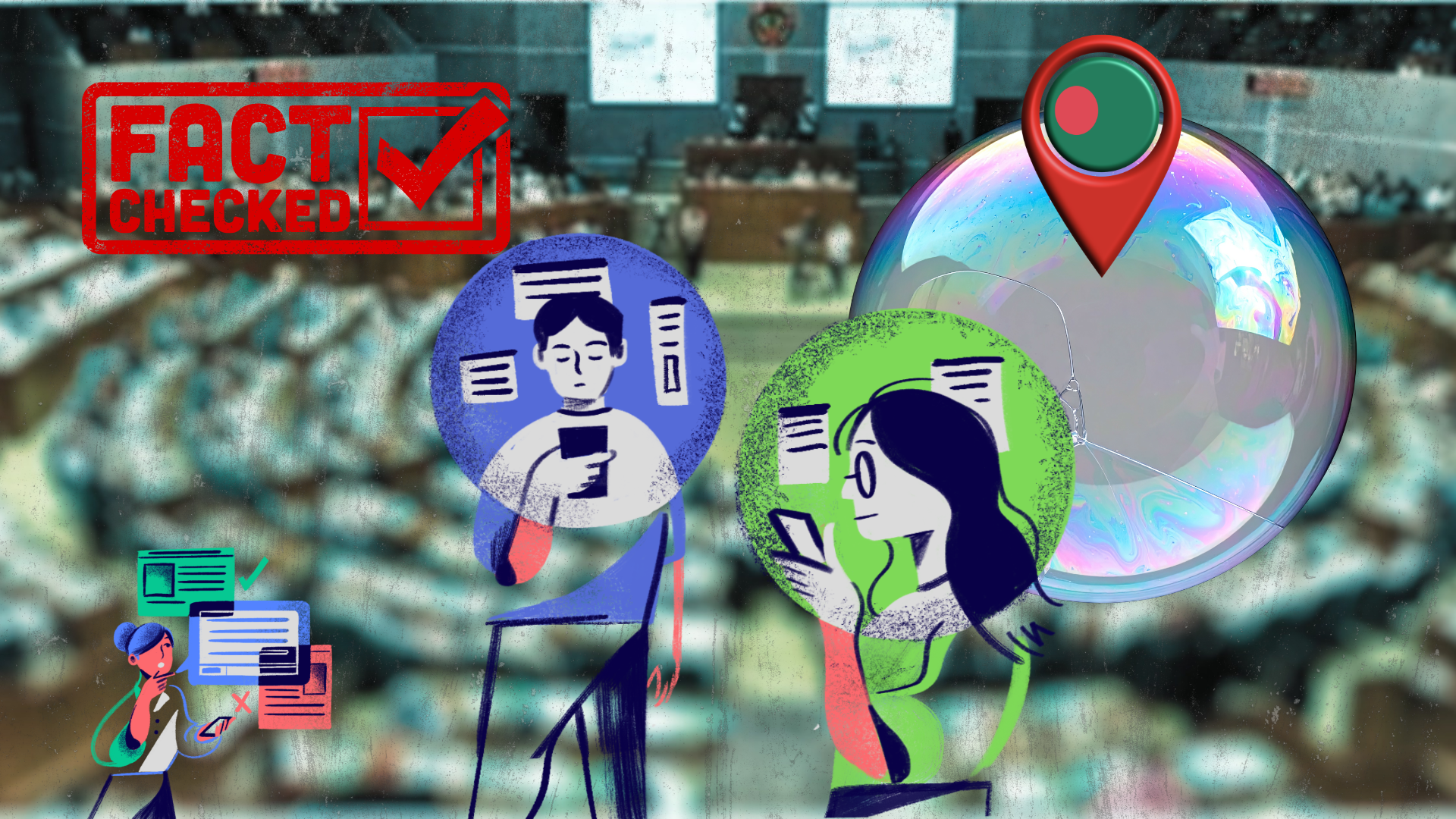
In the digital age, we tend to believe that the internet has brought the world to our fingertips, making it open and accessible to all. But in reality, the opposite is often true. Social media algorithms trap us in an invisible labyrinth where we are exposed only to information that reinforces our existing beliefs. This phenomenon is known as the “Filter Bubble.” The question is: how deeply does it affect Bangladesh’s politics, society, and democratic culture?
What is a Filter Bubble?
The concept of the “Filter Bubble” was first coined and popularised by internet analyst Eli Pariser. It refers to a digital system in which algorithms analyse a user’s preferences, clicks, search history, and behavior, and repeatedly present similar types of information. As a result, users gradually become isolated from differing opinions or alternative perspectives.
This process narrows the scope of information people consume and creates a form of intellectual isolation. Research suggests that algorithmically curated content keeps individuals within a “comfort zone,” where information that contradicts their beliefs rarely reaches them.
Consequently, a kind of digital reality emerges- where each person seems to inhabit their own “universe of information,” much like enjoying freedom within a confined round sphere.
Political Polarisation in Bangladesh and the Filter Bubble
Bangladesh has long experienced intense political polarization. Nevertheless, social media has taken this division to a new level.
Algorithms on platforms like Facebook, YouTube, and TikTok identify users’ political preferences and expose them to similar political content more frequently. Over time, this creates an “echo chamber,” where individuals hear only like-minded voices. As a consequence, the practice of tolerance in thought and mindset diminishes.
In this context, three major changes become evident. First, there is an increased rigidity of opinions, which is different from simply having firm beliefs. People begin to develop a mindset where what they say feels final and what they believe is seen as absolute, leading them to treat their own views as unquestionably true. Second, intolerance toward opposing views grows, as differing political perspectives are no longer seen as part of healthy debate but are instead perceived as threats or enemies. Third, digital mobilisation becomes more pronounced, with social media rapidly shaping public opinion and often amplifying real-world political tensions, sometimes escalating conflicts beyond the online space.
Research shows that personalised content on social media divides people into ideologically distinct groups, further intensifying political polarization. In Bangladesh, this effect becomes particularly visible during elections, movements, or political debates.
Algorithms and Misinformation: The Battle Between Truth and Falsehood
The Filter Bubble not only reduces diversity of opinion- it also creates fertile ground for the spread of misinformation. The primary goal of social media algorithms is engagement- keeping users on the platform as long as possible. As a result, posts that generate strong reactions- such as anger, fear, or excitement- are more widely promoted.
This leads to three major problems:
Firstly, confirmation bias. People are more likely to believe information that aligns with their existing beliefs. Secondly, viral misinformation . False information spreads quickly because it triggers emotional responses. And finally, political propaganda. Digital campaigning becomes easier and more effective.
Studies indicate that recommendation-based algorithms repeatedly expose users to similar content, deepening divisions in opinion. In Bangladesh, the rapid spread of political propaganda, rumors, and conspiracy theories makes this reality even more evident.
The Need for Policy Discussion: What Can Be Done?
Addressing this issue is not only a technological challenge but also a deeply political and social one. Several policy initiatives can play a crucial role in tackling it. First, increasing digital literacy is essential, as people need to be equipped with the skills to identify fake news, verify information from multiple sources, and understand how algorithms shape what they see online. Second, stronger platform regulation is necessary, where governments and policymakers ensure greater algorithmic transparency, develop effective policies to combat misinformation, and hold social media companies accountable for the content they amplify. Finally, promoting algorithmic diversity offers a promising approach, as some researchers suggest that platforms could intentionally design systems that expose users to a wider range of perspectives, thereby fostering greater informational diversity and reducing the risks of echo chambers.
The bottom line is, The Filter Bubble is not a hypothetical concept- it is a real political and social challenge of the digital age. In Bangladesh, social media has amplified citizens’ voices, but it has also created new forms of division. The question remains: can we build an open digital public sphere, or will we all become trapped in our own “bubbles of information”?
The future of democracy largely depends on the answer to this question.
Niaz Mahmud Sakib is a contributor at Muktipotro.
