

The brutal dictatorship of Sheikh Hasina from 2009 to 2024 was marked by a blatant disregard for human rights and the mockery of human rights activists and organisations all across the globe. Members of political parties who were not loyal to the Bangladesh Awami League were victims of being arrested without any sort of warrant or legal procedure. Freedom of speech was curtailed through draconian acts such as the Cyber Security Act of 2023 and its predecessor, the Digital Security Act of 2018, and many more. The primary defence of the regime during Sheikh Hasina’s tenure was that to combat terrorism and anti-national forces, the state had no option but to sacrifice the human rights of the citizens. It repeatedly said that to protect the sovereignty and unity of the nation, the human rights concerns should take a second stage.
One would think that after her ousting, the new political settlement would be committed to not tolerating any further human rights abuses by the state organisations, and ensuring justice for every citizen of Bangladesh regardless of their gender, race, religion and ethnicity. It was hoped that the state actors will not provide excuses used by the previous regimes to justify the human rights violations, such as protecting sovereignty and sedition. It was dreamt that different sections of the population, who unitedly fought and toppled the dictatorship, would receive an inclusive Bangladesh free of discrimination.
But reality on the ground is not so hopeful, it seems. At least one section of the population never received relief from the human rights abuses that were committed against them in the previous regime – the indigenous population. Their condition did not improve during the Interim period, and the new government of the Bangladesh Nationalist Party isn’t showing any hope either. Home Minister Salahuddin Ahmed has claimed that to ensure state security and unity, the armed forces must be allowed to violate human rights in the Chittagong Hill Tracts, and it isn’t possible to maintain 100% human rights in that region.
Is this different from the same exclusionary logic used by the Awami regime? Decade after decade, the military actions taken in the Chittagong Hill Tracts are justified under the veneer of protecting sovereignty. If the focus is brought to the urgent issue of the abuses against the Bawm population, the dire condition becomes more apparent.
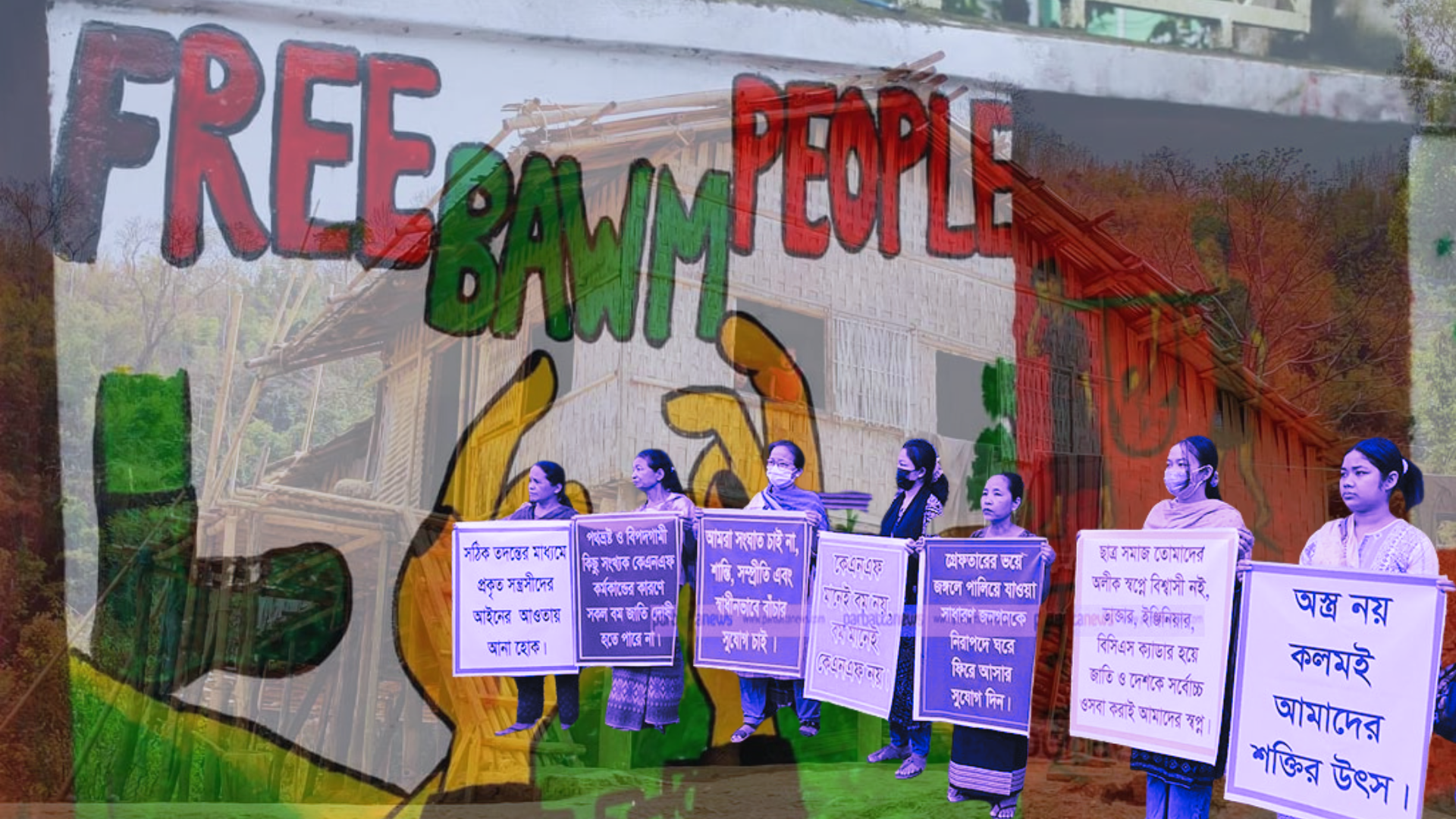
After attacks on two banks by the terrorist group Kuki-Chin National Front (KNF) in April 2024, the military operation in the Bawm community has seen at least a hundred citizens being arrested without proper justification or a warrant, which could go up to more. These citizens were arrested for allegedly being part of or supporting KNF, under the Special Powers Act.
Apart from the arbitrary detention, the military raids have forced a section of the population to flee from the country for safety from arbitrary detentions, taking refuge across the border in India (The Price Of Being Bawm, Netra News). Their freedom was restricted, and their food was rationed as well, often requiring written statements from the military authority to collect food larger than a specific amount.
This is nothing less than a collective punishment pursued by the state on a specific indigenous community. The legal battle has forced a financial burden on many, and most could not afford it. A matter of grave concern is the incidents of custodial deaths. Three Bawm citizens were reportedly denied medical care while being in prison, and faced death in the cell in 2025. Two of them were granted bail one month after their death. These deaths were not properly investigated either. According to the latest reports, 90 citizens are still in custody, and there has not been any charge sheet, even after two years.
These arrests were made during the Sheikh Hasina regime. The Interim Government, which formed after the July Uprising 2024 and the current government of the Bangladesh Nationalist Party have remained silent on this issue and have not addressed it properly. Rather, there have been statements such as the one mentioned above by the Home Minister.
Returning to the comparison with the previous regime, therefore, it is necessary to ask – will the application of human rights remain selective? Will the indigenous communities continue being denied justice? Apart from the violations against the Bawm community, there have been other incidents where the indigenous communities were discriminated against. There has been repeated violence against them and their ancestral homes, and different activists on social media have contributed to furthering the hatred against them and sowing division.
But it must be remembered that state violence spares no one. In the immortal words of Kalpana Chakma, “Everything that is experimented on the Hills will be implemented on the plain lands”. If Bangladeshi citizens continue to be divided along the lines of ethnicity and remain silent when citizens from ethnic minorities are detained without justice on the grounds of their being supposedly “anti-national”, it will come back in reverse as it did in the July Uprising 2024. The Awami League Regime’s primary tactic in justifying all sorts of violence, crossfires, and abuses was that the victims were “anti-national” and “anti-Bangladesh”, and if lessons aren’t learnt from that phenomenon, the same cycle of abuses would repeat in the future.
Bangladesh must free the innocent Bawm citizens and ensure them proper legal justice. The discrimination against indigenous communities must be stopped, whether it is in the Chittagong Hill Tracts or regions like Madhupur. Human rights should not be selective, it must include every single citizen of the country. Admittedly, this is not an easy task. But the state must take visible actions so that every citizen can feel safe to live and enjoy civil rights under the law. This should be the future of inclusive Bangladesh.
Sadman Ahmed Siam is an independent columnist and a student at the Islamic University of Technology.
