

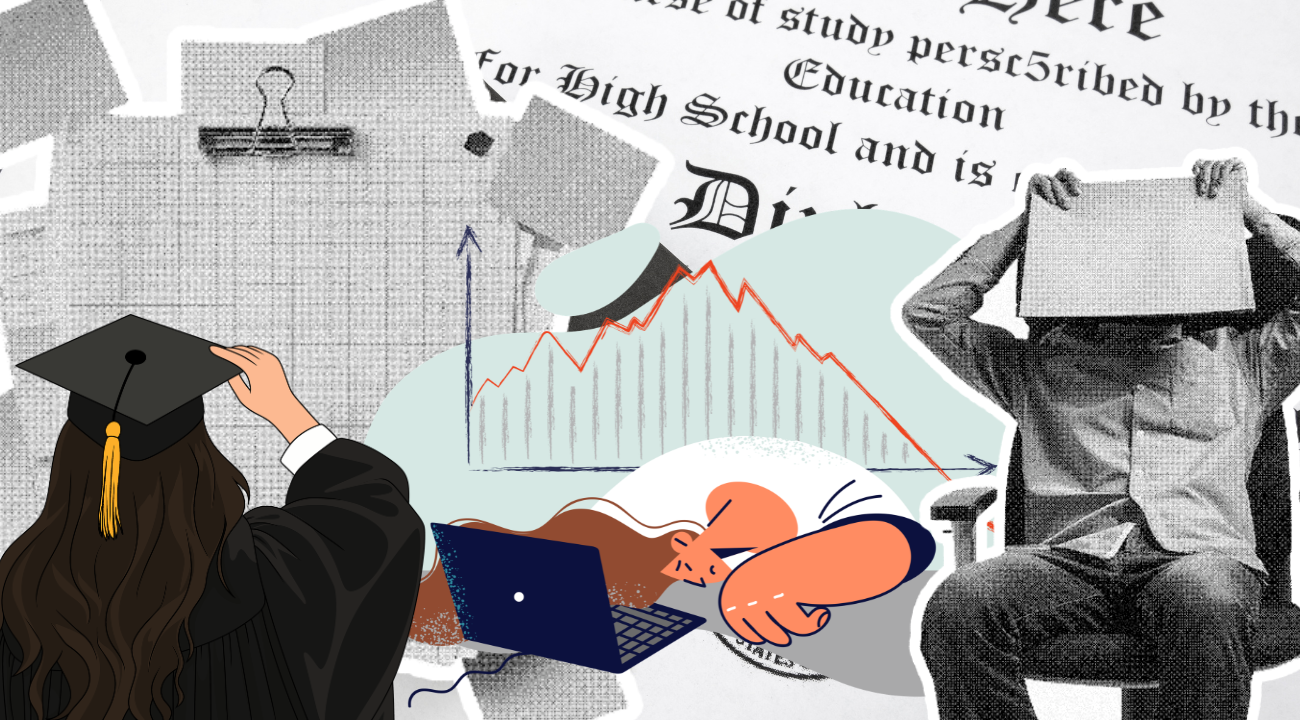
What happens when a university degree no longer guarantees a job? Why are Bangladesh’s graduates struggling to find their place in the very economy they were educated to serve?
Do we know the answer to these two questions? The answers are neither simple nor comfortable. For decades, higher education in Bangladesh has been sold as a ladder to stability- a promise that a university degree would lead to a secure and respectable life. Each year, hundreds of thousands of students step off graduation stages carrying that promise with them. Yet for a growing number, the transition from classroom to career is not a step upward, but a stall into uncertainty.
Across the country, graduates find themselves navigating a labor market that seems increasingly unable—or unwilling—to absorb them. Some remain unemployed for years, cycling through competitive exams and short-term opportunities. Others accept work far removed from their fields of study, trading aspiration for survival. The result is not just a surplus of educated individuals, but a deeper structural imbalance between what the education system produces and what the economy demands.
This is not merely a story of job scarcity. It is a story of mismatch, misaligned expectations, and an evolving economy that has outpaced the institutions meant to prepare its workforce. Understanding graduate unemployment in Bangladesh, therefore, requires looking beyond numbers—into the systems, assumptions, and pressures that shape the journey from education to employment.
For many graduates, the years after university are defined not by momentum, but by waiting and compromise. It is not uncommon to find someone spending four or more years preparing for highly competitive civil service exams, structuring their entire life around the distant possibility of a government position that only a fraction will secure. At the same time, others take a different path-not out of choice, but necessity. An engineering graduate, for instance, may find themselves working in a call center, navigating scripts and shifts that bear little resemblance to their years of technical training. These are not isolated cases, but reflections of a broader pattern, where aspiration and reality drift apart, and where a degree no longer determines the direction of one’s working life.
The Present Condition: A Growing Imbalance
Recent labor market trends suggest that graduate unemployment in Bangladesh is not only persistent but structurally embedded. While the overall unemployment rate in the country remains relatively low, the rate among educated youth is significantly higher- revealing a paradox at the heart of the economy. Each year, universities produce a large cohort of graduates, yet the number of suitable jobs does not expand at the same pace.
The challenge is not limited to outright unemployment. A substantial portion of graduates remain underemployed, working in roles that neither require their qualifications nor align with their training. Many spend years preparing for highly competitive public sector positions, where the number of applicants far exceeds available posts. Others cycle through internships, contractual roles, or informal employment, often without long-term security.
The transition from graduation to stable employment has, for many, become prolonged and uncertain. What was once expected to be a relatively linear path has turned into a fragmented and unpredictable journey.
The scale of graduate unemployment in Bangladesh is no longer anecdotal-it is measurable, persistent, and growing. According to the 2024 Labour Force Survey by the Bangladesh Bureau of Statistics, the graduate unemployment rate has reached approximately 13.5%, significantly higher than the national average. In absolute terms, this translates to nearly 8.85 lakh unemployed graduates, while a September 2025 report by The Daily Star places the figure closer to 9 lakh.
What makes this trend particularly concerning is not just the number, but its distribution. Data cited in labor market analyses indicate that nearly 29% of public university graduates remain unemployed, compared to around 14% from private universities. Among National University graduates, the situation is even more alarming, with roughly one-third (28.24%-Dhaka Tribune reports) still without stable employment by the age of 30.
The crisis also carries a gendered dimension. According to the Labour Force Survey, nearly one in five unemployed graduates are women, pointing to deeper structural and social barriers that shape access to employment. At the same time, the transition from education to work has become increasingly prolonged-one in three graduates remains jobless for up to two years after completing their studies.
Analysts at the Centre for Policy Dialogue (CPD) have warned that a growing skills mismatch between university output and industry demand is a key factor behind this trend. At the same time, the expansion of higher education institutions—particularly under the National University system—has contributed to an oversupply of graduates relative to available jobs.
The numbers, taken together, reveal a troubling reality: the expansion of higher education has not been matched by a corresponding expansion in meaningful employment opportunities.
A Generation in Waiting
Consider the case of a typical graduate in Bangladesh: after completing a degree, they enter a phase defined less by opportunity and more by waiting. Waiting for exam results, waiting for job circulars, waiting for interview calls. Months turn into years, often without a clear sense of progress.
For some, this waiting becomes a full-time occupation. Days are structured around preparation for competitive exams, particularly for government positions seen as stable and prestigious. For others, compromise becomes inevitable. Degrees in fields like business, engineering, or social sciences give way to jobs in unrelated sectors—customer service, sales, or informal work—chosen not out of preference, but necessity.
This lived experience reflects a broader reality: the promise of education remains intact in theory, but increasingly fragile in practice.
Why Is This Happening? Structural Fault Lines
At the core of the crisis lies a mismatch between the education system and the labor market. Universities continue to emphasize theoretical knowledge, often at the expense of practical and market-relevant skills. Graduates leave with certificates, but not always with the competencies employers seek—communication, adaptability, and problem-solving among them.
At the same time, the structure of Bangladesh’s economy limits the absorption of skilled labor. Much of the country’s growth has been driven by sectors that rely on low to mid-level skills, creating fewer opportunities for graduates seeking specialized or high-skilled roles. The expansion of higher education has not been matched by a corresponding diversification of the job market.
Social expectations further complicate the landscape. Many graduates prioritize a narrow set of career paths, particularly in the public sector, leading to intense competition and prolonged preparation cycles like BCS. Alternative paths, such as vocational careers or entrepreneurship, often remain underexplored or undervalued.
To remark, around 43% of graduates aspire to government positions, while about 36% enter teaching. The high rates of unemployment are leading to a rise in “educated unemployed,” where those with the highest education levels face the highest risk of joblessness.One in three graduates remains jobless for up to two years.
Finally, hiring practices themselves can act as barriers. Employers frequently demand prior experience even for entry-level roles, creating a cycle where graduates cannot gain experience without first being employed. Informal networks and connections can also play a significant role in recruitment, disadvantaged those without access to such social capital.
Consequences: Beyond Unemployment
The implications of graduate unemployment in Bangladesh extend far beyond the absence of jobs. At an individual level, prolonged uncertainty reshapes life trajectories. Plans for financial independence, family formation, and social mobility are often delayed, sometimes indefinitely. For many, the years immediately following graduation—once seen as a period of growth—become defined by stagnation.
The psychological toll is equally significant. Repeated setbacks in job searches, coupled with societal expectations of success, can lead to frustration, anxiety, and a gradual erosion of self-worth. The identity of being “educated” begins to lose its meaning when it fails to translate into tangible opportunity. In some cases, this disillusionment fosters disengagement, as individuals withdraw from both the labor market and broader civic life.
At a societal level, the issue represents a misallocation of human capital. Years of education—often supported by families making considerable financial sacrifices—do not yield proportional returns. This inefficiency carries economic consequences, limiting productivity and slowing the transition toward a more knowledge-based economy.
There is also a quieter, less visible shift underway. As opportunities remain constrained, some graduates begin to look outward, seeking employment abroad. While labor migration has long been a feature of Bangladesh’s economy, the increasing participation of educated youth raises questions about long-term talent retention and the country’s ability to leverage its own skilled workforce.
Rethinking the Promise of Education
Graduate unemployment in Bangladesh is often discussed in terms of solutions- skill development programs, curriculum reform, or encouragement of entrepreneurship. While these responses are not without merit, they risk oversimplifying a problem that is deeply structural.
The question is not merely whether graduates are skilled enough, but whether the economy is evolving in ways that can meaningfully utilize those skills. Expanding higher education without a parallel transformation in the nature of available work creates a disconnect that no short-term intervention can easily resolve.
At the same time, long-standing assumptions about education itself warrant reconsideration. The idea that a university degree is the primary-or only-pathway to stability continues to shape decisions at both individual and policy levels. Yet the current landscape suggests that this pathway is no longer as reliable as it once appeared.
Addressing graduate unemployment, therefore, requires more than incremental adjustments. It calls for a deeper examination of how education, economic policy, and social expectations intersect and whether they are aligned with the realities of a changing labour market.
Until those questions are confronted, the gap between aspiration and outcome is likely to persist. And for many graduates, the journey from education to employment will remain less a transition, and more an extended state of uncertainty.
Niaz Mahmud Sakib is a lecturer and researcher.
