

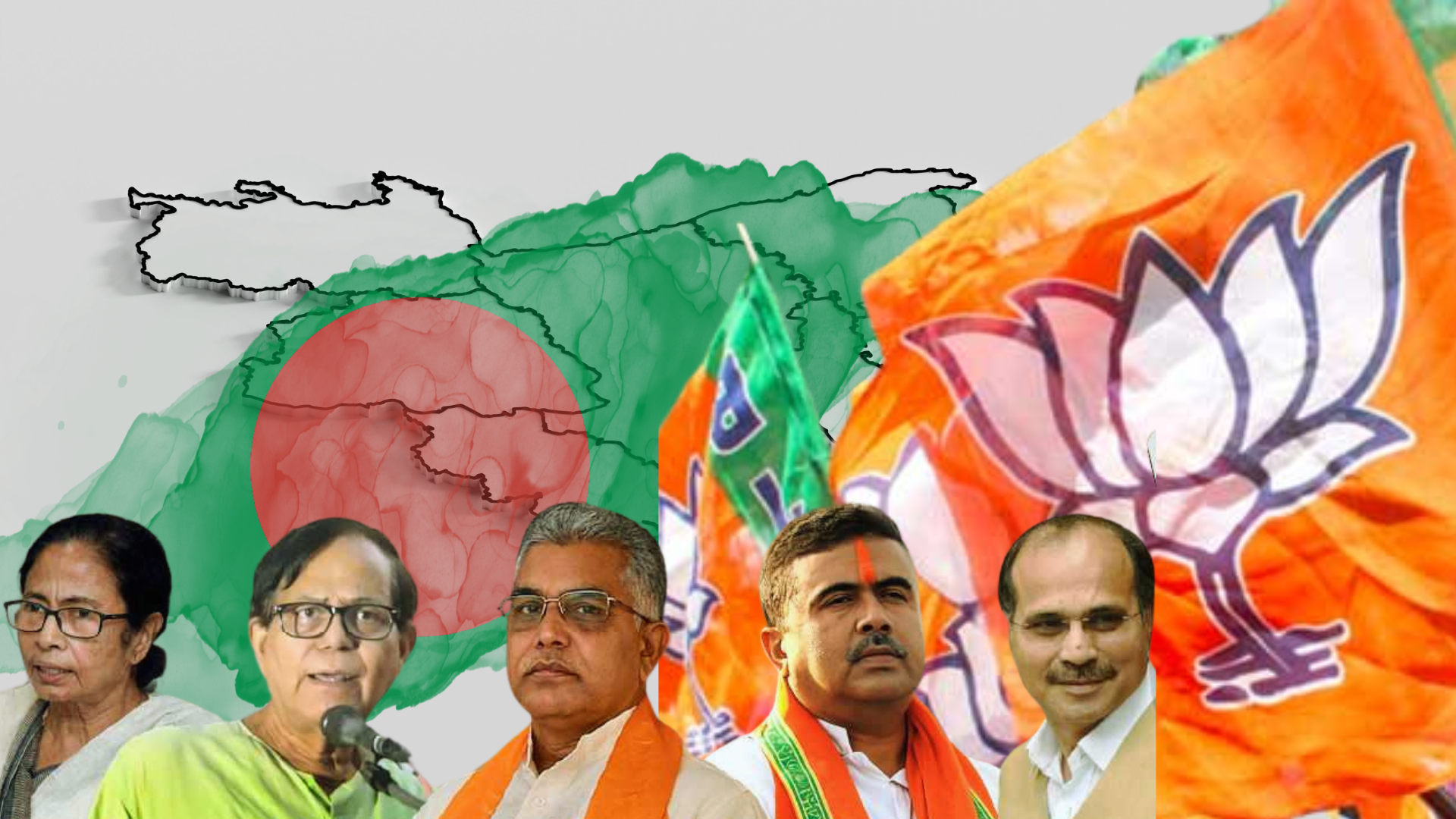
A recurring habit in South Asian political commentary is to narrate a moral timeline: societies are imagined as having moved from a “secular past” to a “communal present,” as if political identity were a straight line of decline. This framing is not only analytically thin, it also flattens the actual historical intelligence of electoral politics in the region. A more careful reading of West Bengal in India and Bangladesh suggests something less dramatic but far more structurally important: political competition has never been about the disappearance of religion from politics, but about how different parties learn to absorb, translate, and redistribute religious identity within democratic competition.
Seen through this lens, neither West Bengal’s recent political shifts nor Bangladesh’s evolving electoral dynamics can be reduced to a simple rise of communalism or a loss of secular virtue. Instead, what is visible is a continuous reconfiguration of identity politics, where electoral success depends less on ideological purity and more on the capacity to manage deep social identities without allowing them to harden into irreversible political antagonism.
West Bengal offers a particularly instructive case because its political history disrupts easy binaries. The long dominance of the Communist Party of India (Marxist) was not built on an abstract rejection of identity, but on a highly calibrated engagement with it. Marxist ideology, in its formal sense, is structurally uncomfortable with religion as a political category. Yet the CPI(M) in West Bengal did not attempt to erase the cultural presence of Hindu social life from its political field. Instead, it operated through a political pragmatism that allowed religious identity to remain socially visible but politically de-escalated.
This is where the usual narrative of “once secular, now communal” begins to fail. The CPI(M)’s durability was not simply the product of land reforms or cadre discipline, although both were crucial. It was also the result of a political grammar that did not force voters into a stark choice between identity and governance. Religious identity existed, but it was not constantly converted into a central axis of political mobilization. The party’s secularism was therefore less a cultural negation of religion and more an institutional containment of it.
However, this equilibrium did not remain stable. The rise of the Trinamool Congress under Mamata Banerjee marked a shift in how political legitimacy was narrated. The slogan “Ma, Mati, Manush” was not ideologically rigid, but effectively powerful. It reintroduced emotion, locality, and symbolic belonging into a political space that had become administratively structured under Left rule. Importantly, this was not a transition from secularism to communalism, but from institutional secularism to a more expressive form of populist pluralism, where identity was acknowledged more openly rather than suppressed through bureaucratic distance.
The more recent electoral developments in West Bengal, where the Bharatiya Janata Party has significantly expanded its vote share and emerged as the principal opposition force, add another layer of complexity. It would be simplistic to interpret this as a sudden communal turn in Bengali society. Instead, it reflects the entry of a national ideological framework into a regional political ecosystem that has historically been resistant to singular narratives. The BJP’s growth signals not a total ideological replacement, but a competitive restructuring of identity claims within the electorate. Voters are not simply moving along a secular–communal spectrum; they are navigating between different forms of identity articulation—developmental, cultural, historical, and religious—depending on context and political incentives.
This is where West Bengal resists reduction. Its political culture is shaped by multiple historical sediments: partition and refugee memory, leftist intellectual traditions, linguistic nationalism, and anti-centralization sentiments. These layers do not disappear when electoral outcomes shift. They continue to operate beneath the surface of voting behavior, producing a politics that is fluid rather than linear. Even the increased visibility of religious polarization in campaign discourse does not automatically translate into a permanent restructuring of social relations.
If West Bengal complicates the idea of linear secular decline, Bangladesh complicates the idea of ideological convergence with India. A superficial reading might suggest that rising religious mobilisation in South Asia would produce similar party configurations across borders, especially with Islamist political actors attempting to expand their influence. Yet Bangladesh’s party system has consistently absorbed religious identity in a different way, primarily through the structure of mainstream political competition rather than its exclusion.
The Bangladesh Nationalist Party occupies a particularly important position in this architecture. It cannot be accurately described as secular in a Western liberal sense, nor can it be reduced to an Islamist platform. Historically, it has drawn from a wide and ideologically heterogeneous political reservoir, including elements influenced by the Muslim League tradition, as well as strands associated with nationalist-populist politics linked to figures like Maulana Bhashani. This ideological hybridity matters because it prevents religious identity from consolidating into a single dominant political vehicle.
Even in periods where Islamist parties such as Jamaat-e-Islami have gained visibility, their influence has been structurally mediated by the presence of larger parties that already incorporate aspects of religious sentiment within broader nationalist narratives. As a result, religious identity in Bangladesh operates more as a distributed political resource than as a monopolized ideological force.
The more recent electoral landscape in Bangladesh further reflects this dynamic. Rather than producing a clean ideological shift, it has shown the continued centrality of mainstream opposition politics, particularly the reassertion of the BNP as a major political actor within the competitive field. This does not represent a simple ideological reversal, but a cyclical recalibration of political contestation where governance, legitimacy, and opposition narratives remain deeply intertwined with—but not fully determined by—religious identity.
When placed side by side, West Bengal and Bangladesh reveal an important analytical symmetry. In both cases, identity politics is not a late-stage distortion of an earlier secular order. It is part of the original architecture of electoral politics itself. What changes over time is not the presence of identity, but the mechanism through which it is politically organised.
This also challenges a common intellectual habit of treating Kolkata—or by extension urban Bengali political culture—as either inherently secular or increasingly communal depending on the observer’s ideological position. In reality, Kolkata’s political identity is a product of layered historical experiences that cannot be collapsed into a single descriptive label. The same applies to Bangladesh, where political behavior is shaped by a continuous negotiation between nationalist sentiment, religious identity, and pragmatic electoral calculation.
What emerges from West Bengal and Bangladesh is not the comforting story of secular decline or communal rise, but something more unsettling: politics does not move away from identity—it learns how to administer it.
The CPI(M) did not survive for decades by suppressing identity, but by disciplining it through institutions that kept religious and cultural belonging politically quiet rather than politically absent. The Trinamool Congress did not break a secular order; it changed the language through which belonging was expressed, shifting from bureaucratic restraint to emotional immediacy. The BJP’s expansion in West Bengal does not represent an abrupt civilizational rupture either, but the entry of a sharper, more centralized vocabulary of identity into an already crowded field of competing loyalties.
Bangladesh, in parallel, does not sit outside this logic. The BNP’s continuing centrality shows that religious sentiment does not require a singular ideological home to remain politically active. It survives precisely because it is dispersed across nationalist, populist, and historical narratives rather than concentrated into one dominant ideological structure. Islamist politics, in this setting, does not automatically translate into system-wide transformation, because the system itself already contains multiple ways of speaking the language of identity.
Seen together, both cases expose the fragility of the “secular versus communal” binary. That framework assumes a moral direction in history that electoral politics consistently refuses to follow. What actually changes across time is not whether identity exists in politics, but which actors gain the authority to define its acceptable form—and which actors are able to convert it into power without triggering systemic rupture.
Mahmud Newaz Joy is a contributor at Muktipotro.
