

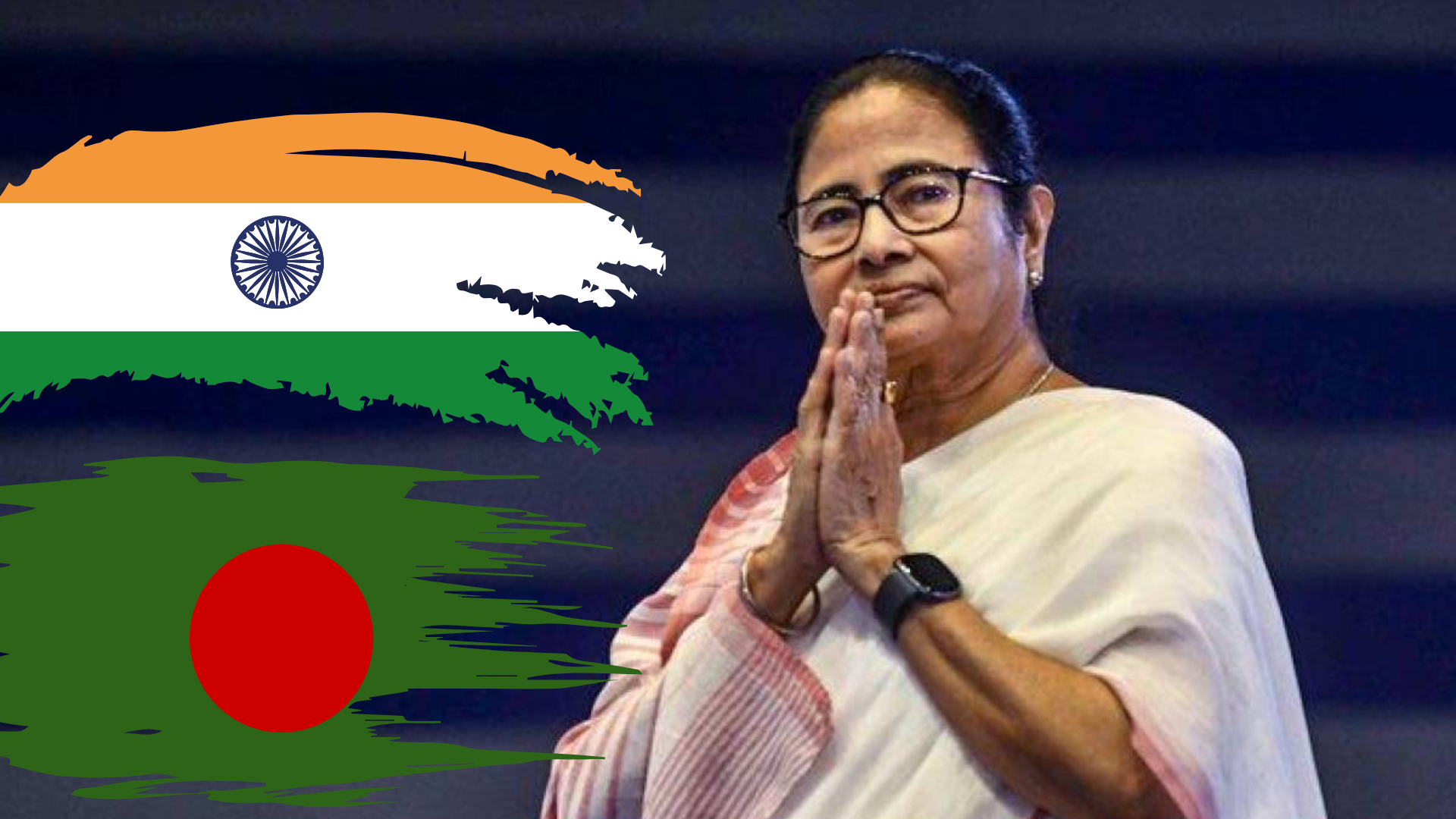
During the Awami League era, ex-prime minister Sheikh Hasina used to regard former chief minister of West Bengal, Mamata Banerjee, in a way which compelled people from both sides of the border to think that the duo had blood connections. During the summer season, Hasina would send truckloads of mangoes chosen carefully for Mamata, and during Durga Puja, the largest religious festival for the Hindu community both in Bangladesh and West Bengal, Hasina would send Mamata sarees and sweetmeats.
In return, Mamata provided only rhetoric, not offering any tangible benefits for Bangladesh. The sisterly relationship between the two firebrand women leaders of South Asia lasted for nearly 13 years, until Hasina fled to India following a mass uprising in July 2024, and Mamata losing her position in the recently concluded assembly election in her state, overtaken by Bharatiya Janata Party (BJP) led by Narendra Modi.
One might question how Bangladesh benefitted while being at the receiving end. The answer is that it never happened. From border security to river water sharing, Mamata never budged to Bangladesh’s demands. Rather, she tried her best to deprive Bangladesh from getting equal share of water from the two major rivers- the Ganges and the Teesta-that crisscross both Bangladesh and West Bengal. Regarding border killings, Mamata turned a blind eye, sometimes calling the Bangladeshi citizens caught inside Indian territory as infiltrators and sometimes resting the matter on the lap of the central government. Due to such apathy from Mamata’s side, Bangladesh has lost nothing from her defeat in the West Bengal assembly election.
Mamata’s bias towards Bangladesh goes a long way. As the opposition leader in 2005, Mamata told the assembly that Bangladeshi infiltrators have become a big risk for West Bengal, which was brushed aside by the then chief minister, Buddhadeb Bhattacharjee, who was from Communist Party of India-Marxist (CPI-M) background. However, she changed her tone on two occasions in 2024, the first time when a total of 84 Indian fishermen illegally entered the Bangladeshi territory and was jailed by the law enforcement, and the second time when hundreds of students, mostly Indian and from other South Asian countries, were fleeing and seeking shelter in West Bengal.
When the fishermen were imprisoned, Mamata urged Hasina to release them immediately, referring to the warm relations that both countries had been enjoying since time immemorial. She pleaded by saying that her government will take actions against the wrongdoers and Bangladesh should handle the issue softly as both India and Bangladesh are friendly nations bound by cultural ties dating back to thousands of years.
Unfortunately, Mamata never chose this line of thought when innocent Bangladeshi citizens were being killed at the Bangladesh-India border by Border Security Force (BSF). This is a glaring example of Mamata’s one-sided, selfish nature.
The second incident happened in December 2024, when relationship between Bangladesh and India turned to a historic low due to a tit-for-tat diplomatic manoeuvre following the killing of some Hindu individuals during mob beating and arrest of an influential Hindu monk. Following these incidents, both countries repeatedly summoned the high commissioners and expressed concern. In the meantime, assistant high commissions of both countries in Chattogram and several parts of India were set on fire by an angry mob. Sensing danger, at least 1,000 students, 900 of whom were Indians, gathered at the Benapole-Petrapole border and sought refuge from the Indian government.
When asked about the issue, Mamata said at the time that people coming from Bangladesh are welcome as they had been facing threats to their lives there. This shows Mamata’s self-contradictory nature. Mamata, who always termed Bangladeshi citizens entering Indian territory as trespassers, was showing sympathy and extending support to those who were leaving Bangladesh on the basis of a false perception about the country’s situation. By losing Mamata, Bangladesh has finally come out of the clutch of a two-faced woman, who never regarded Bangladesh as a priority.
Another big issue between Mamata and Bangladesh was the sharing of Teesta river water. Former prime minister Sheikh Hasina and her team of experts had formulated a treaty on water sharing from the Teesta River in 2011 and the then Indian prime minister Manmohan Singh was set to visit Dhaka and sign the pact. Although Mamata was to accompany Manmohan, she ditched the plan at the last moment, stalling the process of the signing of the Teesta Water Sharing Treaty. On various platforms since then, Mamata had been saying that if West Bengal lets Teesta water flow into Bangladesh, her state will not get enough water for agriculture. While giving this rationale, she did not think about the plights of the farmers living in northern Bangladesh. As a result, the northern region of Bangladesh faces acute water crises during the summer and the winter seasons, resulting in a spike in food prices and influx of rural people to big cities like Dhaka and Narayanganj, creating serious housing and food crises.
When Mamata was in power and the Bangladesh-India relations were at their lowest, she had made another blunder, which was humiliating for Bangladesh. When angry mobs were setting fire to the Indian Assistant High Commission in Chattogram and killing hindu individuals, Mamata stood in the assembly and urged the United Nations (UN) to interfere and send a peacekeeping mission to Bangladesh to tame the conflict. By saying this, Mamata had compared Bangladesh with war-torn countries like Sudan or Yemen, and such lopsided thinking damaged Bangladesh’s image to the international community. Mamata’s false portrayal of Bangladesh’s internal problems as communal attacks made her one of the greatest liabilities, and Bangladesh has had a sigh of relief knowing that Mamata will not be dictating the Bangladesh-India bilateral relations anymore.
All is well that ends well. It is yet to be known what kind of rule the new chief minister of West Bengal, Suvendu Adhikari, will offer to both his pupils and to Bangladesh as a neighbouring entity. The only takeaway from this discussion is that whatever happens in the future, they must be properly structured and stabilised due to the sync between the central and the state government ruled by the same party with likeminded ideology and interests.
No need to bid adieu to Mamata Banerjee. She was a rotten apple for Bangladesh-India bilateral relations.
Muhammad A. Bashed is a journalist based in Dhaka, Bangladesh. He can be reached at: bashed.muhammad@gmail.com
