

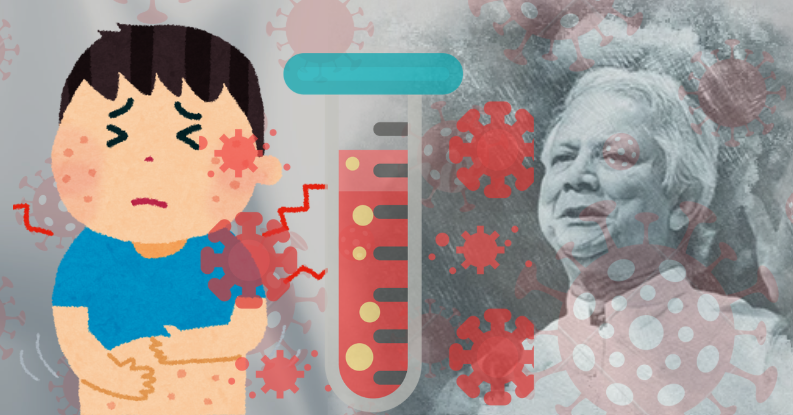
Whenever a crisis hits Bangladesh, certain people put the blame on the government and hold them accountable for failing to prevent the situation from unfolding. When news about cases regarding the measles- rubella disease started to appear in the media, people from a certain quarter found a perfect scapegoat- the recent interim government led by nobel laureate Muhammad Yunus. According to them, children were dying from the disease in 2026 because Yunus’s administration failed to vaccinate them on time back in 2024 and 2025. This may be true to some extent, but it can’t be the sole reason, as knowing which disease might cause a public health crisis in the future is quite impossible for any government. The following passages will try to find out who or what is actually responsible for the ongoing measles crisis.
Bangladesh is not alone when it comes to public health crises. For the past few years, public health is being constantly hit by severe outbreaks all over the world. We must not forget the Covid-19 crisis that prevailed from 2020 to 2021 and took thousands of lives worldwide. Even currently, another disease named ebola has been raging across the African continent, and people are dying there by a wide margin. In the last six years, the people around the world have seen three health emergencies worldwide. This begs the question- why are we falling prone to continuous outbreaks?
The easiest way is to blame the government and sit idle on the couches, waiting for them to solve everything. But diseases don’t spread from government offices, it originates at people’s own bedroom or kitchen. If you search for the reason for outbreaks like measles on the internet, you’ll find that lack of hygiene is the first and foremost cause behind the disease. In Bangladeshi context, the measles crisis has been rampant because urban centres like Dhaka and Chattogram have become over- populated and the environment in these places, including the conditions of air, water and soil, have fallen below the minimum quality.
More people are living in less areas, as the per capita land allocation has declined to a great extent. Except some affluent neighbourhoods like Dhanmondi, Gulshan, Banani and Bashundhara R/A, most areas in Dhaka city are filled with filth, giving birth to dangerous viruses able to cause a pandemic. Not only Dhaka but other city centres across the country are facing the same fate, making unplanned urbanisation as the most important reason for diseases.
What follows urbanisation is a drop in people’s economic capacity. Due to inflation, prices of essentials have skyrocketed, which has led to the decline of the intake of healthy, nutritious food by people. While food prices are moving upwards, people’s income is on a downward spiral, which is resulting into people consuming less protein, vitamin and minerals needed for a healthy body. This economic reality is leading
towards lower immunity among the people, especially women and children, and as a result, they are becoming more prone to infectious diseases like measles, as their bodies are failing to fight the viruses.
Yes, a person cannot resist the lure of migrating to urban centres, increase his income or reduce inflationary pressures by himself. Here comes the role of the government, which is responsible for managing these issues. Instead of making Dhaka the sole place for all economic and political activities, the governments that had ruled the country since its independence in 1971 should’ve created multiple city centres across the country so that people nationwide could have remained in their respective localities and find employment and residence there. Like India and the United States, divisional cities like Khulna and Rajshahi should’ve been made alternative financial centres to the least, and if there were five to six such centres across the country, the rapid urbanisation and poor human settlements like slums could’ve been avoided. Bangladesh is yet to experience one such governance structure which emphasises decentralisation of power and economy, and until that happens, people will continue to live in ghettos and fall victim to viral diseases like measles.
While Muhammad Yunus was in power, the country was in complete
chaos. Former prime minister Sheikh Hasina had ruined the nation both
politically and economically before fleeing to India following a mass
uprising in 2024. Every section of the government- the administration,
police, courts, hospitals, business entities- was in a flux and unsure of
what to do next. During the one and a half year of rule, Yunus had to
continuously face protests from various quarters, which kept him quite
occupied. Along with domestic instability, Yunus also had to tackle the
growing diplomatic pressure coming from various directions, with the
US, China, India and Russia trying to exert their influences on
Bangladesh and secure their geopolitical interests. Such dual challenge
might have led Yunus away from some basic functions at home, one of
which was vaccinating children against diseases like measles. But before
blaming the Yunus government for the public health fallout, the growing
unrest at home and diplomatic manoeuvres beyond the border must be
kept in mind.
Till the end of May, more than 500 children have died from measles- rubella and its symptoms. The time has come for the current government to take lessons from the public health failure, carry out widespread
immunisation campaigns, and prepare for such hazards in the coming days. The takeaway from this health crisis is that no matter how troubled a government might be at home and abroad, public health must be one of its top priorities, which cannot be compromised, ever.
Muhammad A. Bashed is a journalist based in Dhaka, Bangladesh.
He can be reached at: bashed.muhammad@gmail.com
