

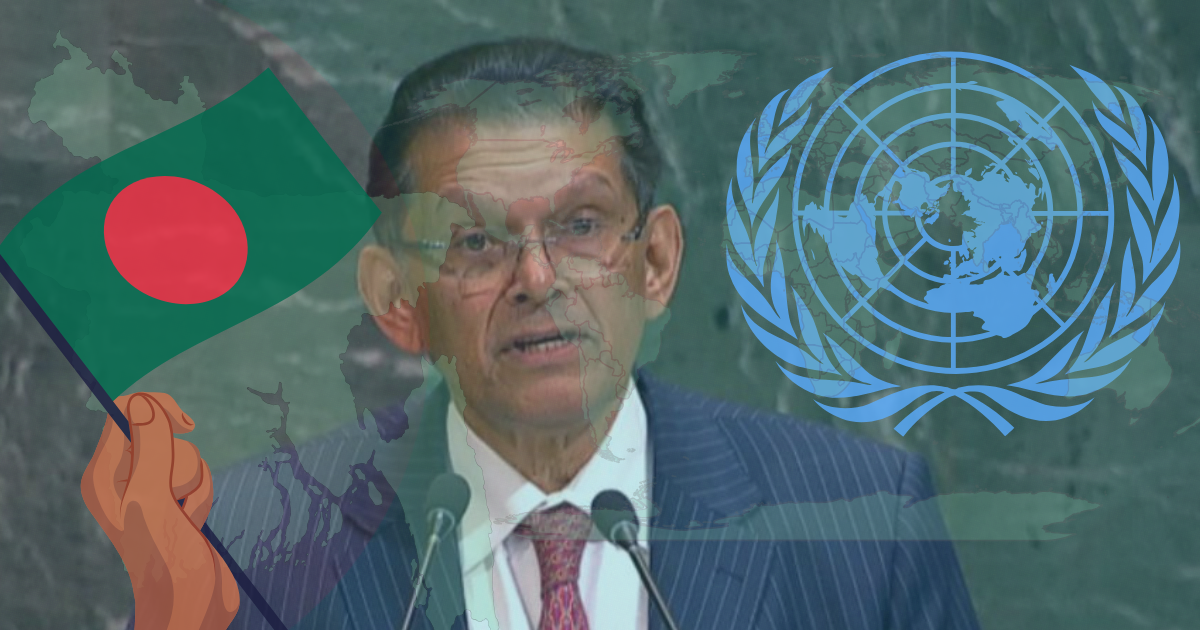
There is a profound, almost tragic dissonance in the spatial geography of a state that holds the
symbolic microphone of the world while struggling to secure the literal ground beneath its
feet. In New York, a chief diplomat steps onto polished marble, adjusting a global
microphone under the soft glare of international cameras; at that exact moment, on a rain-
swept frontier thousands of miles away, border guards are left to physically push back
unverified crossings and endure unilateral, aggressive pressures. This stark fracture between
the global stage and the local frontier defines the core paradox facing a post-uprising
Bangladesh: a demonstrated mastery of symbolic international inclusion existing alongside a
profound structural vulnerability to raw, material coercion in its own backyard.
To view the election of Dr. Khalilur Rahman to the presidency of the 81st United Nations
General Assembly as either an unmitigated national triumph or a completely toothless
administrative footnote is to look at the geopolitical chessboard through a remarkably flat
lens. The UNGA presidency is fundamentally a vacuum—an empty vessel of institutional
pageantry. If treated by the newly elected BNP administration as a mere victory lap or a
source of cosmetic validation, it acts as a form of structural sedation, blinding us to real
vulnerabilities while leaving the new government exposed to the cynical counter-narratives of
a deposed regime poised to frame any initial domestic governance struggles as a failure of the
post-July order. However, if approached through the lens of “institutional judo”—the art of
utilizing the immense institutional weight of a massive, global bureaucratic apparatus to
defend a fragile domestic experiment—the wooden gavel in Manhattan can be weaponized as
an aggressive strategic shield for both our paralyzed economy and our contested frontiers.
Crucially, this presidency must be leveraged as an institutional firewall to solidify the global
standing of the “New Bangladesh.” Post-uprising states are historically vulnerable to
sophisticated external disinformation campaigns and domestic counter-narratives designed to
frame the post-revolutionary administration as a volatile, legally unstable intermission.
Holding the UNGA gavel instantly immunizes the elected government against these attempts.
By taking center stage in global governance, the administration transitions from an entity seeking external validation to the very entity presiding over international law. It signals undisputed global recognition, embedding the post-July order into the international architecture not as a fragile democratic anomaly, but as the legitimate vanguard of political renewal in the Global South.
Beyond narrative defense, the platform must be aggressively utilized to dismantle the legal protections enjoyed by laundered capital. For over a decade, the structural looting of Bangladesh’s financial sector was legally insulated by an autocracy that weaponized constitutional mechanisms like Article 70 to enforce absolute legislative blindness. By preventing parliamentarians from voting against bank-looting budgets or crony-capitalist policies under the threat of losing their seats, Article 70 turned the legislature into a silent spectator while oligarchs hollowed out national banks from within. Today, the state finds itself playing a desperate, exhausted defense—begging Western courts and foreign jurisdictions to track, freeze, and return billions in laundered capital.
As UNGA President, Rahman can shift Bangladesh from a desperate supplicant to an active norm-entrepreneur. The president wields immense power over the assembly’s thematic debates and agenda-setting. He must use this clout to spearhead an international resolution on Transnational Financial Transparency for Transformed States. By forcing Western and regional banking havens to cooperate under the explicit glare of international law, Bangladesh can strip these jurisdictions of their plausible deniability, turning a domestic macroeconomic emergency into a binding global policy mandate that effectively breaks the structural immunity traditionally offered to stolen wealth.
Similarly, this office can alter the realpolitik of our frayed frontiers. While the General Assembly lacks the mandate to dispatch battalions to defend a nation’s physical borders against sudden push-ins or weaponized, uncoordinated water discharges, it does possess undisputed custody of the global agenda. Rahman should introduce a definitive, overarching thematic focus on the Asymmetric Vulnerabilities of Post-Authoritarian Transitions. By reframing cross-border pressures not as isolated, bilateral frictions to be settled quietly, but as systemic, hybrid threats designed to destabilize a nation undergoing democratic reform, Bangladesh can transform localized coercion into an international reputational hazard. This radically increases the diplomatic and geopolitical cost for any regional neighbor attempting to exploit a country’s moment of political realignment.
Simultaneously, the podium must be used to dismantle the flawed geopolitical paradigms that
enabled the old regime’s longevity. For fifteen years, the international community and global
capital tolerated a deepening autocracy in Dhaka because they accepted the transactional
myth of “authoritarian stability”—the false premise that economic progress and regional
security require the suppression of democratic rights. Rahman must use his tenure to
articulate the July Manifesto, a clear-eyed demonstration to global investors and superpowers
alike that true, durable regional stability is structurally impossible without domestic
democratic legitimacy. The new government must not be presented to the world as an
unpredictable or temporary regime, but as the stabilizing anchor of a sustainable model of
governance for the Global South, proving that accountability is the only true foundation for
economic and geopolitical predictability.
The ultimate test of this institutional leverage, however, will be Bangladesh’s willingness to
shatter the geopolitical gridlock surrounding the Rohingya crisis. For nearly a decade, the
state’s approach within the UN architecture has been that of a tragic solicitor, pleading for
diminishing humanitarian aid while quietly accepting the West’s paralyzing paradigm of
“humanitarian containment.” This unspoken global consensus is designed merely to fund the
indefinite maintenance of a protracted refugee crisis, keeping a displaced population
cordoned off in Cox’s Bazar so they do not migrate further or disrupt broader maritime or
Western borders. It does zero heavy lifting to fix the root cause or enforce repatriation,
effectively treating Bangladesh as a permanent, global refugee camp manager.
As UNGA President, Rahman has the historic opportunity to shatter this global complacency.
He must use the gavel to forcefully pivot the UN’s bureaucratic machinery away from
indefinite refugee management toward an aggressive, time-bound framework for repatriation.
Crucially, this requires the intellectual courage to abandon archaic diplomatic loops. The UN
remains paralyzed because it insists on attempting to negotiate safe returns with a decaying,
illegitimate military Junta in Naypyidaw that has lost actual administrative control over its
own frontiers. The reality on the ground in Rakhine State has fundamentally evolved; ethnic
armed groups, most notably the Arakan Army, now hold territorial custody over the lands to
which the Rohingya must return. Rahman should utilize his institutional clout to pioneer an
unconventional, pragmatic UN track—one that bypasses a gridlocked Security Council to
engage directly with the actual territorial stakeholders inside Myanmar to secure a safe,
legally recognized return.
To compel international movement, the crisis must also be stripped of its tired framing as a
localized humanitarian tragedy. Global superpowers do not act on empathy; they act on
strategic self-interest. Bangladesh must reframe the protracted displacement of over a million
people as an acute, destabilizing threat to the maritime security of the Bay of Bengal,
explicitly linking it to transnational crime, radicalization risks, and Indo-Pacific supply-chain
vulnerabilities. By transforming repatriation from a moral plea into a regional geopolitical
necessity, global actors will finally realize that resolving this crisis is a matter of systemic
stability, not a charitable afterthought.
Statecraft cannot be sustained on cosmetic trophies or the empty applause of international
forums; it requires hard structural dignity, economic accountability, and uncompromised
material sovereignty. For the newly elected BNP administration, the UNGA presidency must
not be treated as a prestigious diplomatic retirement post or a sanctuary for abstract global
debates. The wooden gavel in Manhattan carries strategic weight only if it is wielded with
sharp geopolitical clarity and a calculated, state-centric resolve. If the new government can
successfully transform global pageantry into raw asymmetric leverage, Bangladesh will
finally cease to be a passive theater where regional crises play out—and instead stand as the
sovereign architect of its own survival.
Jannat Binte Aslam is an economics student by trade, she navigates Dhaka’s
chaos by looking up, choosing the silence of clouds over the performative liberty of the city.
