

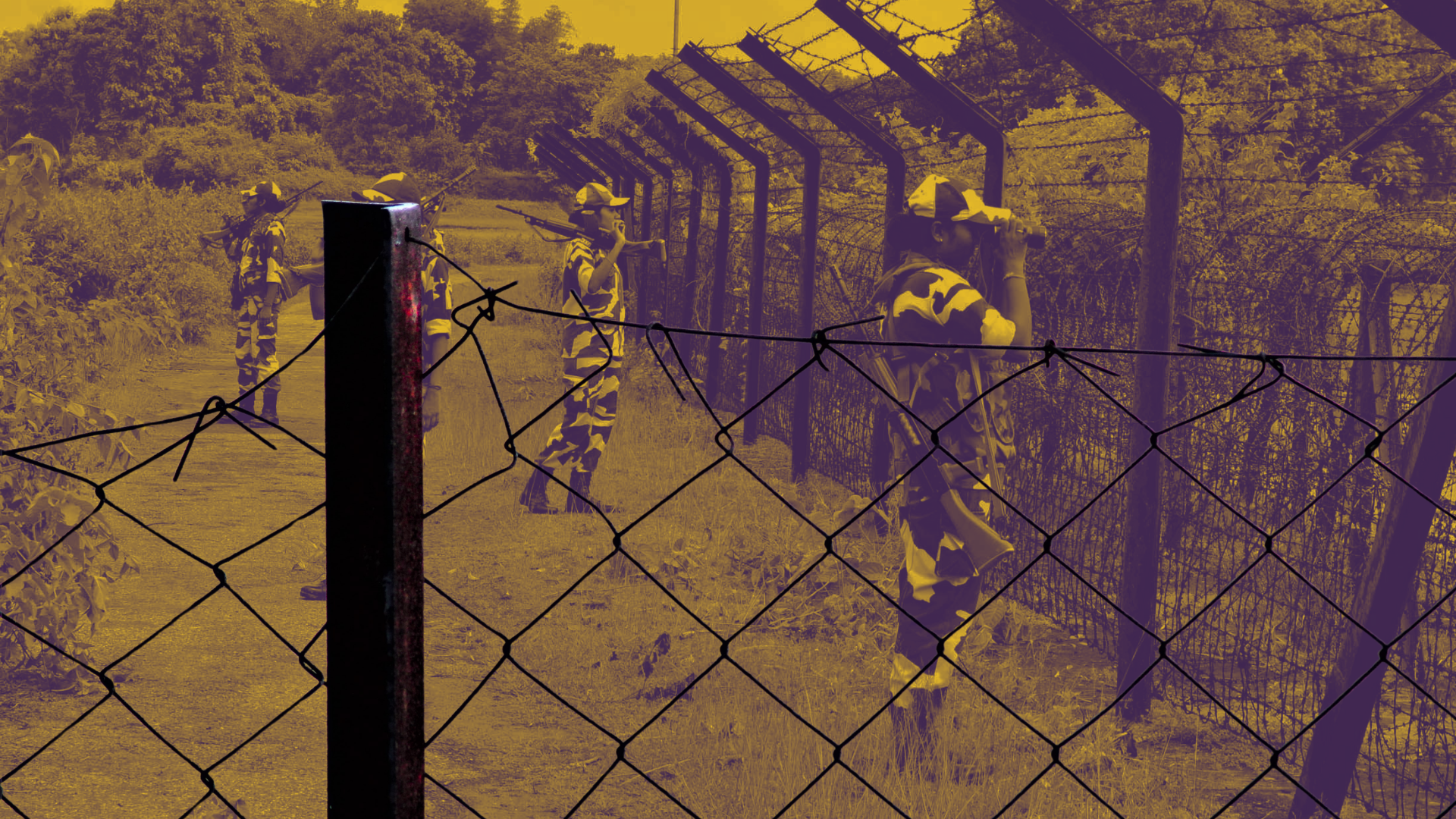
In May 2026, a man named Obaidul Khandaker showed Indian border guards his identity documents. He was from Cooch Behar, a district inside India. The guards told him the papers needed “verification.” Ten days later — no food, no lawyer, no word to his family — he was pushed across the border into Bangladesh. When he finally made it back home, his house had been looted and his power line cut.
He is not an outlier. He is the policy.
recent BGB data cited by Bangladeshi media says at least 2,303 people were pushed into Bangladesh between May 2025 and January 2026 — pregnant women, children, the elderly. Human Rights Watch puts the broader figure at over 1,500 between May and June this year. New Delhi has not disputed the numbers. It has not offered an explanation. It has continued.
This is not immigration enforcement that spiraled out of control. I want to be honest about what I can and cannot prove: I cannot prove intent from a ministry memo. What I can show is a pattern — and the pattern is not random.
For nearly a decade, the Bharatiya Janata Party (BJP) has built its electoral machinery around one villain: the illegal Bangladeshi Muslim infiltrator. Stealing jobs. Diluting culture. Threatening Hindu India. In West Bengal and Assam — states with long, porous borders and large Muslim populations — this narrative won elections. It drove the National Register of Citizens in Assam, which stripped nearly two million people, mostly Muslim, of citizenship. It produced the mandate to “Detect, Delete, Deport.”
Nobody seriously asked what happens when you run that playbook for a decade. The answer is this: the narrative stops being domestic. It starts governing how you actually treat your neighbors.
The “Bangladeshi infiltrator” is no longer just an electoral figure. It has become the operating logic of Indian foreign policy toward Dhaka. What began as a way to mobilize voters in West Bengal has become a tool for pressuring a neighboring government. The people caught in between — literally, geographically, legally — are paying for it.
The timing is not subtle.
For fifteen years, India had in Sheikh Hasina a Bangladeshi prime minister who was, frankly, useful. She kept Islamist groups in check, gave India transit access, cooperated on intelligence, kept Chinese investment at arm’s length. In exchange, New Delhi looked away — from the rigged elections, the disappeared journalists, the opposition members who vanished into custody. That was the deal. It worked for India.
It ended in August 2024, when a student-led uprising forced Hasina out. The interim government that replaced her is not hostile to India. But it is independent in a way Dhaka hasn’t been in fifteen years. It has talked to China. It has declined to inherit Hasina’s deference. Delhi does not appear to like this. And the push-ins — which escalated sharply through 2025 and peaked in 2026 — track almost perfectly with the souring relationship.
Coercive diplomacy doesn’t send a press release. It just makes things harder for the other side until the message lands.
The message, delivered not in words but in bodies dumped across a border in the middle of the night: Bangladesh under a government we don’t control will pay a price.
What makes this hard to fight is the deniability.
India doesn’t need to threaten anyone. It simply takes people — some undocumented, some not, some holding Indian identity cards that guards decide on the spot to distrust — and deposits them across the border. Bangladesh absorbs them. Houses them. Explains to its own public why people are arriving from India in the middle of the night.
Bangladesh cannot easily push back. India is its largest neighbor, largest trading partner, and controls the upstream flow of rivers that Bangladeshi agriculture depends on. Dhaka’s leverage is real but narrow. Its loudest available option is a strongly-worded statement.
So the costs land entirely on Bangladesh. The optics stay clean for India. The victims get filed under enforcement.
Here is where I think New Delhi is making a serious mistake — and I say this not as someone sympathetic to Dhaka’s current government, but as someone who thinks India’s strategic position in South Asia is genuinely deteriorating and that Indians should be angry about why.
Bangladesh is not a bilateral nuisance. It is a pivot point in a region China has been methodically reshaping for years. Beijing doesn’t need Bangladesh to love China. It just needs Bangladesh to find India more trouble than it’s worth. The push-ins are doing that work for Beijing, for free.
India has watched this pattern play out with Nepal. With Sri Lanka. The sequence is always the same: India antagonises, China fills the space, India complains about encirclement. What’s remarkable is that India keeps repeating it — and in Bangladesh, the stakes are higher than almost anywhere else in the neighborhood.
Influence doesn’t erode in speeches. It erodes procurement decisions, port agreements, and the quiet drift of a country that used to default toward you and no longer does. By the time it’s visible, it’s already done.
Obaidul Khandaker made it back to India. Many others haven’t. Some are Indians who can no longer prove it. Some are Bangladeshis expelled without any legal process. Some are neither — just Bengali-speaking Muslims who fit a profile the current government finds convenient to move.
What they share is that they’ve been turned into instruments of a story. A story about infiltrators and borders and who really belongs. It started as an election strategy. It became law. It is now foreign policy. Somewhere along that journey, the actual people stopped mattering.
So let me be direct about where I land: what India is doing is wrong — strategically, legally, and by any standard of basic decency. The push-ins are not a tough but necessary policy. They are not enforced with unfortunate collateral damage. They are a government using manufactured fear about one group of people to pressure another country, and then dressing it up as border management.
India is a democracy — or at least it still calls itself one. Democracies are not supposed to do this. And the fact that it is being done quietly, without accountability, without even an official count of how many people have been expelled, should bother Indians as much as it bothers anyone watching from outside.
The border is a signal. Right now it signals that partnership with New Delhi is contingent on compliance, and that the price of independence gets collected in people.
That is not what a serious regional power looks like. It is what a nervous one does.
