

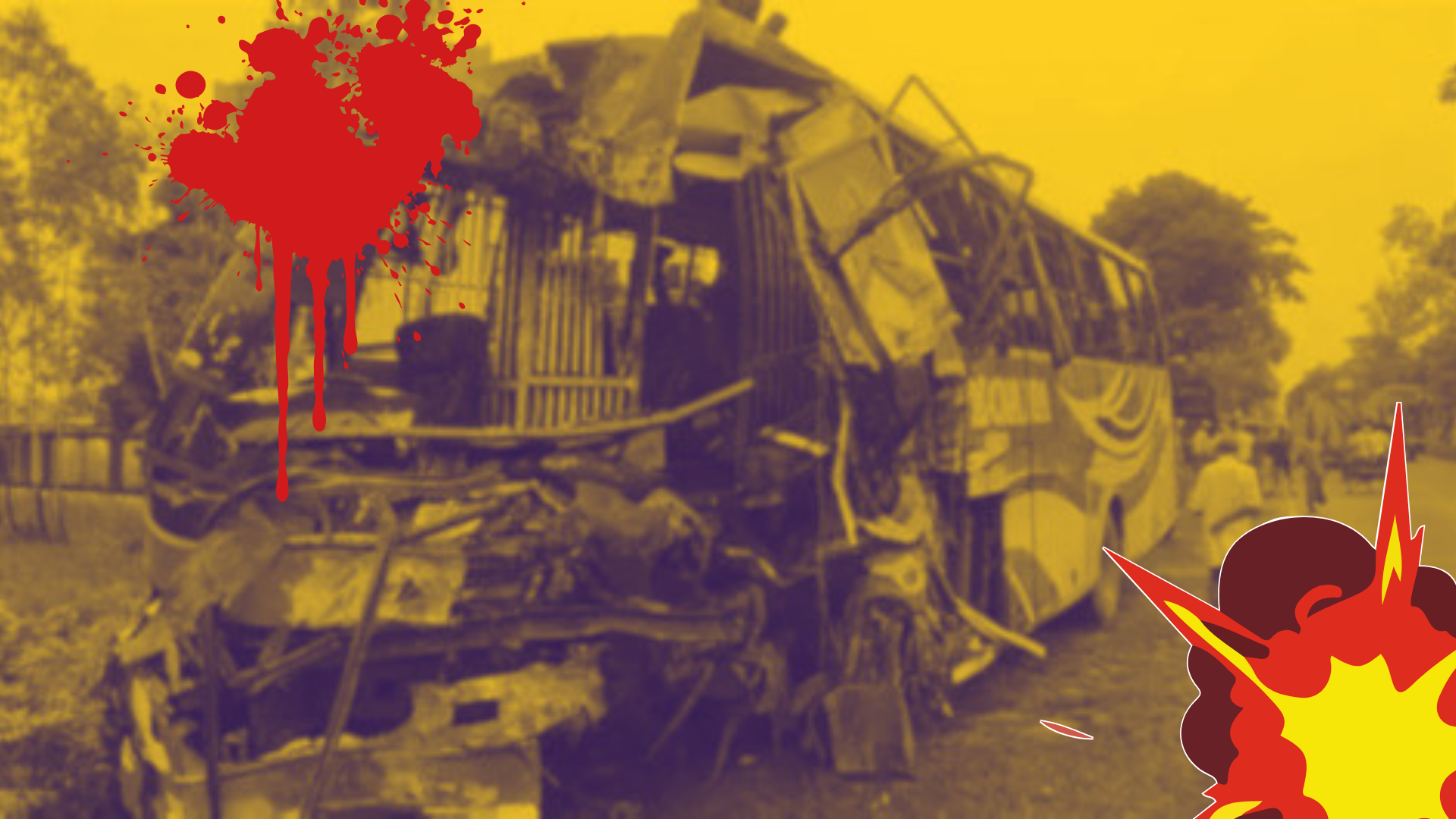
Shaheda put her daughter Jyotsna on a bus to Dhaka and never heard her voice again — only a few words, desperate and final, tearing through the static before the line collapsed into silence: the bus is falling, Amma, the bus is falling into the Padma. Then nothing. The river had taken her. Jyotsna’s eight-year-old son Alif, who had been sitting on her lap when the bus tipped off the edge of Pontoon 3 at the Daulatdia ghat and plunged thirty feet into the river, survived only because she had the presence of mind – in her last moments, in the dark and the cold and the rushing water – to push him through a window. He swam ashore. He looked back at the water. He could not find her.
We speak often, in this country, about the tragedy of transport. We speak of it the way we speak of monsoon floods: as something vast and seasonal and largely beyond the reach of human remedy. But Jyotsna did not drown because of the monsoon. She drowned at a busy ferry terminal on a clear afternoon in March, because a utility ferry struck a pontoon and a bus rolled into the river, and because there was nothing – no barrier, no failsafe, no mechanism of any kind – standing between the edge of that pontoon and thirty feet of Padma River. What swallowed her was not fate. It was the accumulated weight of every decision not made, every safety measure not installed, every law not enforced.
And she was not alone that week. In the eight days before the Padma took the bus, a train had derailed in Bogura sending passengers hurtling off the roof ; a launch collision on the Buriganga had killed a twenty-two-year-old man and left his pregnant wife hospitalised while his father’s body drifted downriver and was recovered two days later near a salt mill in Keraniganj ; and a Chittagong-bound mail train had ploughed through a sleeping busload of passengers at a level crossing in Comilla at three in the morning – dragging the wreckage nearly a kilometre -because
Both gatekeepers assigned to that crossing had abandoned their posts. Twelve dead in Comilla. Seven men, three women, two children – killed in their sleep, in the dark, because two men were not standing where the system had placed them and there was nothing else to stop a train.
The cycle, as it always does, continues.
The word “accident” does not adequately describe what Bangladesh has. An accident implies the unforeseeable, the collision of circumstances no reasonable system could have anticipated. What we have, instead, is a transport system that kills between seven and thirty-two thousand people every single year – the range itself is an indictment, a measure of how little we even bother to count the dead – and has done so with the grim consistency of a machine, year after year, decade after decade. The World Health Organisation estimates 31,578 road deaths in Bangladesh in 2021 alone (WHO Global Status Report on Road Safety 2023): roughly six times the figure the Bangladesh Road Transport Authority reported for the same year.
The Road Safety Foundation counted 7,294 road deaths in 2024. The Passenger Welfare Association put it at 8,543. Over eleven years — 2014 to 2024 — the cumulative toll reached 105,338 dead and 149,847 injured. On the waterways in 2024: 118 incidents, 152 dead, 39 people still missing. On the railways: 497 incidents, 512 killed. At Bangladesh’s current fatality rate of 18.6 deaths per 100,000 people — above the Asia-Pacific average, above the South Asia average — the country is not merely failing to improve. Between 2010 and 2021, as the region broadly moved toward safety, Bangladesh’s rate went up by 8 percent.
These are not accidents. They are a policy outcome.
Consider the precise architecture of what happened at Paduar Bazar on the night of March 22. The level crossing exists. The law requiring it to be manned exists. The gatekeepers, Md Helal and Mehedi Hasan, were employed and assigned to stand there. They were not there. A bus full of sleeping passengers
crossed onto the tracks. A train arrived. Twelve people died, among them two children who had done nothing more dangerous than fall asleep on a bus. RAB arrested one gatekeeper two days later. Three probe committees were formed.
What was not arrested – what no committee was formed to examine — was the system that placed one unmonitored human being, without any mechanical failsafe or automated barrier or redundant alarm, as the sole line of defence between a sleeping bus and an oncoming train at 3:00 in the morning.
This is not the failure of two men. It is the failure of institutional imagination — the refusal to accept that human beings will sometimes not be where they are supposed to be, and to build systems accordingly. The Nilsagar Express reportedly ignored a signal before entering a maintenance zone. The ferry Hasna Hena struck a pontoon without apparent consequence until a bus was in the river. None of these systems have redundancy. All of them rest on the assumption that the human being at the critical point will perform correctly, every time, without fail. Sweden’s Vision Zero framework which has reduced that country’s road fatality rate to 2.8 deaths per 100,000 people, a fall of over 66 percent since its adoption – was built on the explicit rejection of that assumption. One of its architects called it, plainly, “a very unprofessional approach” to design systems that only work when humans do not err. We do not design aviation that way. We do not design rail signalling in wealthy countries that way. We design everything in Bangladesh that way.
What makes all of this most difficult to sit with and most painful to examine is that none of the solutions are mysterious. The Asian Transport Observatory estimates that a targeted investment of just 0.2 percent of GDP, roughly 768 million USD per year, could prevent 11,000 road deaths annually in Bangladesh. The government’s own plans – the National Road Safety Strategic Action Plan, the Eighth Five-Year Plan, the Perspective Plan 2021–2041 – all carry commitments to reducing fatalities. A new Road Safety Act, aligned with the UN’s Safe System approach, was initiated in January 2024. As of mid-2025, it remained stalled in the drafting stage.
The Road Transport Act 2018 is itself a story worth grieving over. It was born of blood passed after students filled the streets of Dhaka following the deaths of two classmates crushed beneath a speeding bus, a rare moment of raw, public grief forcing itself into legislative chambers.
Within months, a committee dominated by transport sector leaders produced 111 recommendations. Almost none were implemented. The Act that came into force in 2019 prioritised the interests of transport operators over the safety of road users and was subjected to amendment pressure from those same interests before the ink was dry.
The pattern is now familiar enough to describe in one sentence: crisis produces protest, protest produces legislation, legislation is quietly hollowed out by lobbying, and enforcement, when it finally arrives, falls on the smallest and most powerless person in the chain. The gatekeeper is arrested. The shipping company’s permit is suspended for a fortnight. The assistant station master is sacked. And the system that produced the absent gatekeeper, the unguarded pontoon, the unmaintained signal — that system files its report and continues. New Age’s editorial board wrote it plainly: what is needed is not another law, but the institutional will to enforce the laws already on the books.
What we are calling for is not radical. Life cannot be weighed against other benefits. Not against transport operators’ profit margins. Not against the revenue unfit vehicles generate for the BRTA. Not against the cost of installing automated barriers at level crossings. The Swedish system works because it redistributes moral responsibility upward – away from the gatekeeper at 3:00 in the morning and toward the administrators who designed the crossing, the ministers who funded it, the parliament that legislated it. In Sweden, when someone dies on a road, the question is: how did we allow this to be possible?
In Bangladesh, the question is: who do we arrest?
Arresting individuals has not worked. We have been arresting gatekeepers and suspending station masters for decades. The death rate is rising.
There are, at last, some tentative signs that the state understands this; though understanding and acting upon it remain different things. In October 2025, the government announced that all driving licence applicants would be required to complete a mandatory 60 hours of formal training before receiving a licence, with the licensing process itself transferred away from BRTA and into the hands of approved training
institutes. (The Business Standard, 23 October 2025) This matters because it confronts, directly, one of the most dangerous structural features of the current system: most commercial bus and truck drivers in Bangladesh have never received institutional training of any kind, learning instead through apprenticeship to uncertified seniors, inheriting bad habits alongside the wheel.
BRAC’s Shurakkha programme – which provides residential defensive driving training to in-service commercial drivers – has shown what rigorous instruction can do: one transport company reported a 30 percent drop in fuel consumption after its drivers completed the course, a proxy for the calmer, more deliberate driving that does not kill. And in May 2024, Bangladesh became the first country in Asia to issue a speed limit guideline aligned with WHO standards, setting a national maximum of 80 km/h on highways — a framework that did not exist before, and whose enforcement, if it ever truly comes, could save thousands of lives a year. These are real steps. The grief they arrive against is that they are steps taken on a road already paved with 105,000 dead, and that there is no guarantee, none at all, that they will not be diluted, deferred, or quietly abandoned the way every reform before them has been.
Research on lower-middle income countries that have implemented elements of the Safe System approach points toward a set of measures that are neither unproven nor unaffordable (Ferdous J et al., Safety, 2025): an independent Road Safety Authority with genuine enforcement power, insulated from transport lobbies; automated and redundant failsafes at level crossings; physical barriers at ferry ghats so that no vehicle can roll into a river regardless of what any individual does or does not do; and a national crash data system that actually counts all the dead, because a country where the official toll and the WHO estimate differ by a factor of six does not have merely a road safety crisis; it has a crisis of acknowledgement. We cannot mourn what we have refused to count.
None of this is easy. Bangladesh’s transport sector is politically formidable, entangled with the livelihoods of millions of drivers, helpers, operators, and labourers whose vulnerability is real and whose resistance to disruption is understandable. The Road Safety Coalition Bangladesh, which includes BRAC and the Accident Research Institute among its members, has been working carefully within this landscape, noting the weight of opposition from transport owners’ associations and importers’ groups.
These are not trivial obstacles. But they are not new ones, and the price of leaving them unaddressed is being paid every day. Not by the transport owners and not by the ministers, but by people like Jyotsna and Sohel Fakir and twelve sleeping passengers on a bus in Comilla, whose names were entered into a probe committee report and who will be forgotten by the time the next disaster comes, which it already has.
Alif swam ashore. He is eight years old, and he is alive because his mother used her last seconds to save him. Somewhere in Rajbari, Shaheda holds a phone that has gone silent. The rivers and the earth remember. They keep what they are given.
Bangladesh has plans. It has legislation, or the incomplete draft of it. What it has never been able to sustain is the political will to see them through — to hold the system accountable rather than the individual, to ask not who to arrest but what to rebuild. That is not an extraordinary demand. It is, in fact, the minimum owed.
