

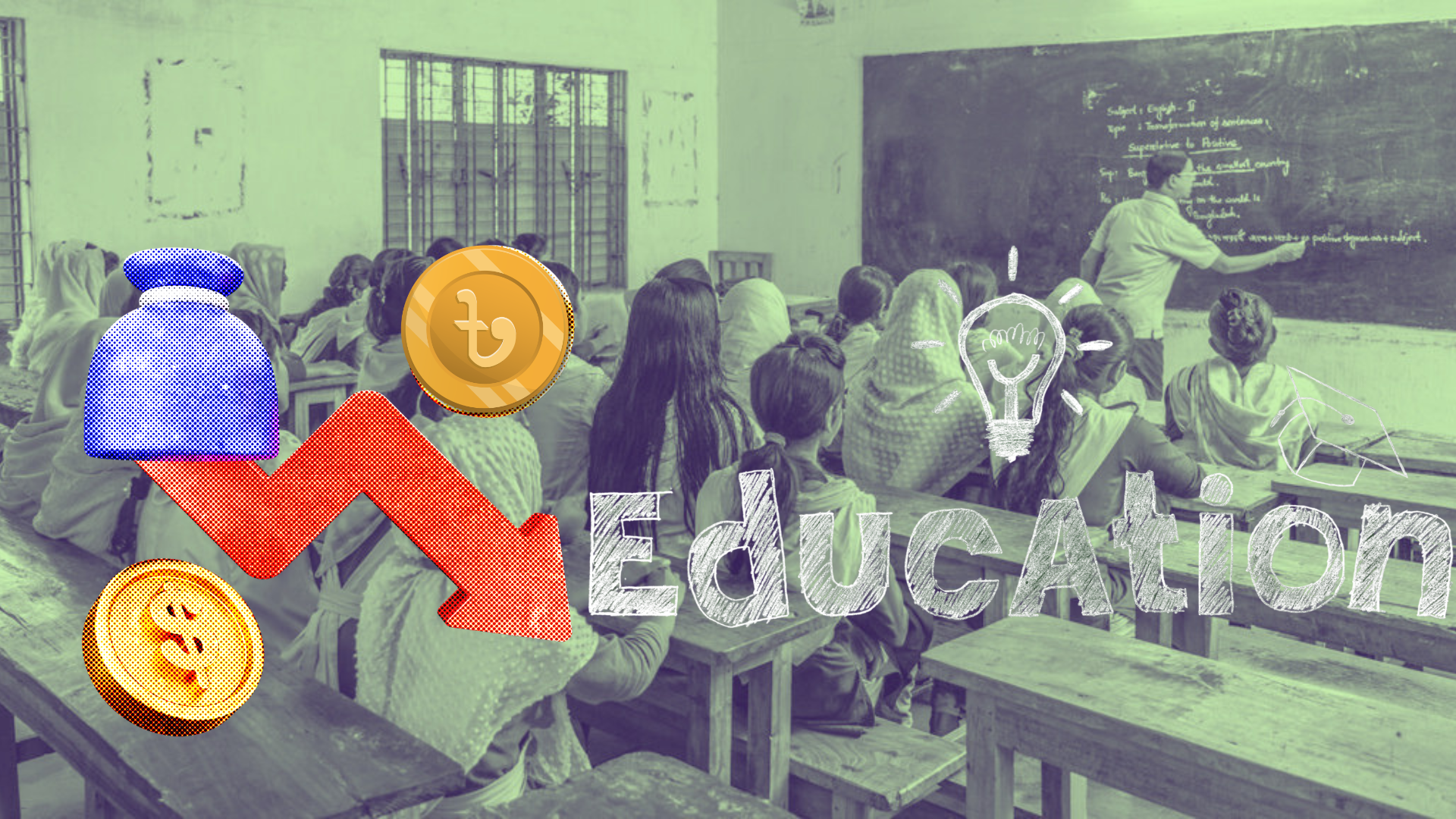
We all talk about expanding educational opportunities for the underprivileged, but never do enough to make the economics of this work. The government talks about making education free for children and young adults—often up to the undergraduate level for women, for example—but that too is insufficient when it comes to the ultra-poor. What we need instead is to make education gainful for those who are desperate for money. If the cost-benefit calculation can be changed, outcomes would be a net positive.
People refrain from sending their children to school for various reasons. Some do not realise the need for education or its long-term benefits. But many do not do so simply because they cannot afford it. It is not just a problem of failing to pay the fees for public schools—which are already quite low (and I agree that they should be nil for the poor).
It is also a problem of opportunity cost.
By sending young children to school, families lose a key asset: an earning individual. Child labour, sadly, is a common practice in many underdeveloped countries. Children can make a lot of money, often equal to adults, by doing odd jobs, often in the informal market. A family experiencing abject poverty cannot afford to lose that much money by allowing their child to go to school, let alone to college or university.
The key problem can be simplified to a simple sentence: there are no immediate short-term gains from sending a child to school. There is a very visible and visceral loss: that of fast cash. There are also hidden costs of schooling, such as money for books, uniforms, stationery, etc. Making fees nil does not make this cost go away. When you add up the opportunity cost and the hidden cost, it simply becomes too much for the absolute poor to afford.
So what is the solution?
I propose we make education financially gainful for the families of the ultra-poor children in question. A conditional cash transfer (CCT) tied to attendance rates and/or school performance can be used. Under this system, ultra-poor families would receive a monthly cash transfer per child they send to school as a stipend for the student. To prevent the encouragement of overprocreation, this can be capped at three children per family. This would tilt the cost-benefit analysis of an ultra-poor family, and suddenly sending their child to school will seem much more feasible and gainful. Other stipends for females can be added on top of this to encourage the attendance of girl children in schools.
This is not something alien to Bangladesh or the underdeveloped world—this has been tried before and this has worked, and it will continue to work. CCT is a policy tool that has been widely used in various parts of the world with varying but overall positive success. Bangladesh itself has seen massive gains in education through the scholarship system for female education. India has had the Apni Beti Apni Dhan (ABAD) programme in Haryana, which successfully increased school enrolment up to the 8th grade, and Brazil has the Bolsa Escola programme that increased school enrolment by approximately 5.5%–6.5% and reduced dropout rates. We need to design our welfare system in a way that boosts educational access and opportunities for the ultra-poor. This will lead to a more educated and powerful electorate, labour force, and citizenry.
However, in an initial survey of opinions on social media, it seems that people are very much worried about the fiscal pressure this would create on the government. This is a legitimate concern, but it would be countered by the positive externality of the investment in terms of better socialisation, a boost in employability, and general improvement of life that is evidently tied to an improvement in the general level of education of the overall population. If money is a problem, let us means-test educational subsidies, remove subsidies for the rich, and use that money to support the poor. Sounds crude, but this could work. Money can be saved from a lot of different sectors by tightening overspending and curbing corruption.
If people are worried about families procreating too much to gain monetary benefits by getting more welfare through school-going children (which is an anti-poor notion to begin with, but no more on that now), there could be a cap on the number of children eligible for the stipend, as proposed before. A three-child cap would easily discourage people from procreating beyond desired levels. But having said that, I am against treating the population as a problem. I think the uneducated and unemployed population is a problem, and the educated and trained population can be an asset at a time when birth rates in many countries that need working people are declining. With proper training, Bangladesh can become the primary supplier of top-quality manpower for the global market.
We must face it: telling poor families to send kids to school does not work if they lose cash. Right now, it costs too much in lost wages and supplies. The fix is pretty simple: pay them to do it. A cash stipend tied to attendance flips the maths, making school actually profitable for those desperate for money. While the government drives for improving educational outcomes, this simplistic policy can go a long way towards changing the calculus of the ultra-poor when deciding on schooling.
Anupam Debashis Roy is the editor-in-chief of Muktipotro. He can be reached at writeranupam1101@gmail.com.
