

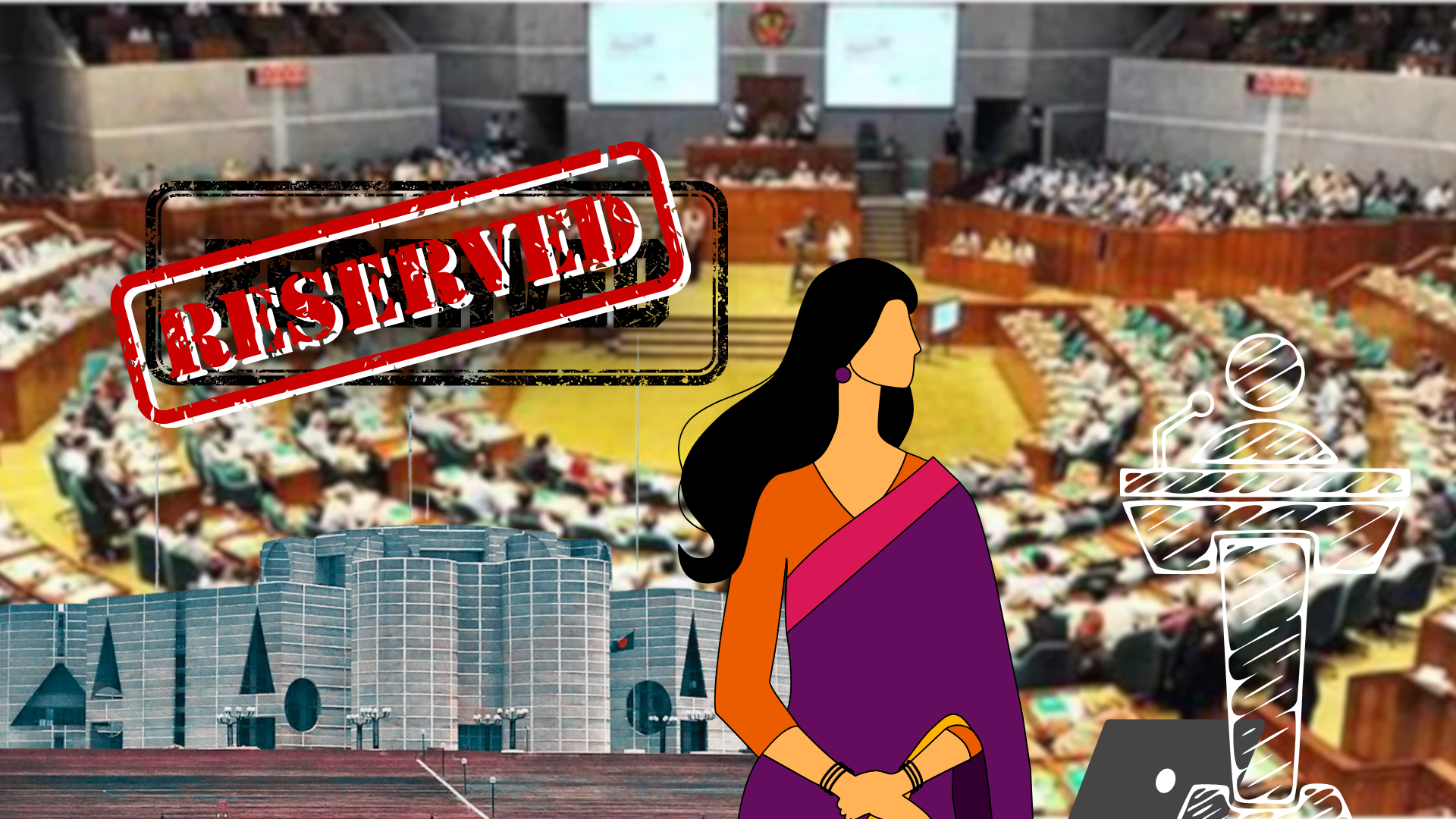
This week, the BNP has announced 36 nominations for the reserved women’s seats in Parliament. The opposition alliance of Jamaat and NCP has also put forward around 10–12 names. As these lists circulate, a familiar debate returns: what exactly do these seats represent and who do they really serve?
Bangladesh’s journey with reserved seats began in 1972 with just 15 positions for women. The number has since increased, but the core structure has remained unchanged. Women in these seats are not directly elected by voters. Instead, they are nominated by political parties based on their share of seats in Parliament.
If an MP is chosen by a party rather than elected by a constituency, a fundamental question emerges: who is she accountable to? Without a defined geographic constituency, reserved-seat MPs often operate in a political space that is broader, but also more uncertain. They are expected to speak on national issues, yet lack the direct electoral mandate that anchors most parliamentary work.
This has led critics to describe the system as inherently limited—if not tokenistic. To be fair, reserved seats were introduced with a clear purpose: to ensure women’s presence in a political system where structural barriers often prevent equal participation. In many ways, they have succeeded in increasing numerical representation. Bangladesh today has far more women in Parliament than it would have without such measures.
But representation is not just about numbers. It is also about power, independence, and accountability. There is a growing perception that reserved seats, as currently structured, can weaken all three.
Take the nomination patterns themselves. While some parties, including the BNP, have brought in younger faces with backgrounds in student politics and grassroots organizing, there is also a noticeable trend of selecting candidates with strong political family ties. Daughters, spouses, and relatives of long-time party figures often feature prominently.
There is nothing inherently wrong with political lineage—experience and exposure can be valuable. But it raises a valid question: if these individuals are already politically active and influential, why are they not being fielded in direct elections? Why place them in a system that limits their autonomy instead of allowing them to build their own electoral base?
Ironically, the very women who might be most capable of winning public support are often placed in positions where they do not need to seek it.
The issue becomes even more complicated when we look at recent nominations. Three candidates who lost direct constituency elections—Sanjida Islam Tuli (Dhaka-14), Sabira Sultana (Jashore-2), and Sansila Zebrin (Sherpur-1)—have now been nominated for reserved seats.
This sends a mixed message. On one hand, it ensures experienced candidates remain within the political system. On the other hand, it raises a difficult question: if voters have already rejected a candidate, should party nomination override that decision?
At its core, Parliament is meant to represent citizens. When entry into Parliament bypasses voter choice, even for well-intentioned reasons, it risks diluting that principle. These concerns are not just theoretical; they are increasingly reflected in public discourse.
Recently, independent candidate Tasnim Jara publicly stated that she declined an offer for a reserved seat, arguing that it conflicted with her belief in direct representation. After securing around 40,000 votes in a national election, she expressed confidence that she could return stronger in a future direct contest. Her stance resonates with a broader global conversation: meaningful representation cannot be reduced to symbolic inclusion.
There is also a question of voice. Over the years, some figures who were once outspoken on critical issues have appeared less vocal after entering formal party structures through such routes. While political realities are always complex, this shift feeds into the perception that reserved-seat MPs may have less space to dissent or challenge party lines.
For instance, Sanjida Islam Tuli; now nominated by the BNP, has previously been vocal on enforced disappearances through her activism. Given that history, some observers have noted her relative silence in recent months on allegations of arrests without warrants affecting both political and non-political individuals.
A related example further complicates the picture. BNP leader M Ilias Ali’s enforced disappearance remains a defining political issue. His wife, Tahsina Rushdir Luna, now a directly elected MP, faced scrutiny when related legislative discussions arose, with critics suggesting that party alignment may have limited her ability to publicly challenge her own bloc’s position.
At the same time, there are counterexamples that show what direct electoral legitimacy can achieve. Independently elected MPs like Rumeen Farhana, representing Brahmanbaria-2, demonstrate how a clear constituency base can translate into visible, grounded political work.
So where does this leave us?
Interestingly, multiple reform efforts have already tried to address these concerns. Both the Constitutional Reform Commission and the Electoral Reform Commission proposed increasing reserved seats to 100 but with a key difference: they recommended direct elections.
One proposal suggested creating 100 constituencies where only women could contest. Another introduced a rotating system, where different constituencies would be reserved for women in each election cycle. Both aimed to combine representation with accountability.
A third proposal went even further; abolishing reserved seats altogether and requiring political parties to nominate women in at least one-third of constituencies. But none of these ideas gained consensus among political actors.
Notably, there was no female representative in the National Consensus Commission discussions on this issue. That absence is hard to ignore. Debates about women’s political representation unfolded without women’s voices at the decision-making table.
In the end, Bangladesh remains where it started: committed to the idea of women’s inclusion, but divided on how to achieve it. Reserved seats are not inherently flawed. They were and in many ways still are a necessary intervention in an unequal system. But their current form raises legitimate concerns about accountability, independence, and democratic legitimacy.
The question, then, is not whether women should be in Parliament. That answer is obvious. The real question is how. Should representation come through nomination or election? Through protection or competition? Through party structures or direct public trust?
Perhaps the answer lies somewhere in between. Political parties do play a crucial role in shaping leadership. Serving through a party is, in many ways, serving the people. But that link becomes stronger and more credible—when it is reinforced by voter choice.
Celebrating the inclusion of activists and vocal figures in Parliament may offer a sense of progress, but if their presence is shaped more by nomination than by public mandate, it risks adding more to symbolism than to real agency. At some point, representation must move from being assigned to being earned. Until then, reserved seats will continue to do what they were designed to do: ensure presence. But whether they ensure power remains an open question.
