

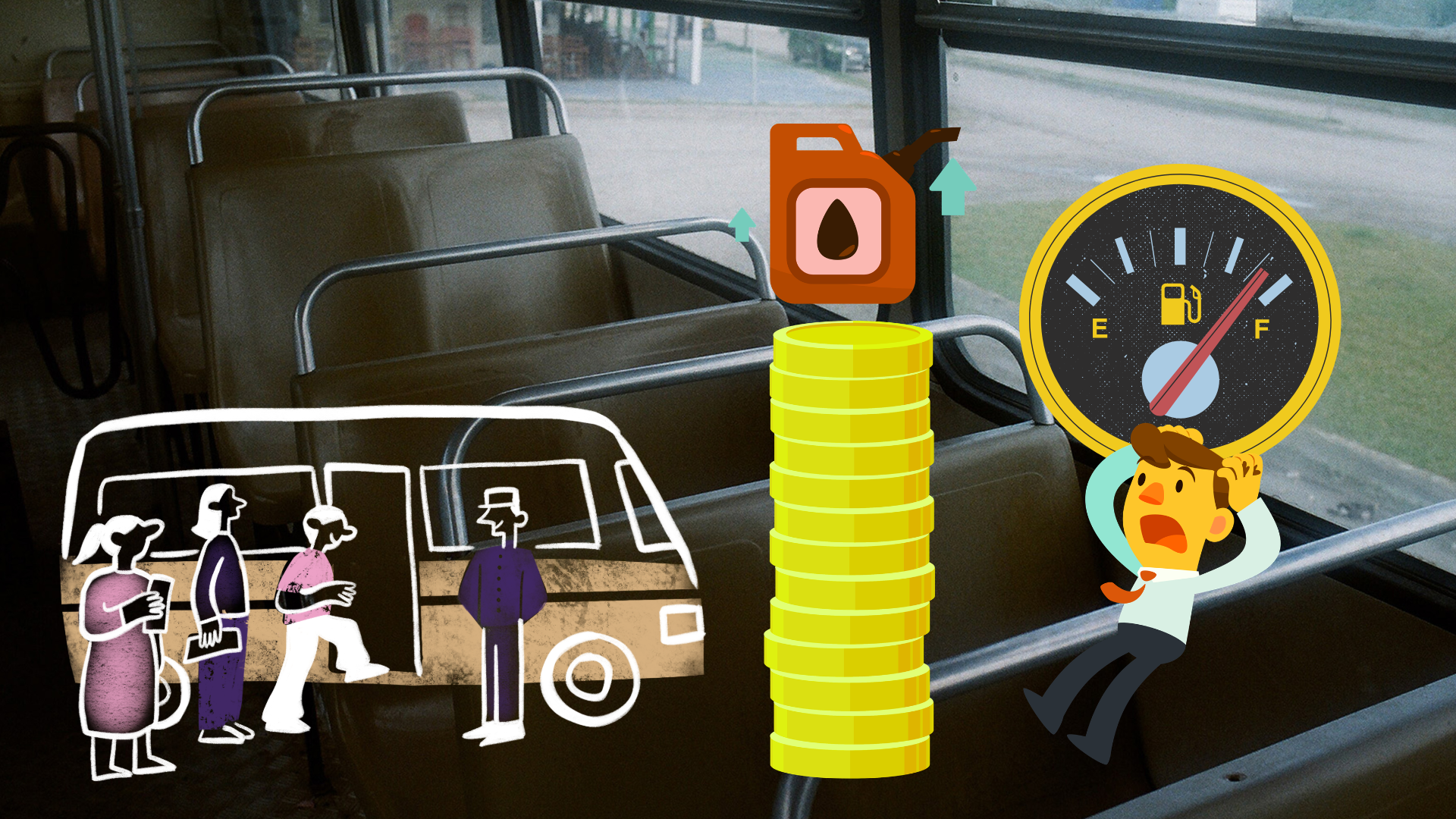
In Bangladesh, a rise in fuel prices sets off a predictable chain reaction. Transport owners call for fare hikes. Authorities negotiate. Fares go up. And then—nothing. When fuel prices stabilize or even fall, fares remain exactly where they were. The latest demand to increase bus fares by 4 taka per kilometer follows this all-too-familiar script.
At this point, the question is no longer whether fare hikes are justified. The real question is: why are they never reversed?
On paper, the argument for increasing fares is simple. Higher fuel prices mean higher operating costs. Bus owners must cover diesel expenses, maintenance, and wages. In a functioning system, this logic would hold—temporarily. Because if rising costs justify higher fares, then falling costs should logically lead to reductions. But that second half of the equation is missing in Bangladesh.
In recent years, fuel prices in Bangladesh have been adjusted multiple times—both upward and downward. However, fare structures show a clear upward bias: increases are implemented almost immediately, while reductions are virtually nonexistent. This disconnect raises serious questions about how “cost-based” these adjustments really are.
Take the COVID-19 pandemic as a case study. During that period, transport fares were increased under the justification of reduced passenger capacity. Buses were allowed to carry fewer people to maintain distance, so higher fares were introduced to compensate for lost revenue. At the time, the public accepted this as a necessary, if painful, adjustment.
But what happened when restrictions were lifted? When buses returned to full capacity? When the economy reopened and life resumed its usual pace?
The fares stayed exactly the same.
A ‘temporary’ increase quietly became a permanent policy. No formal rollback, no serious discussion—just silence. And now, years later, passengers are being asked to accept another round of increases, this time under the banner of a fuel crisis.
This is not a pricing mechanism. This is a pattern. And like any pattern, it reveals something deeper: an imbalance of power.
Consider the daily commuter. A student traveling across the city. An office worker already struggling with rising living costs. A day laborer counting every taka. For them, a 4 taka increase per kilometer is not abstract—it accumulates quickly, eating into already fragile budgets. Transport is not a luxury in Bangladesh; it is a necessity. And when necessities become more expensive without ever becoming cheaper again, the burden becomes permanent.
Meanwhile, the system that governs these fare adjustments remains opaque. There is no widely communicated formula that links fuel prices to fare structures. No automatic trigger that reduces fares when costs fall. Instead, decisions appear reactive, negotiated under pressure, and often skewed in favor of transport operators.
Even more troubling is the recurring allegation of artificial scarcity. It is a complaint heard often from commuters: fewer buses on the road during critical moments, overcrowded vehicles. Whether fully orchestrated or not, the effect is undeniable. Reduced availability increases public frustration—and strengthens the case for fare hikes. When people are desperate to get home, resistance weakens.
In such a system, passengers are not participants. They are hostages to circumstance.
To be clear, transport workers and owners do face real challenges. Fuel price volatility is not imaginary. Operating costs do rise. But acknowledging that reality does not mean accepting a one-way system where every increase is permanent and every relief is temporary—or nonexistent.
What Bangladesh lacks is not justification for fare adjustments, but a fair mechanism for them.
In many countries, public transport fares are tied to transparent indices. When fuel prices go up, fares adjust accordingly. When they go down, fares are reduced—sometimes automatically, without the need for negotiation. This creates predictability and, more importantly, trust.
Bangladesh needs a similar model. A clear, publicly available formula that links fares to fuel prices and other measurable costs. A regulatory authority that enforces adjustments in both directions—not just upward. And strict monitoring to ensure that services are not deliberately reduced to manufacture pressure.
Without these reforms, the cycle will continue. Fuel prices will rise, fares will increase, and passengers will pay. Then fuel prices will fall, and nothing will change. The burden will remain, quietly absorbed into the daily cost of living.
Over time, this does more than strain wallets. It erodes trust. It normalizes the idea that public inconvenience is acceptable, that accountability is optional, and that certain sectors operate beyond scrutiny.
In Bangladesh, transport fares have a memory for increases—but amnesia for decreases.
An economy cannot function efficiently if its people are constantly paying more for the same service. A society cannot call itself fair if its most basic systems—like transport—operate on asymmetric rules.
The fuel crisis, whether real or exaggerated, should not become a permanent excuse. Because at some point, it stops being about fuel.
And starts being about fairness.
Mahmud Newaz Joy is a graduate of the Department of Mass Communication and Journalism at the University of Dhaka.
