

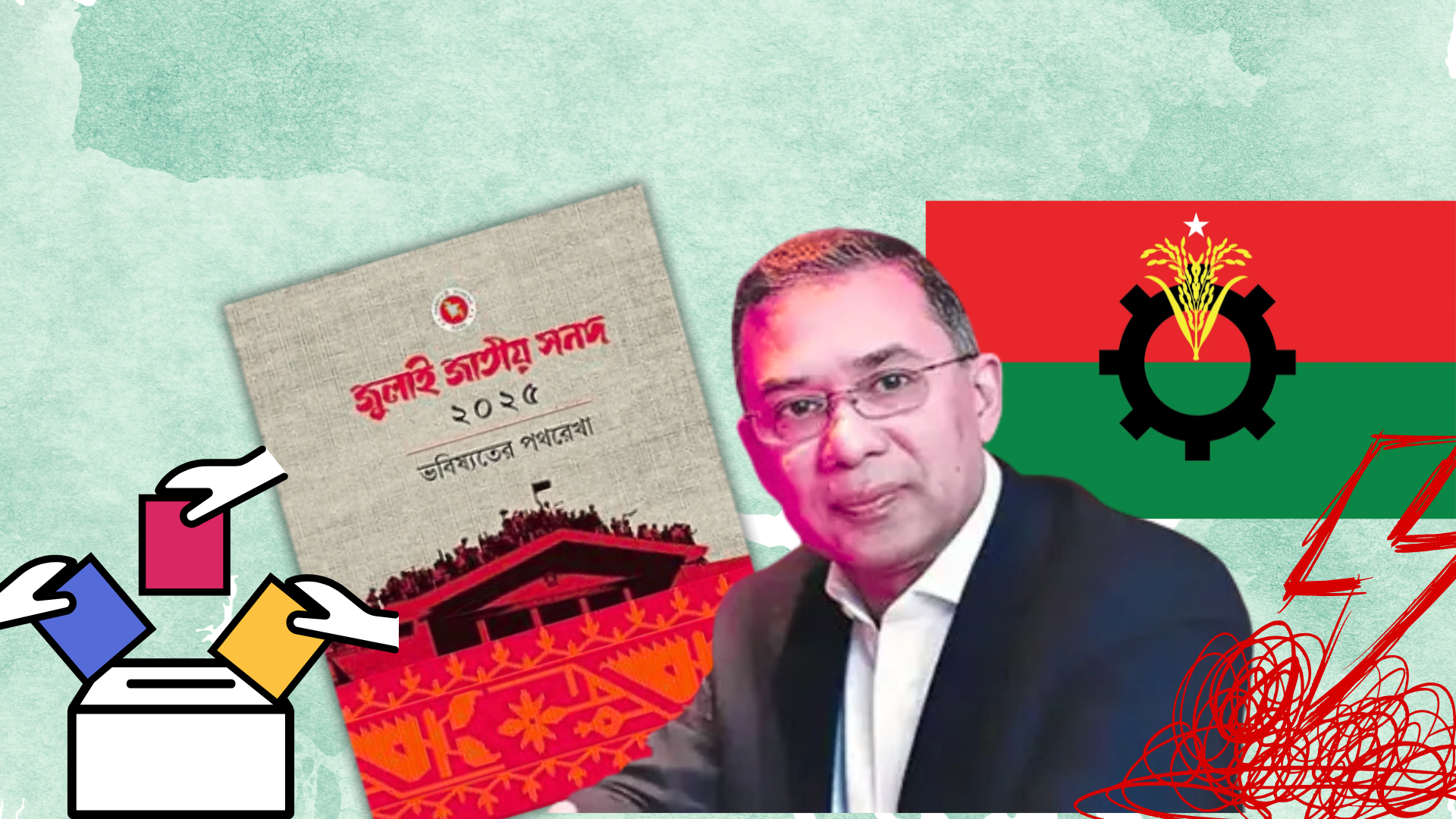
When Tarique Rahman stood before a crowd in Rangpur on January 30, 2026, in the very city where July martyr Abu Sayeed was born and called on voters to say yes in the referendum on the July National Charter, it looked like a rare moment of national agreement. The BNP, Bangladesh’s oldest major party, was throwing its weight behind a reform agenda that had grown out of the blood and sacrifice of the 2024 uprising. Ten days after that rally, 68 percent of the country voted yes.
Then February 17 arrived. The new parliament was sworn in. BNP lawmakers took their oaths as members of parliament. They did not take the second oath, the one that would have made them members of the Constitution Reform Council, the body built specifically to turn the charter into concrete constitutional changes. That decision came directly from Tarique Rahman.
In one morning, the entire post-uprising reform story acquired its defining contradiction. To understand how things reached this point, you have to go back to the months of argument that preceded the charter, to the long and often fractious sessions inside the National Consensus Commission where BNP, Jamaat-e-Islami, the National Citizen Party, and scores of others sat together and fought over what a new Bangladesh would actually look like.
The Architecture of Disagreement
The July National Charter was finalised in October 2025, after more than 75 commission meetings. It was signed formally on October 17 and contained 84 reform proposals touching everything from the restoration of the caretaker government to the creation of a bicameral parliament. Most parties eventually signed. But signing and agreeing turned out to be very different things. The final document carries over 50 dissenting notes.
BNP’s dissents were not scattered or incidental. They followed a clear internal logic: protect executive authority, defend the advantages that large parties enjoy under the first-past-the-post system, and resist what the party saw as an overreach by institutional reform commissions into areas that elected governments should control.
In the upper house, the charter proposed filling a 100-member chamber through proportional representation based on national vote share. BNP rejected this. It wanted allocation based on parliamentary seats instead, a formula that would hand the biggest parliamentary winner an equally dominant grip on the upper chamber. The difference is not trivial. Under true proportional representation, a party with 40 percent of the national vote gets 40 upper house seats. Under BNP’s preferred model, a party that sweeps constituencies under first-past-the-post takes the upper house with it. For a party that just won 209 out of 300 seats in the general election, this is not an abstract preference.
On the question of whether a prime minister can also serve as party chief, the charter said no. BNP said yes. The provision would apply squarely to Tarique Rahman, who now holds both roles simultaneously. The party framed its objection as a matter of democratic principle, arguing that restricting what office a party elects its leader to hold amounts to constitutional interference in party affairs. The real-world consequences of the provision were obvious to everyone in the room.
On prime ministerial term limits, the National Consensus Commission proposed a strict lifetime cap of two terms. BNP accepted the spirit of the idea but changed the terms: the restriction should apply to three consecutive terms, not a total of two across a lifetime. The implication is straightforward. A leader could serve two terms, step back, and then return for more. The commission’s version closes that door. BNP’s version leaves it open.
On institutional appointments, the charter proposed removing the president’s power to appoint the Bangladesh Bank governor and the heads of the Energy Regulatory Commission without consulting the prime minister. It also proposed independent selection committees for appointments to the PSC, ACC, CAG, and Ombudsman. BNP dissented on multiple counts, arguing that constitutionalising these processes was unnecessary and would chip away at executive flexibility.
On the fundamental principles of the state, BNP pushed to restore the four original pillars, namely nationalism, socialism, democracy, and secularism, to their pre-15th Amendment form. It rejected the commission’s proposed language around pluralism and multicultural recognition and objected to the idea that the 2024 mass uprising should be constitutionally placed on the same footing as the 1971 Liberation War.
Taken together, these were not peripheral quibbles. They struck at the core of what the charter was trying to accomplish: shift power away from the executive, protect minorities and smaller parties, and anchor the legitimacy of the uprising in the constitutional text.
Where Others Stood
To grasp the weight of BNP’s positions, you need to know where everyone else was standing.
Jamaat-e-Islami played a complicated role throughout. As the party that eventually became the main opposition, winning 68 seats in the election, Jamaat was a consistent voice for rapid and full implementation. It pushed hard for proportional representation in the upper house, supported constitutional recognition of the July uprising, and on the morning of February 17, took both oaths, with Ameer Shafiqur Rahman framing it as a civic and political duty. He accused BNP of disrespecting the July movement by declining the reform council oath. Yet Jamaat’s own path to the charter was not seamless. The party initially sought clearer legal grounding before putting its signature on the document, and its relationship with the NCP during negotiations was not always harmonious.
The National Citizen Party, born on February 28, 2025 from the leadership of the July uprising’s student movement, was the most consistent advocate for the charter in its unaltered form. It signed without dissenting notes, though only after the election had taken place. The NCP’s alliance with Jamaat, finalised in late December 2025, caused genuine internal pain. Prominent members resigned in protest over what they saw as a betrayal of the uprising’s spirit by aligning with a party that had opposed Bangladesh’s independence in 1971. But the alliance reflected a cold calculation: to put pressure on BNP, a larger bloc was needed. Senior joint convener Ariful Islam Adeeb made the reasoning explicit, saying the NCP would remain aligned with Jamaat specifically to keep pressure on the government to deliver on the reforms the interim government had promised.
Left-leaning and smaller parties also recorded dissents on the charter’s fundamental principles, but from an opposite direction to BNP, objecting to what they considered insufficient secularism or a weak left-wing framing of the state’s core values.
What this produces is not the simple picture of a unified reform alliance facing down a resistant BNP. It is something messier: multiple competing visions of reform, with BNP prioritising executive strength and electoral advantage, Jamaat pushing for procedural legitimacy and institutional balance, and the NCP fighting for fidelity to the uprising’s founding demands.
The Oath Crisis and Its Meaning
The drama of February 17 did not come out of nowhere. BNP had been telegraphing its discomfort for months. A senior party figure put it plainly to the press: taking the CRC oath would bind the party to implement the July Charter wholesale, overriding every note of dissent it had formally lodged.
The official justification was constitutional. Salahuddin Ahmed argued that the Constitution Reform Council has no explicit grounding in the existing constitution, and that asking elected MPs to swear allegiance to an extra-constitutional body before parliament had formally approved it was procedurally irregular. He pointed to Article 65, which vests legislative authority solely in parliament. The BNP’s position was that parliament itself, wielding its two-thirds majority, already had everything it needed to implement any reform it chose, making a parallel council both redundant and legally suspect.
This argument has genuine substance. Bangladesh’s constitution does set rigorous procedures for amendment, and there are real questions about creating institutional structures outside that framework. The High Court subsequently issued a rule questioning the legality of the charter implementation order itself, though Jamaat and the NCP were sharply critical of the political circumstances surrounding those petitions.
But the constitutional argument cannot be cleanly separated from the political arithmetic behind it. BNP holds 209 seats. With its two-thirds majority, it can write constitutional amendments on its own terms, at its own pace, with its own priorities. The Constitution Reform Council, had it been constituted, would have included Jamaat and NCP MPs who took the second oath, creating a forum where BNP’s numerical strength would have been diluted by a collective obligation to work through a shared body. Routing reforms through parliament instead means the ruling party controls the entire process.
NCP’s Asif Mahmud Sajeeb Bhuiyan put the opposition’s reading directly: the ruling party was playing a dual game, endorsing the charter publicly to win the referendum, then selectively picking which parts to honour once it had the votes and the power.
The Structural Stakes
This dispute is not really about procedural technicalities. It is about whether Bangladesh’s post-uprising transition will produce lasting institutional reform or simply a change in which the party dominates an unchanged system.
The July uprising was, in large part, a revolt against concentrated executive power, the very concentration that allowed the Awami League to erode judicial independence, manipulate elections, and punish dissent across fifteen years. The charter’s most consequential provisions, including PM term limits, the ban on the dual PM-and-party-chief role, independent appointment processes for constitutional bodies, and an upper house as a check on lower-house dominance, were all designed with a specific lesson in mind: that no future government, regardless of party, should be able to replicate what Hasina built.
BNP’s specific dissents map with uncomfortable precision onto those very provisions. The party wants a PM who can serve beyond two terms with a gap, who can simultaneously lead the party, whose government retains control over central bank appointments, and whose parliamentary supermajority drives constitutional change without the constraint of a parallel reform body.
That is not a reform programme in the spirit of the uprising. It is a programme for replacing one dominant party with another while preserving the institutional structures that made that dominance possible.
The counterargument, made in good faith by some BNP sympathisers, is that Bangladesh has historically suffered from parliamentary weakness and a culture of destructive opposition politics. The caretaker government system, now restored, is itself a testament to how little trust parties have in each other. In this environment, constraining the executive through multiple simultaneous institutional reforms risks creating paralysis rather than accountability. Some of the dissents, on this reading, reflect genuine caution about locking in poorly designed constraints rather than pure self-interest.
That argument deserves to be taken seriously. It just cannot explain all nine dissenting notes.
Where Things Stand
As of early 2026, the Constitution Reform Council has not been formed. More than two-thirds of MPs did not take the second oath, which means the council technically cannot function. The High Court has issued a rule questioning the legal basis of the implementation order. BNP says parliament will enact the reforms on its own timeline. Jamaat and the NCP say that reforms controlled entirely by the ruling party are not the reforms the people voted for.
The referendum delivered the charter a decisive mandate. 68 percent said yes. But Bangladesh’s political history offers little comfort that a referendum result, on its own, protects anything. Majorities have been claimed before. Constitutions have been rewritten. Governments with large parliamentary margins have, in the end, found ways to govern in their own interest.
The question now is whether BNP, sitting on a majority it could not have imagined a few years ago, will make the choice that almost no party in Bangladesh’s history has made freely: to limit its own power before someone forces it to.
On the morning of February 17, BNP lawmakers walked past the oath station for the Constitution Reform Council without stopping. It was a short walk. It may turn out to be one of the most consequential ones in recent Bangladeshi history.
K. M. Zarif Rahman is the Head of Supply Chain and Project Management at 300 Ltd., with a strong background in procurement and operations across leading organizations in Bangladesh.
