

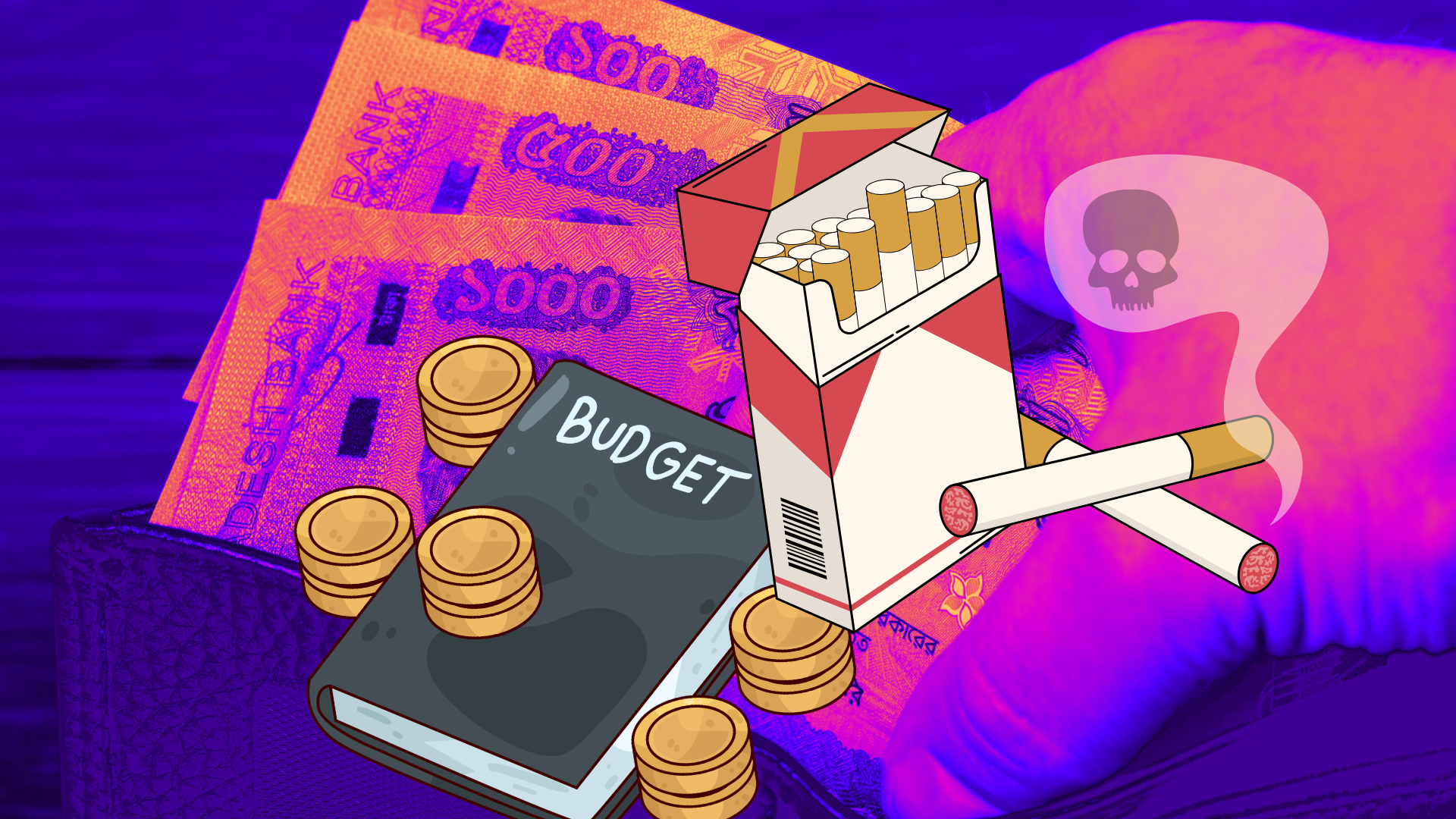
When the government proposes a new budget every year, the first items that see an increase in prices are tobacco products, mainly cigarettes. Tobacco companies do not even wait for the budget to be passed, and the following day after the finance minister presents the budget before the parliament, people have to buy cigarettes at a higher price than the night before. In most cases, the tobacco companies create artificial supply chain disruptions and tap on people’s reliance on this highly-addictive product to gain extra profits. As the prices of tobacco products rise every year without any major decline in consumption, one might ask why the tobacco pricing has never worked in Bangladesh.
As always, prices of all types of cigarettes have increased after the national budget for fiscal year 2026-27 was proposed in the parliament on 11 June. If the budget is passed, low-tier cigarettes will sell at Tk62 per 10 sticks, medium-tier at Tk92 per 10 sticks, high-tier at Tk160 per 10 sticks and premium at Tk210 per 10 sticks. This means that a person will be able to buy any cigarette he likes at a price range of Tk120 to Tk420 per pack after the new budget is passed. While increasing cigarette prices, the government’s line of thinking might have been that if cigarettes become costlier, either less people will buy this item or at least people will cut back on them. However, this is not the case in real life.
Smokers have always found a way to quench their thirst for tobacco. More prices mean there will be some people who will change their brands and shift to a lower tier to save money, while there will be some others who will do anything possible to manage the extra money needed to buy costlier cigarettes. These tendencies will create some deeply rooted issues. A person who used to smoke high-tier cigarettes will be more prone to tobacco-related diseases like cancer and stroke when he smokes a medium or low-tier cigarette, due to a drop in quality. The same person will face severe problems regarding his personal finances if he remains adamant on continuing with his chosen cigarette brand, as an increase in prices will require extra costs, to cover which the person will have to cut back on expenses from some other necessities and ensure the supply of cash required to buy his favourite brand of smoke. No matter which brand of tobacco a person choses, an increase in prices will always result in new health and family issues. This is why raising the prices of cigarettes to force people to cut back on their intakes has never been a good idea.
Then there are the tobacco companies, who have always been the biggest achievers after an increase in tobacco prices. Companies like British American Tobacco (BAT) or Japan Tobacco International (JTI) have always put the burden of increased tobacco taxes set by the government on the ordinary people through raising cigarette prices and creating artificial shortages if people display unwillingness to pay the extra prices. The tobacco companies pay around Tk50,000 crore per year as taxes to the government, and majority of this amount comes from the everyday people who buy their products. All the direct and indirect taxes, including the 83% tax that the government puts on cigarettes, are levied on the buyers, not the producers. The process is simple-if the government increases taxes, tobacco companies collect that amount from the customers by increasing prices, and pay those taxes with that surplus amount of money. As the production and operational costs of tobacco companies remain the same, they avoid being liable for an increased tax payment.
Both the government and cigarette companies profit from rising tobacco prices in the form of increased revenue. The only sufferers are the customers, who cannot let the habit of smoking go due to years of tobacco reliance. Increasing tobacco prices will never result in a decline in demand, unless the root causes of why a person smokes are identified and steps are taken to deal with them.
In the Bangladeshi context, a person starts smoking around the age of 15-18, when he is either starting his intermediate or bachelor’s studies either at a college or a university. This is the first time a person begins to enjoy independence in his life, with little or no monitoring from parents and spending most of the time outside with friends. When a young person of this age comes out of his house and sees other people older than him buying cigarettes and exhaling smoke at tea shops or any other open place, his curious mind makes him think that he must reveal the mystery and have that experience.
The first cigarette on someone’s lips is always fuelled by a strong desire to taste the unknown flavour, and from then on, the habit gains momentum. Not only people become addicted to tobacco due to curiosity but they also feel an eagerness to try cigarettes due to their glamorisation through dramas, movies and music. Increased exposure to contents which portray smoking as a sign of manliness and maturity are highly susceptible making a young person addicted to nicotine. Elder members of our family, especially fathers, brothers and uncles, are also responsible for turning a young person into a smoker. When our family members smoke in front of us, or when we find the smell of smoke from their bodies and dresses, we tend to think this as a norm and take up the habit ourselves.
Then there is also something called genetics. In most cases, a smoker’s progeny will also carry the habit through his genes, and like any other characteristics of his predecessors, the habit of smoking will also pin him sometime in his life to have a puff.
To keep people away from smoking, increasing prices will never be enough. The first thing that the government must do is to make tobacco products highly unattainable, with a few designated places where they might be found and consumed. Letting people to sell cigarettes almost everywhere and not enforcing the law that punishes people if they smoke in public will only exacerbate the situation.
Strong family support is also needed to bring smokers back to a normal life. Elder family members need to let their habit go for the sake of their smoke-free successors, and if they cannot do that, they should take every step to keep the habit from being exposed to their juniors.
When a boy nears adulthood and steps outside, he should be closely monitored and strategically dealt with so that bad habits like smoking do not get on with him. Most importantly, the underlying causes of smoking, including stress, depression, heartbreak etc must be dealt with caution and care.
People who smoke mostly do so from an inner need for support. Instead of increasing tobacco prices every year and reprimanding a person for falling prey to the habit of smoking, providing mental support to smokers must be the primary intervention of the government in general and the family members in particular.
Muhammad A Bashed is a journalist based in Dhaka, Bangladesh. He can be reached at: bashed.muhammad@gmail.com
