

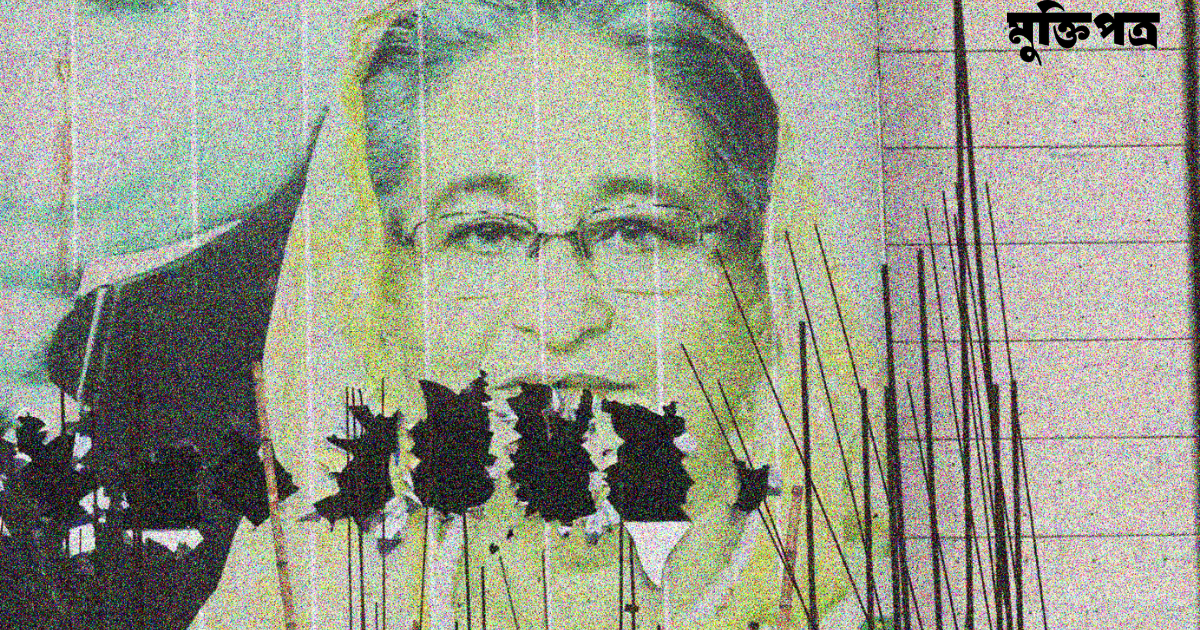
When people discuss the July Uprising in Bangladesh, they quickly reach a simple conclusion- Sheikh Hasina killed thousands of protesters and she should be punished for her crimes. Very few ask why Hasina did
so, what were the reasons that made Hasina despise the protesters so fiercely that she had to resort to annihilate thousands for the sake of holding onto power? On the second anniversary of that fateful event, these questions need careful examination. As a former prime minister and leader of one of the biggest political parties of Bangladesh, Hasina’s choice of violent politics did not happen in a day. Long years of political hatred, setbacks and a biased, one-sided understanding of how and why people come to the streets with demands dragged her to the extremes. The altering of her mind started long before she became the prime minister and had a taste of power for the first time,
or when she was leading street agitations as an opposition leader.
It all began in 1975, when almost all of her family members, including her father Sheikh Mujibur Rahman, were killed by some army members in a deadly ambush at the dead of the night. Hasina was in Europe at that time, and the news of her family’s massacre made her feel that the people of Bangladesh, specially those with the guns, were up against her family and her father’s party, the Awami League, which later became her own. Hasina might have thought at that time that if some armed troops could kill a sitting president with most of his family members, they could take down anyone anytime. To prevent such an incident from happening again, absolute grip on the security forces had to be established through fear, corruption and engagement in criminal activities. Hasina did exactly that before and during the July Uprising, as she used the police and other armed units of her government to quell the protests, killing innocent civilians in the meantime. As the armed men took away her family in 1975, Hasina used her own armed units as a shield to fulfill her personal vendetta in 2024 as an act of revenge.
Hasina’s next misconception about Bangladeshi people brewed in 2004, when a grenade attack during one of her party rallies killed 24 of her party men and injured 300 others. Although Hasina narrowly escaped the attack, she endured a hearing impairment that she still suffers from. The attack was so devastating that it killed Ivy Rahman, then Mohila Awami League president and wife of former president Zillur Rahman. This attack made her realise once again that she was surrounded by vicious enemies all around, trying to eradicate her at any cost. As Hasina
was in the opposition at that time and the BNP-Jamaat alliance was ruling the country, the attack gave her the false impression that it was a state-sponsored one. She continued blaming BNP-Jamaat for the violence throughout the rest of her political career, and during her tenure as prime minister, launched a massive crackdown on both parties, which included extrajudicial killings, enforced disappearances and political witch hunt. The discovery of secluded torture cells, popularly known as “Aynaghar”, inside Rapid Action Batallion headquarters in the capital’s
Airport area, stands as testament to this episode.
The third and most fatal of her political convictions again came from the military, when an army-backed caretaker government was formed in 2007, which imprisoned Hasina and initiated corruption charges against her. As the caretaker government’s tenure extended and there was no sign of her release or the possibility of her participation in a free and fair election, Hasina might have felt that the army-backed government, now known as the 1/11 government, was trying to eliminate her from politics, which was later confirmed by political experts, who termed the ploy as “Minus-Two Formula”, as the same fate befell Khaleda Zia, then chairperson of BNP, and her family, with Khaleda’s eldest son and current Prime Minister Tarique Rahman enduring intense torture at the hands of the 1/11 government’s security forces. However, public pressure forced the then government to release both Hasina and Khaleda from prison, and the former emerged with a landslide victory in the 2008 parliamentary election.
But the damage was done. Following the election, Hasina changed her tactics, and over the next 15 years, she turned the country’s security establishment into her cronies, and used them to muzzle public dissent, including the July Uprising. In the process, Hasina created an ecosystem of torture, intimidation and built a house of cards, with the underlying strategy that if I fall, everything falls. No one will be spared this time.
Some other turn of events created Hasina’s twisted mindset. One of them was her stanch apprehension of Jamaat-e-Islami, a party which had shown their true faces to her time and again. There was a moment when Awami League and Jamaat fought side by side for a free and fair election under a caretaker government. Later, as Jamaat sensed that aligning with AL was not meeting their political calculation, they switched sides and joined hands with BNP through forming an alliance that fractured their relationship with Hasina for good. During their time together, Hasina closely watched Jamaat’s ideological and organisational capabilities, and when Jamaat exchanged their political allegiance, Hasina understood that if the alliance could not be broken, BNP and Jamaat would pose the biggest threat for her in the future. She started to find a scapegoat, found it in Jamaat’s opposition during the
1971 Liberation War, and used this historical fault line to tarnish Jamaat’s image and confuse their sympathisers about its intentions.
During her 15 year rule, Hasina repeatedly accused Jamaat for being the mastermind behind all the anti-government protests including the July Uprising, which she initially termed as led by anti-Liberation War elements, proven by her “Offsprings of Razakars” remarks during the initial days of the uprising. However, her tactics did not save her, as the country’s people, frustrated by long years of corruption and violence, threw her out of power, and the nation’s political trajectory has now made Jamaat the second biggest political party, and placed them as opposition in the parliament.
Hasina’s mental architecture was riddled with a mixture of trauma, fear and resentment- trauma from losing her family in 1975, fear of a BNP- Jamaat alliance from the turbulent 1990’s, and resentment towards Jamaat for leaving her halfway in her political career. Such a wild cocktail of personal and political tragedies mixed with a lurking threat from the country’s military-bureaucratic establishment forced Hasina to take the last resort of retaining power by crushing the July Uprising with all her might. But, she failed, and her failure was so catastrophic that now she has lost all hopes of ever returning to her own country with dignity, and even if she returns, she will possibly face the gallows, an end shaped by gross political mistakes.
Muhammad A. Bashed is a Sub Editor at Daily Sun. He can be reached at: bashed.muhammad@gmail.com
