

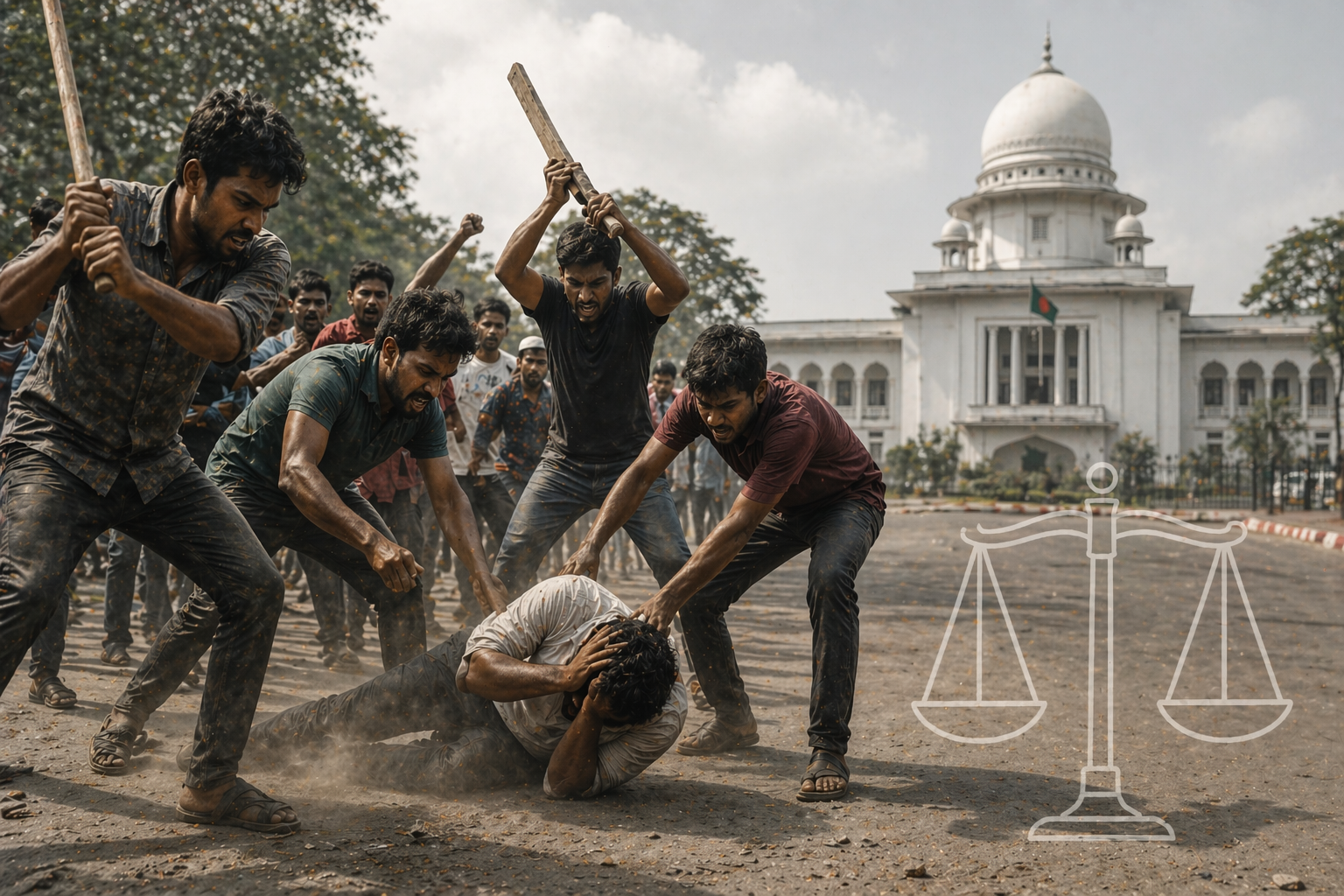
Mob justice, becoming a concerning issue, means punishing the accused by a group of people taking the
law into their own hands instead of following the formal legal procedure. It usually occurs based
on no credible information or evidence. Recently, it has risen rapidly & often occurs where
social pressure, rumors & third person’s instigation contribute to it. This tendency not only
creates social disorder but is considered the foremost violation of fundamental human rights.
According to various newspaper reports, in urban & rural areas, including the Dhaka University
campus, mob justice occurs frequently, accusing someone of theft, child abduction, violent
assaults, subjecting the accused to lynching or public humiliation.
In such extrajudicial incidents, justice is wounded because of not getting any chance to defend the accused through due process. Analysing the issue from a human rights perspective, it can be seen that Articles 3 and 10 of the Universal Declaration of Human Rights (UDHR) declared by the United Nations guarantee the right to life and the right to justice, respectively. Similarly, Articles 31 and 32 of the Constitution of Bangladesh provide for the protection of life and personal liberty of the individual. These
fundamental rights are directly violated through mob justice.
According to the Human Rights Support Society (HRSS) report ‘since the interim government
took office in August 2024 until 06 March 2025, at least 119 people were killed, and 74 were
injured in 114 incidents by mob beatings. HRSS report added that at least 30 cases were recorded
in the first two months alone in 2025, leading to 19 deaths and 20 injuries, while according to
Various media reports & HRSS data, from 2015 to 2024, Bangladesh saw 1,009 mob beatings
incidents, resulting in 792 deaths & 765 injuries.
In people’s views, as seen in social media, the reasons behind mob justice rising so much, which
causes insecurity in the movement, are: distrust of the judiciary and a violent mindset. The normalization of mob justice & results of it are increasing because of the failure of the justice
system, which can’t ensure effective remedies in a timely manner. It violates the constitution
guaranteed fundamental rights: including the right to life, protection of law and the right to a fair
trial, which establishes a culture of impunity instead of the rule of law.
But the Constitution of Bangladesh, the supreme law of the country, is fully consistent with the
International Human Rights Law (IHRL) guarantees the right to justice for all citizens. Where
Article 19(1) of the Constitution says that the state shall ensure equality of opportunity for all
citizens & Article 27 of the Constitution states that all citizens are equal before the law, while Article 31 of
the Constitution ensures the right to equal protection of the law. Article 33 of the Constitution
provides protection against the arbitrary arrest and detention of a citizen. Furthermore, Article 35(7)(a) of the Constitution guarantees the right of a citizen to a speedy and public hearing by an independent
and impartial court or tribunal.
While provisions for alternative dispute resolution processes have been incorporated in various
laws in order to establish the rule of law in Bangladesh and to ensure access to justice.
Moreover, the Government of the People’s Republic of Bangladesh has taken some moves to
increase access to justice and avenues of appeal for the poor by enacting the Legal Aid Act,
2000 to bear the burden of litigation for the poor and needy. In light of the provisions of this act,
the government itself bears all the expenses incurred in the litigation of the financially indigent,
socially disadvantaged and people who are unable to obtain justice due to various socio-economic
economic reasons. As a result, it is seen that the government has taken effective steps to fulfil
the constitutional barrier of accessibility to justice. Consequently, no person is deprived of
obtaining justice due to a lack of money at present.
But in recent times, due to various rumors, propaganda on social media & lack of trust in the law
enforcement agencies, mob justice incidents have increased in Bangladesh. While in many cases,
it is being seen that a mob has beaten someone to death on charges of child theft, blasphemy, or
theft, which is later proven that the victim is innocent. Such incidents not only indicate mob
occurred by a meticulously designed group, but also points a finger at the irresponsibility of the law
enforcement agencies & judiciary, despite relevant provisions, while police may arrest any
suspicious person without a warrant under section 54(1) of the Code of Criminal Procedure, 1898
and the ex officio justices of the peace, at any time within their respective jurisdictions, can
Issue any order to maintain peace under section 25 of the same code.
Main reasons identified behind mob, such as people looking for alternative avenues forced by
the protracted and delayed judicial process, distrust among the people created by the perception
of law enforcement agencies’ weakness or irregularities, the public incited by the rapid spread of
unverified information on social media and people to take the law into their own hands, tempted
by the lack of legal awareness. These issues should be solved soon to make a peaceful & better
tomorrow by removing mobs from the country. Several moves are necessary to conclude the mob, such as making the trial procedure speedy & effective, rebuilding trust in law enforcement agencies by ensuring accountability & transparency and taking strict measures against corruption & misuse of power, raising awareness & controlling social media by increasing cyber monitoring to detect & instantly remove rumours, and penalising strictly for spreading false information.
Amirul Islam Bapon is a Law Student, Poet & Columnist.
