
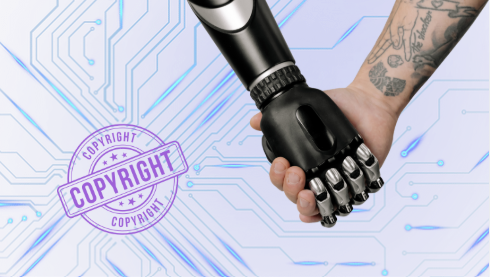
Writers, designers, lawyers, musicians — producing work with AI and hoping nobody asks how. Some out of shame. Some out of confusion. Most because they genuinely don’t know: can you even own something AI helped you create?
The answer is yes. You can own it. You can commercialize it. You can register it, license it, enforce it in court. But you have to follow some rules. And most people aren’t.
Last month, a computer scientist asked the U.S. Supreme Court to grant copyright to an image his AI made entirely on its own. No human hand. No human eye. Just a machine. The Supreme Court said no. Every court below said no. The Copyright Office said no. Stephen Thaler lost — not because AI art can’t be protected, but because he deliberately claimed zero human involvement. He gave the courts nothing to work with.
Here’s what most people missed: the door didn’t close. It opened. The Fight Over Who Owns AI Work — Right Now, Across Five Jurisdictions. This isn’t a future problem. Courts are deciding it today. And the answers are splitting across borders.
United States
In January 2025, the U.S. Copyright Office confirmed that AI outputs can be protected — but only where a human determines the expressive elements. Prompts alone won’t do it. What matters: editing, selecting, arranging, modifying. The office had already granted hundreds of registrations for works incorporating AI-generated material since its 2023 guidance — and on January 30, 2025, one day after the Part 2 report, it registered “A Single Piece of American Cheese,” the first work created entirely with AI-assisted material using an inpainting technique. Then in March 2026, the Supreme Court killed the Thaler case for good. The line is now drawn: no human author, no copyright. But human + AI tool = protectable.
China
While America was debating, Beijing acted. In November 2023, the Beijing Internet Court ruled that a plaintiff who used Stable Diffusion — selecting over 150 prompts, adjusting parameters, iterating until the output matched his vision — owned the copyright to the resulting image. The court treated AI as a camera. The photographer still owns the photo.
European Union
The European Parliament voted in January 2026 on a draft report pushing for transparency, licensing, and fair remuneration for creators using generative AI. The EU AI Act’s transparency obligations take effect August 2026. No separate framework for AI outputs yet — but the direction is unmistakable: human creativity stays at the center. And in Germany, the Munich I Regional Court ruled in GEMA v. OpenAI (November 11, 2025) that large language models can memorize copyrighted texts — that fixation within the model counts as reproduction under copyright law. The copyright wars in Europe are just beginning.
United Kingdom
As of March 18, 2026, the UK government has abandoned its “opt-out” model for AI training. More striking: it is now proposing to remove copyright protection for wholly computer-generated works — while confirming that works created with AI assistance and human involvement remain protected. The message is surgical: if a human shaped it, it’s protected. If a machine made it alone, it’s not.
Bangladesh
The Copyright Act, 2023 does not mention AI. But two provisions create an opening similar to the USCO’s framework. First, the Act expanded its scope to cover “Information Technology-Based Digital Works” — databases and works created using IT tools — which means works created with AI tools can receive protection if human authorship is demonstrable. Second, the Act requires originality and human creative contribution for authorship, and does not recognize non-human authors. The logic mirrors the U.S. position exactly: AI is a tool. The human who directs and shapes the output is the author. No Bangladeshi court has tested this yet — but when it does, documented human creative input will be the deciding factor.
India
India may have the most AI-ready copyright provision in South Asia, and it’s been sitting in the statute since 1994. Section 2(d)(vi) of the Copyright Act, 1957 defines “author” in relation to any literary, dramatic, musical, or artistic work that is computer-generated as “the person who causes the work to be created.” That language — “the person who causes” — doesn’t require the author to physically create the work. It requires them to cause it. A human who prompts, directs, selects, and refines AI output is arguably the person who caused the work to be created. In May 2025, India’s Ministry of Commerce & Industry constituted an expert panel to review whether the 1957 Act can handle generative AI — with early deliberations considering new definitions for “AI-assisted” vs. “AI-generated” works and mandatory disclosure norms. Then in December 2025, the DPIIT published its Working Paper on Generative AI and Copyright, proposing a hybrid licensing model. The framework is moving — and Section 2(d)(vi) gives Indian practitioners a statutory foothold that most jurisdictions, including the U.S., don’t have.
The Real Conflict: You Think You Own It. You Might Not.
Here’s what’s actually happening on the ground:
A designer uses Midjourney to create a brand identity. A lawyer drafts contract clauses with ChatGPT. A content creator generates marketing copy with Claude. A developer builds UI components with Copilot.
Every one of them assumes they own the output. Most of them haven’t read the terms of service. Most haven’t documented a single creative decision. Most couldn’t prove in court that they — not the machine — determined the expressive elements.
This is the gap between using AI and owning what AI helps you create.
Five Steps to Close That Gap — Today
1. Document your creative process. Keep your prompts. Save your iterations. Screenshot rejected outputs. The difference between “AI made this” and “I made this using AI” lives in the paper trail. Courts in both the U.S. and China have treated selection, arrangement, and modification as the threshold for authorship.
2. Edit, select, and arrange — visibly. Typing a prompt is not enough. Choose between multiple outputs. Combine elements. Modify the result. Integrate AI material into a larger human-authored work. Every creative decision you make after generation strengthens your copyright claim.
3. Disclose AI involvement when registering. In the U.S., if your work contains more than minimal AI-generated material, you must disclose it in your copyright application. Failure to disclose can kill your registration. Transparency isn’t weakness — it’s a legal requirement and, increasingly, a global norm. In Bangladesh, where registration provides prima facie evidence of ownership, disclosing your process and documenting human input at the registration stage is equally strategic.
4. Read your platform’s terms of service. Most AI tools don’t automatically transfer ownership to you. Some retain broad licenses. Some grant ownership only under paid tiers. OpenAI, Midjourney, Adobe, Stability AI — each operates differently. If you haven’t read the contract, you don’t know what you own.
5. Register your work. In the U.S., only registered works qualify for statutory damages — your enforcement tool. In Bangladesh, registration under the Copyright Act, 2023 gives you prima facie evidence in court. If you’ve created something with meaningful human input using AI, register it. Now. Not after someone copies it.
Where This Is Heading
The Disney-OpenAI deal announced in December 2025 tells the whole story. Disney isn’t fighting AI. It’s licensing 200+ characters into OpenAI’s Sora video generator, making a $1 billion equity investment, and receiving warrants to purchase additional equity. Universal Music settled with Udio in late October 2025. Warner Music settled with both Udio and Suno in November 2025. The entertainment industry has stopped asking whether AI will use copyrighted work and started negotiating how much they get paid.
The law hasn’t caught up with the technology. It won’t for years. But the principle emerging across every major jurisdiction — Washington, Beijing, Brussels, London, Delhi, Dhaka — is consistent:
Human creative control is the key to ownership. If you’re using AI to create — write, design, code, compose — start treating your process as a legal asset. Document it. Shape it. Register it. The people who do this now will own their work. The people who don’t will discover — in a courtroom, in a licensing dispute, in a cease-and-desist letter — that someone else does.
Ferdows Hossen is an Advocate at the Supreme Court of Bangladesh.
