

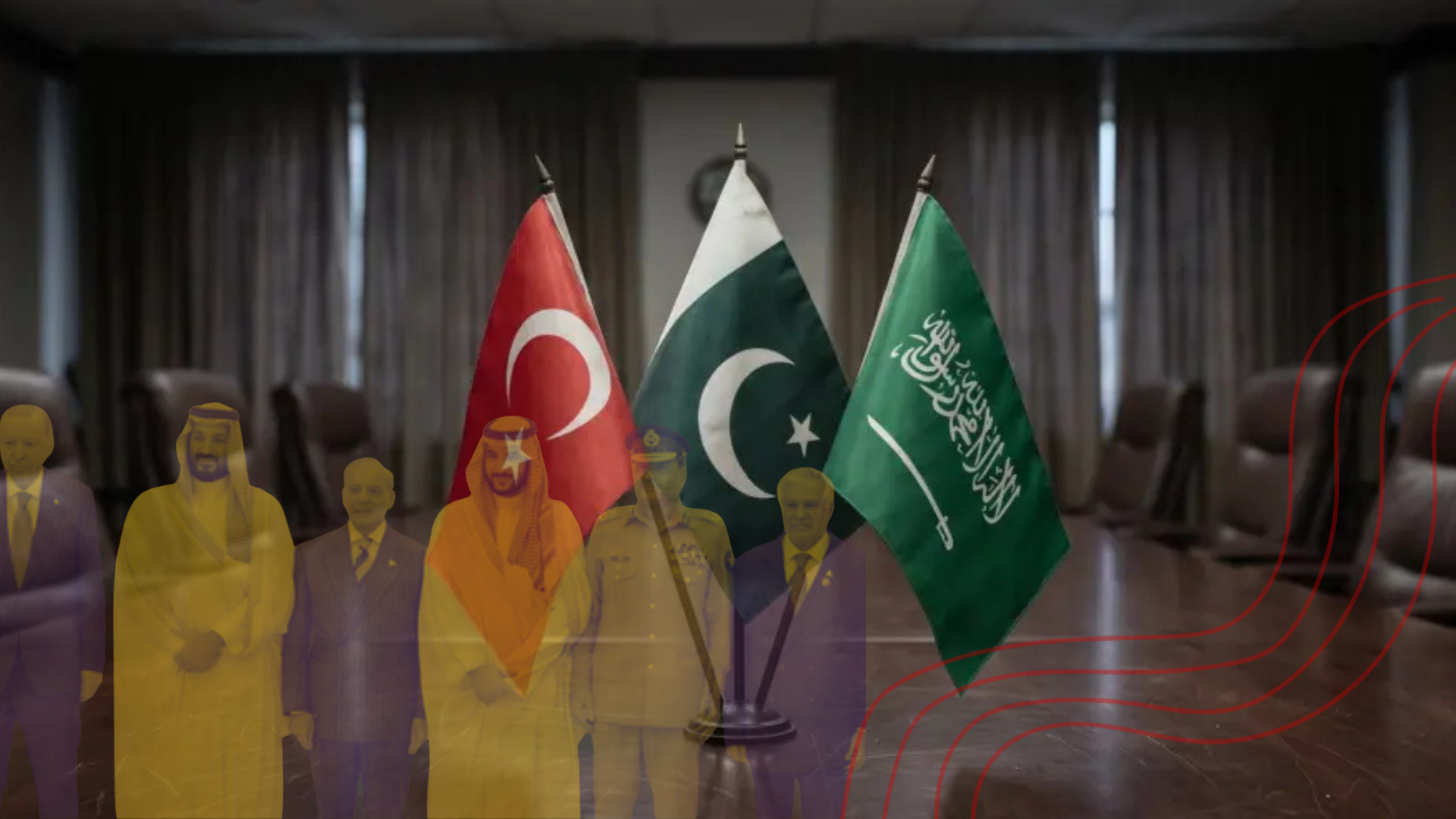
Pakistan’s Prime Minister Shehbaz Sharif circled the Kaaba on the morning of 7 August, Field Marshal Asim Munir — his chief of defence forces — a pace behind him, the two men moving at the unhurried gait pilgrims are supposed to move at. No camera was meant to matter there. The Umrah answers to nothing external; its authority is older than any signature. A few hours later, at Safa Palace, Sharif signed something that needed exactly that — cameras, a table, three heads of state arranged for the frame — the Mecca Joint Defence Agreement, binding Saudi Arabia, Türkiye and Pakistan to treat an attack on one as an attack on all three.
Commentators reached almost immediately for “Muslim NATO”, then “Islamic NATO”, then “Sunni NATO”, as if the label mattered more than the clause. Turkish Foreign Minister Hakan Fidan did nothing to discourage the comparison, invoking NATO’s own vocabulary when he described the pact’s defence provisions to reporters. But a mutual-defence clause borrowed from Article 5 is not an alliance with Article 5’s plumbing underneath it. The text names no adversary — a deliberate ambiguity, not an oversight. It sets up no central command. There is no interoperability roadmap between three militaries that do not train together, do not procure from the same suppliers, and do not speak to each other in the same operational language. Nothing binds any signatory to a defence-spending floor. And nuclear weapons — arguably the single most consequential fact shaping two of the three countries’ regional postures — go entirely unmentioned, a silence too large to be accidental.
None of which makes the pact hollow. It makes it precise about what kind of instrument it is. Riyadh’s risk calculus had already been shifting before this year; the war that opened across Iran gave the shift its shove. Saudi Arabia absorbed Iranian drone strikes once the fighting began, a direct puncture of the old assumption that oil infrastructure and internal stability could be quarantined from a war being fought next door. Confidence that Washington would show up in real time, rather than after the fact, has been eroding for longer than this war has run. Read that way, the Mecca Pact is not a new doctrine. It is an insurance policy, taken out against an old one that has started to look uncollectable.
It also did not arrive from nowhere. Riyadh and Islamabad had already poured a bilateral floor for it through the Strategic Mutual Defence Agreement of September 2025, signed eight days after an Israeli strike on Hamas leadership in Doha — a bilateral commitment formalising a military relationship that runs back decades, built chiefly on Pakistani officers training Saudi forces. Türkiye’s seat at the table draws on a quieter, parallel track: years of warship exchanges and pilot training with Islamabad, and a 2023 order for Turkish-built Akinci drones that Baykar’s own chief executive called the biggest defence and aviation export contract in the history of the Turkish Republic. Strip away the ceremony and the Mecca Pact is less an invention than a welding job — two working relationships fused into a triangle, with Mecca supplying the ceremony the welding needed to look like statecraft rather than convenience.
The symbolism is not decoration, though. It is doing load-bearing work of its own. Islam’s holiest city, chosen deliberately as both venue and namesake, signals unity and sincerity in a register no foreign-ministry communiqué can reach — aimed as much at domestic and pan-Islamic audiences as at any external rival. That may explain why Cairo, by most accounts sounded out for a fourth seat, has kept its distance. Egypt’s existing defence arrangements with Greece and Cyprus sit awkwardly beside a pact that could, in theory, drag it into unconditional military backing for allies it has no quarrel with. Ankara’s own position carries a similar strain, split between NATO membership, an Israel relationship that runs hot and cold by the month, and now this.
Mecca was not even the first such grouping this year. Six months earlier, days before the Iran war opened, Prime Minister Benjamin Netanyahu had already floated his own answer to a fracturing regional order — a “hexagon of alliances” built around Israel, India, Greece and Cyprus, with unnamed Arab, African and Asian partners left for later. Two loose, symbolically freighted groupings now face each other across the region’s imagination, neither wired with the plumbing of a genuine mutual-defence treaty, both built to declare allegiance rather than to guarantee an outcome on the ground.
This is the pact Bangladesh’s Foreign Affairs Adviser, Humaiun Kobir, gestured towards this month, saying Dhaka maintains “a positive approach” towards joining some future economic or defence framework involving Saudi Arabia, Pakistan and Türkiye, carefully wrapped inside the government’s “Bangladesh First” language. Note the hedge inside the hedge: not the Mecca Pact as signed, but a framework that does not yet exist, floated in a tense that commits to nothing. Kobir opened a door towards a room nobody has built yet, and left it there.
There is a harder fact sitting underneath Kobir’s soft phrasing, and it has nothing to do with defence at all. Bangladesh’s actual exposure to Saudi Arabia runs through remittances and migrant labour, not through arms deals or joint exercises — a dependency that gives Riyadh far more leverage over Dhaka than any defence pact could manufacture and gives Dhaka correspondingly little room to say no when Riyadh comes asking for alignment on something symbolic. Read against that imbalance, the “positive approach” starts to look less like strategic ambition and more like a government keeping a major labour-market patron comfortable, at the lowest possible cost, for as long as the ask stays vague enough not to require anything.
That caution reads as shrewd once the pact’s actual architecture is priced in. A mutual-defence clause naming no enemy costs almost nothing to stand near, which is precisely why it is cheap to gesture at and expensive to walk away from once gestured at. But the low cost that makes MJDA convenient for Riyadh’s diplomacy would not travel the same distance to Dhaka. Bangladesh carries none of Pakistan’s decades-deep military entanglement with Saudi Arabia, none of Türkiye’s drone contracts or pilot-training pipelines; whatever role it might carve out sits closer to remittance-linked solidarity and OIC-bloc positioning than to anything operational. And a tilt towards a Pakistan-anchored security architecture will be read in Delhi with a suspicion sharper than Dhaka’s foreign ministry may want to manage — not against some abstract backdrop, but against a working, load-bearing security relationship with India that still does more for Bangladesh on an ordinary Tuesday than anything signed in Mecca has yet promised to do on its worst day.
The three men at Safa Palace were each hedging against a security order they no longer fully trust — Riyadh against Washington’s patience running out, Islamabad against isolation, Ankara against being cut out of a Gulf realignment it helped set in motion. Bangladesh’s interest, such as it is, looks like a smaller, more cautious version of the same reflex: a hedge kept deliberately unfinished, costing nothing today, leaving Dhaka free to decide later — once it is clear whether any of this hardens into more than a photograph outside a palace in Mecca — how much of it, if any, is actually worth signing.
