

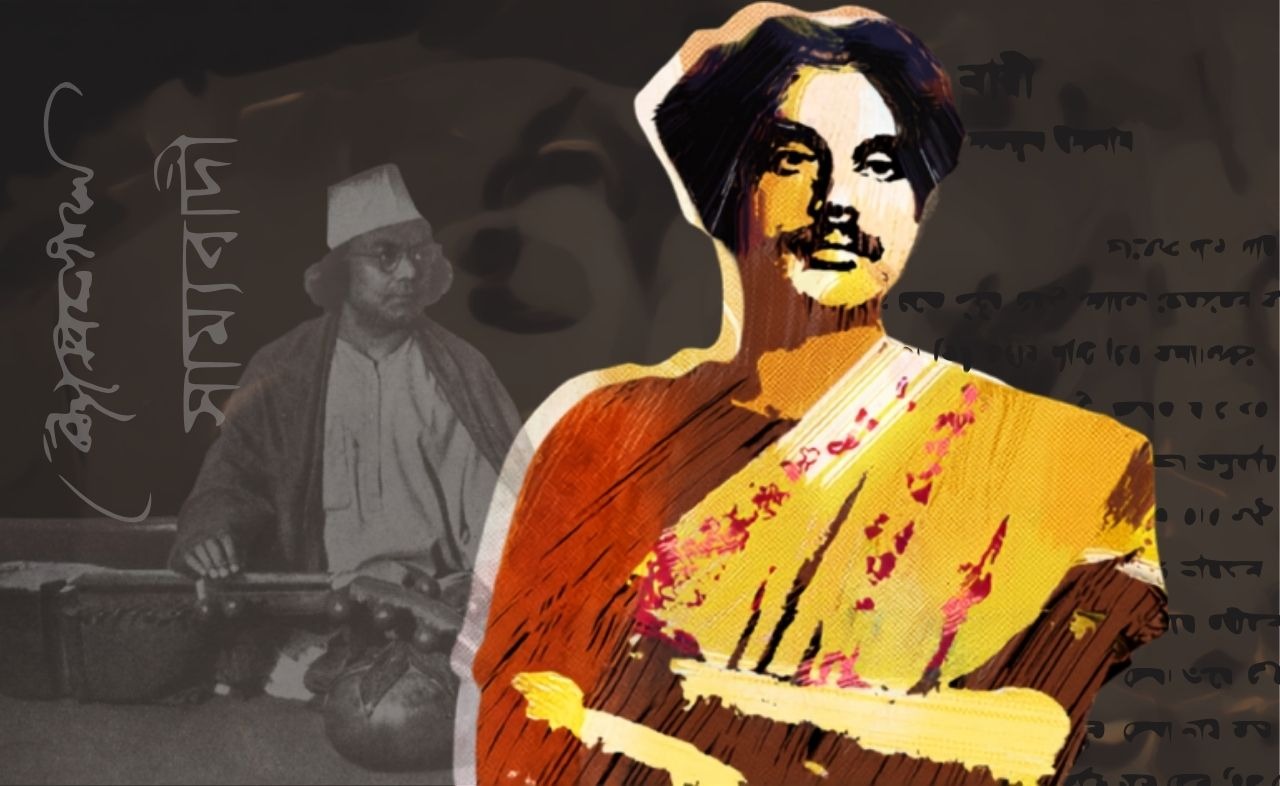
Kazi Nazrul Islam is perhaps the most politically misunderstood poet in Bengal. The tragedy is not that he is forgotten. The tragedy is that he is remembered selectively. His fire is celebrated, but not its
direction. His rebellion is romanticized, but not politically examined. In contemporary Bangladesh, Nazrul is often reduced into a symbolic Muslim counterweight to Rabindranath Tagore — a convenient cultural weapon for insecure nationalist and right-wing politics that never truly understood the depth, contradictions, tenderness and radicalism of the man himself.
But Nazrul was never merely “the Muslim poet.” He was perhaps the greatest secular literary consciousness Bengal ever produced. To understand Nazrul honestly is to confront a poet who shattered
religious boundaries with alarming ease. A Muslim man writing Shyama Sangeet with spiritual intimacy was not a minor cultural event in colonial Bengal — it was revolutionary. Nazrul wrote devotional songs dedicated to Kali, Krishna, Shiva, and Durga with the same passion with which he wrote Hamd and Naat. His poetry dissolved the artificial walls between mosque and temple long before secularism became a state slogan. In “Samyabadi,” he writes:
“Gahi samyer gaan —
Manusher cheye boro kichu nai, nohe kichu mohiyan.”
This was not merely poetic idealism. It was political philosophy. Nazrul envisioned a world where human dignity superseded religious identity, caste, scripture and social hierarchy. Quran, Bible, Vedas, and Tripitaka appeared side by side in his imagination. He did not tolerate communalism from either Hindus or Muslims. That is precisely why both orthodox Hindu conservatives and Muslim fundamentalists attacked him during his lifetime.
His personal life reflected the same politics. Nazrul married Pramila Devi, a Hindu woman, despite enormous backlash. Even more symbolically, he named his children Krishna Mohammad, Arindam
Khaled, Sabyasachi, and Aniruddha. In today’s Bangladesh, where identity itself is increasingly policed through names, clothing and rituals, Nazrul’s life feels radically contemporary. He practiced secularism not as elite liberal performance, but as lived social defiance. Yet Nazrul’s secularism was deeply connected to another aspect of his politics that is often erased: his profound sympathy toward workers, peasants, and oppressed classes. Nazrul was not a textbook Marxist, but his literature carried unmistakable pro-socialist, pro leftist and anti-elite consciousness. In poems like “Kuli-Mazur,”
“Daridro,” “Chashar Gaan” and “Samyabadi,” Nazrul consistently centered laborers and the poor as the moral core of civilization. “Kuli-Mazur” remains one of the sharpest poetic critiques of class exploitation in Bangla literature. He glorified workers not through pity, but through political dignity. The laboring body became heroic in Nazrul’s imagination. Similarly, in “Daridro,” poverty is transformed from humiliation into revolutionary companionship.
Nazrul writes not from above the poor, but beside them. This class consciousness also explains why colonial authorities considered him threatning. His “Bhangar Gaan” and “Anandamoyeer
Agamane” were not abstract literary provocations. They were direct political threats to the British empire and its oppressive power structures. His “Rajbondir Jabanbandi” remains one of the most powerful anti-colonial political statements in Bengali prose. Nazrul understood that domination was not merely economic or political, but also cultural and psychological. So why are these dimensions of Nazrul often ignored in Bangladesh? Because engaging honestly with Nazrul requires confronting the contradictions of our own political culture.
The Bangladeshi right wing, especially cultural conservatives, often celebrates Nazrul superficially while overlooking his actual politics. They elevate him primarily because he offers a Muslim name against Rabindranath Tagore — the ‘Hindu’ zamindar poet associated with Bengal’s intellectual elite and Indian nationalism. In this reductionist framework, Nazrul becomes useful not as Nazrul, but as an anti- Tagore symbol. This is intellectual dishonesty.
Nazrul was never anti-Rabindranath. In fact, the relationship between Rabindranath and Nazrul was built upon deep mutual admiration. Rabindranath dedicated his play “Basanta” to Nazrul while the younger poet was imprisoned by the British. Nazrul, in return, wrote poems celebrating Rabindranath, including “Aji Srishti Sukher Ullashe.” Their relationship represented artistic solidarity beyond religious identity.
But contemporary political discourse often refuses nuance. It prefers binaries. Muslim versus Hindu. Nazrul versus Rabindranath. Such simplistic cultural nationalism cannot fully embrace Nazrul because
Nazrul himself resisted containment. His secularism threatens religious nationalism. His class politics threaten elites. His anti- authoritarianism threatens the establishment. Perhaps that is why Nazrul is frequently depoliticized in state narratives too. We celebrate the rebel aesthetically while
neutralizing the revolutionary politically.
Yet reducing Nazrul into a loud rebel alone also misses another extraordinary dimension of his personality. The same poet who terrified colonial authorities with revolutionary songs could also
become astonishingly tender in love. Nazrul’s romantic writings reveal emotional vulnerability, longing, softness, jealousy, devotion and intimacy with remarkable openness. The man who wrote against empire with volcanic rage could also write love songs with heartbreaking delicacy for Pramila. That combination is rare.
A poet who becomes the establishment’s nightmare and simultaneously remains deeply human in love is not easily categorizable. Nazrul’s masculinity itself challenged dominant ideas of power. He was fierce without abandoning tenderness. Political without losing romance. Revolutionary without becoming emotionally sterile. And perhaps that is why Nazrul still matters.
Not as a token Muslim poet. Not as a state-approved “Bidrohi.” Not as an anti-thesis to Rabindranath. But as one of Bengal’s most radical literary humanists — secular, anti-communal, anti-colonial,
emotionally vulnerable and politically restless. To critically engage with Nazrul today is not merely an act of literary appreciation. It is an act of political recovery.
Because buried beneath the simplified iconography is a poet who still asks dangerous questions about religion, nationalism, class, memory, violence and freedom. And maybe the greatest tribute we can offer
Nazrul is not blind celebration, but the courage to read him honestly — in all his contradictions, tenderness, and rebellion.
