

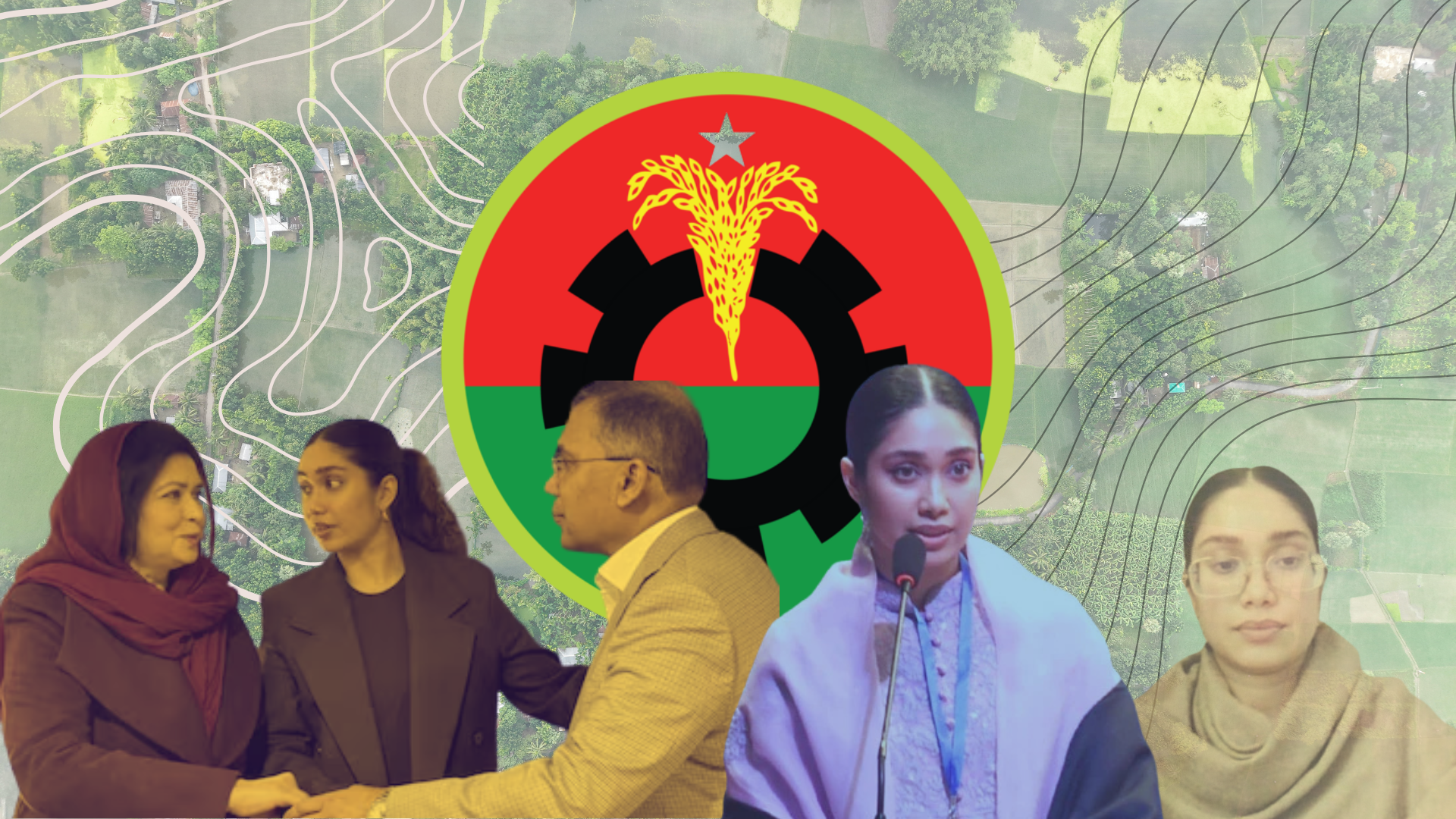
Zaima Rahman, the daughter of Tarique Rahman and granddaughter of Begum Khaleda Zia, has moved from a quiet life in London to the front lines of the BNP. The way she has done this will remain a masterclass in image-making. Her public appearance isn’t just about showing up; it’s about manufacturing a carefully designed look meant to bridge the gap between her Western education and the traditional sentiment of Bangladesh.
Her entrance into the Bangladeshi political arena can best be understood as calculated but candid at the same time. By dressing similar to her grandmother, she is trying to look reliable as the living embodiment of the Zia legacy. Zaima Rahman is proving that she understands the core tenet of leadership: before you can lead the people, you must look like someone they are willing to follow. Some may argue that focusing on clothing and companionship is superficial. But politics, especially dynastic politics, is not a fancy dress competition; it is a battle for the public imagination. Every photograph is a calculated frame meant to evoke nostalgia. To believe these choices are accidental is to misunderstand the nature of power.
She is often seen with a pair of heavy, dated frames that don’t suit a young woman of her background. But this isn’t a fashion mistake; it’s a political choice. Zaima is visually signaling maturity, sobriety, and intellectual depth. It is a costume of the serious stateswoman, designed to distance her from the image of a privileged “Gen Z” heir. In a recent appearance in the graveyard of Begum Zia, she was accompanied by Fatema, the same domestic aid who served Khaleda Zia for decades. This was not a random staff assignment. This is the same woman who famously stood beside her grandmother and even went to jail with Begum Zia on her free will.
In high-level politics, nothing happens by coincidence. By placing this familiar face in the frame, the BNP sent a powerful message to its loyalists. It suggests that the same hands that cared for the family in their rainy days, will be remembered and appreciated in the long run. This is evident from the recent recognition of Fatema as his sister by Tarique Rahman.
However, Zaima isn’t just sliding into a family business; she is rebranding the BNP’s approach to the youth and the ‘unheard’ classes. Traditionally, BNP leadership was associated with agitation and local dominance. Zaima is rebranding the role of the ‘leader’ into that of the ‘listener.’ In her public meetings, she has notably adopted a style of listening more than speaking. Being a London-trained barrister from Lincoln’s Inn gives her a type of authority her predecessors lacked. Her legal training makes her the perfect envoy. It allows her to shift the party’s narrative from power-driven to a ‘people-centric’ party. As Bangladesh approaches the February 2026 national elections, she is being positioned as a symbol of renewal. Her lack of past political baggage allows the youth to view the BNP through a fresh, untainted lens.
Zaima has already begun using her legal and international background to represent the BNP on the world stage. Her participation in events like the National Prayer Breakfast in Washington, D.C., where she stood in for her father, demonstrates her role as a diplomatic proxy. Her ability to navigate Western political and legal circles makes her an asset for a party that has often struggled with its international image. Her presence also serves to soften the image of her father, Tarique Rahman, and helps to build a reputation toward that of a dedicated father and patriot.
In yesterday’s Policy Dialogue, Zaima Rahman’s speech further reinforced the carefully constructed narrative the BNP is now projecting ahead of the election. Her speaking style was notably measured, restrained, and analytical. This calm, almost deliberative delivery signals a shift in BNP’s political posture from confrontation to competence, positioning the party as capable of governance rather than merely opposition.
Zaima has also moved the party’s communication into the 21st century through strategic social media use. In her viral facebook posts, she often refers to the ‘responsibilities’ and ‘integrity’ of her grandfather (Ziaur Rahman) and grandmother (Khaleda Zia). She frames her own legal career as the modern tool she has chosen to ‘carry that legacy forward’ in a way that is compatible with 21st-century global standards. This shifts the focus from her being a ‘VIP heir’ to being a ‘public defender’ for the nation. It frames her entry into politics not as a grab for power, but as a pro-bono service for the country. It is apparent that the people of Bangladesh have welcomed her as the face of the future of BNP, but if she will last in the long run of the political game is yet to be determined.
Whether Zaima will actually become a larger-than-life political figure like many of the other towering political figures of the Zia family is yet to be determined. But the early signs show that Zaima, who has been called a princess in the past, may not be just a royal figurehead but may play a role in fundamentally changing the way the BNP does politics. That may be a good thing, but it may backfire as well. As Zaima knows little about the root level politics of the country, she still obviously has a lot to learn. But as we have already seen, if she can continue to be able to put a finger on the pulse of the country and listen carefully and adapt while using her training as a barrister, the dynastic politics of the BNP may be poised to get another headliner in the coming days.
Aparajita Debnath is an advocate at the Dhaka Judge Court and the Law Editor at Muktipotro.
